Every market page publishes the numbers behind its offer. See the math
Home › Guides › How Fast Can You Really Close on a House?
Guide
How Fast Can You Really Close on a House?
How fast can you really close on a house? "We can close in 30 days" and "we can close in a week" are both true statements about different things, and conflating them is how sellers end up disappointed on a closing date that mattered. A financed sale's timeline is built from federally regulated waiting periods and third-party turnaround times that no amount of urgency shortens. A cash sale's timeline is built from title work alone. Here is what actually happens in each, in order, with real day counts.
Takes about two minutes. Or call
(313) 710-6129 — we answer.
Educational only. This explains how these situations generally work. It is not legal, tax or financial advice, and the rules differ by state — talk to an attorney or CPA about your own situation before you act on any of it.
How fast can you really close on a house: the short answer
A financed purchase typically closes in 30 to 45 days, driven by the appraisal, underwriting, and a federally mandated three-day disclosure period that cannot be waived except in a genuine emergency. A cash sale is limited mainly by title work and can close in one to two weeks. The gap is regulation and third-party scheduling, not marketing.
This is educational information, not legal or financial advice, about how transaction timelines generally work. Lender processing times, title turnaround and local recording office schedules vary and change; confirm current timelines with your own lender or title company.
The financed timeline, stage by stage
This is what actually consumes the 30 to 45 days, in the order it happens.
Stage
Typical duration
Loan application and initial disclosures
1–3 days
Appraisal ordered and completed
7–14 days
Title search and examination
5–10 days (often run in parallel)
Underwriting first review
3–7 days
Conditions cleared, final underwriting sign-off
3–10 days
Closing Disclosure issued
Must be received at least 3 business days before closing
Total, ordinary case
30–45 days
Two of these are not lender preferences — they are federal rules. Under Regulation Z, 12 CFR § 1026.19(f)(2), a lender must ensure the borrower receives the Closing Disclosure no later than three business days before the loan closes, and “business day” for this rule counts every day except Sundays and federal holidays. That clock exists to give a borrower time to review the final numbers before signing, and it can only be waived for a documented, genuine financial emergency — a seller's or buyer's convenience does not qualify. If anything changes the loan's terms materially after that disclosure goes out, the clock restarts.
The appraisal is the other structural bottleneck. It has to be ordered by the lender, not the buyer directly, under appraiser-independence rules, then scheduled with the homeowner or listing agent, completed, and reviewed — and if it comes in low, the whole file often pauses while the parties renegotiate or the buyer contests the value, adding one to three weeks on its own.
Why underwriting alone eats a third of the calendar
Underwriting is not one review — it is typically two. The first pass, usually three to seven days after a complete file is submitted, produces a conditional approval with a list of items the underwriter still needs: updated pay stubs, an explanation of a bank deposit, an insurance binder, a payoff statement on an existing debt. Clearing those conditions is mostly on the borrower and moves at the speed of paperwork, not underwriting capacity. The second, final pass — confirming the conditions are satisfied and reissuing approval — commonly takes another three to ten days. A borrower who is slow to produce a document does not just lose the days it takes to get it; they lose the days it takes the underwriter to get back to a file that has gone stale in the queue, which is a common reason a “30-day close” becomes a 50-day one.
The cash timeline, and why it is genuinely shorter, not just marketed that way
A cash purchase removes the loan-related stages entirely — no appraisal ordered by a lender, no underwriting, no Closing Disclosure waiting period, because there is no loan to disclose. What remains is:
Title search and examination — 5 to 10 business days, the same as a financed deal, because clear title matters regardless of how the buyer is paying.
Payoff statements on any existing liens — a few days to two weeks depending on the lienholder, covered in our mortgage payoff statement guide.
Scheduling with the title company or attorney — the remaining variable, and the one a seller can usually move fastest.
That is why a genuine cash purchase can close in one to two weeks and occasionally faster if title comes back clean and there is no existing mortgage to pay off — not because the buyer is more motivated, but because two of the three structural bottlenecks in a financed deal simply do not exist in a cash one.
What a fallen-through financed deal actually costs
This is the risk a pure timeline comparison misses, and it is where the real money is. A financed sale is not just slower — it can fail after weeks of exclusivity, and the cost of that failure is rarely counted.
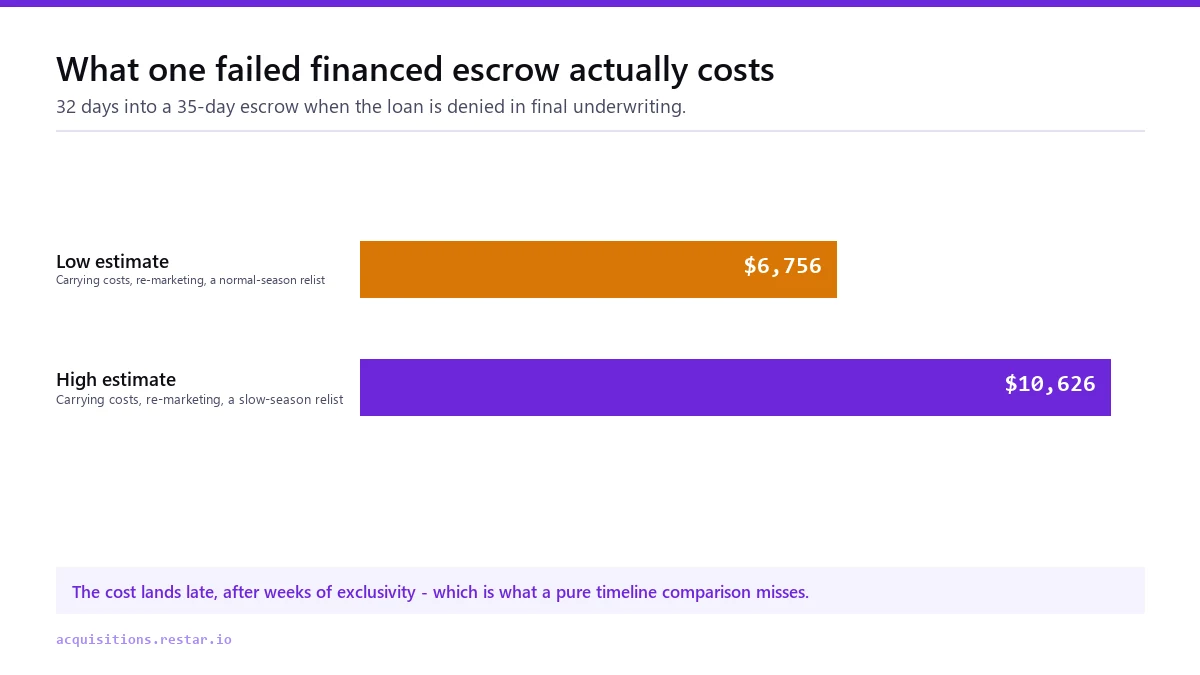
Take a house under contract at $260,000 to a financed buyer, 32 days into a 35-day escrow, when the loan is denied in final underwriting over an undisclosed debt. The seller has been off-market the entire time.
Cost of the failed 32-day escrow
Amount
Carrying costs during escrow — mortgage, taxes, insurance, utilities (32 days at $58/day)
$1,856
Re-listing and re-marketing (new photos, re-staging touch-ups)
$450
Lost peak-season market timing (property relists in a slower month)
$3,000–$6,000, market-dependent
Second round of showings and negotiation, additional 25–40 days average
$1,450–$2,320
Realistic total cost of one failed financed escrow
$6,756–$10,626
What one failed financed escrow actually costsRestar Acquisitions · worked example from this page
A worked illustration on one hypothetical scenario. Not a quote, not a prediction about your transaction, and not a fixed formula we apply.
Financing fallout is well documented as concentrated late in the process — appraisal gaps, last-minute credit changes and employment-verification failures are common reasons files die in final underwriting rather than at application — which is exactly why the cost above lands late, after weeks of exclusivity, rather than early when re-marketing is cheap. This is the genuine argument for certainty of close, separate from and in addition to speed: a slower close that completes is worth more than a faster-quoted one that has a real chance of failing in week five. Ask any financed buyer for their pre-approval letter, their loan program, and how recently underwriting reviewed their file — a pre-approval from three months ago is a weaker signal than one from three weeks ago.
What this means for your decision
None of this is an argument that cash beats financing on price — it usually does not, and our own cash offer versus listing net-proceeds guide and how cash home buyers calculate offers show the gap in real numbers. It is an argument for pricing timeline and certainty explicitly rather than treating every accepted offer as equally likely to reach the closing table. If you have a hard deadline — a foreclosure sale date, a job relocation, a court-ordered sale — the fallout risk above matters more than it would in an ordinary sale with room to absorb a failed escrow and try again.
Alternatives to consider
List with financing contingencies as normal — the right call when you have no fixed deadline and want the higher expected price the math above generally favors.
List but require a larger earnest money deposit or a shorter financing contingency window — a middle path an experienced agent can structure to filter out weaker buyers without giving up the open market.
Sell for cash when the date itself is the constraint — worth it specifically when a fixed deadline makes a failed escrow unaffordable, not as a general rule.
Common questions
How fast can you really close on a house with a mortgage?
Most financed purchases close in 30 to 45 days from an accepted offer, driven by the appraisal, underwriting, and a federally required three-business-day period between the final Closing Disclosure and closing. None of those can be meaningfully shortened by either party's urgency.
Can the 3-day Closing Disclosure waiting period ever be skipped?
Only for a documented, genuine financial emergency affecting the borrower, under a narrow exception in the TILA-RESPA rule — not for a seller's convenience or a buyer wanting to move faster. If loan terms change materially after the disclosure is sent, a new three-day period generally starts over.
Why do financed deals fall through so late in the process?
Because underwriting's final review — the stage most likely to catch an appraisal gap, an undisclosed debt, or a last-minute credit or employment change — happens near the end of the timeline, often in the final one to two weeks, after the seller has already been off-market for a month.
How fast can a cash sale actually close?
Typically one to two weeks, limited mainly by title search and examination and any existing lien payoff, since there is no appraisal ordered by a lender, no underwriting, and no loan disclosure waiting period involved.
Does a faster closing always mean a lower price?
Not automatically, but for a cash sale specifically, yes — the four-term math in how cash home buyers calculate offers shows why a cash buyer's number is typically lower than a financed retail sale. What a fast, certain close buys you is the removal of the fallout risk described above, which has its own real dollar value depending on your deadline.
What should I actually ask a financed buyer to gauge how likely their deal is to close?
Ask for a current pre-approval letter (not pre-qualification), which loan program they are using, how recently a lender actually reviewed their income and credit file, and their down payment source. A pre-approval more than 60 to 90 days old is weaker evidence than a recent one, because income and credit can change in that window.
Want a close with nothing left to fail in week five?
If a firm closing date matters more to you right now than squeezing out the last dollar, we can tell you within 24 hours what we would pay and when we could close — no appraisal, no underwriting, no financing contingency to fail late in the process.
Every offer on this site is underwritten by a person, not a form. If the
numbers do not work for you, say so and I will tell you what would.
Also from Restar
Want the data behind all of this?
Restar Acquisitions is the acquisitions arm of Restar — a housing-market analytics
platform tracking 180+ metrics across every U.S. market, with composite scores and 12-month
price forecasts. The numbers on this page come from the same work.