Title insurance is the one closing cost almost every seller pays for and almost nobody can explain. It shows up as a single line on a settlement statement, usually described as "customary," and most sellers never learn what it actually buys, why an owner's and a lender's policy are priced so differently together than apart, or that the document meant to protect a wired down payment covers far less of that risk than people assume.
Step 1 of 5
Send the address. We order the title search and cover the owner's policy and settlement fee on our purchases.
You’ll talk to Trevor McAmis, Owner & Acquisitions Lead
(313) 710-6129
Takes about two minutes. Or call (313) 710-6129 — we answer.
Educational only. This explains how these situations generally work. It is not legal, tax or financial advice, and the rules differ by state — talk to an attorney or CPA about your own situation before you act on any of it.
Title insurance cost typically runs 0.4% to 1.0% of the purchase price for an owner's policy, paid once at closing rather than annually, and it insures against defects in the property's ownership history — not against wiring money to the wrong account, which a separate, narrower document called a closing protection letter only partly covers.
This is educational information, not legal or financial advice. Filed rates, who customarily pays, and available coverage vary by state and title company — confirm current figures with your closing agent.
Almost every financed purchase involves two separate title insurance policies, sold together but protecting two different people.
A seller in a retail sale is typically not buying protection for themselves at all when title insurance shows up on their settlement statement — in most of the markets this site buys in, the seller customarily pays for the buyer's owner's policy, protection that benefits the person buying the house, not the person selling it.
Two things set your title insurance cost: which state you are in, and whether you buy the two policies together. Nationally, an owner's policy runs roughly 0.4% to 1.0% of the purchase price, and the exact rate is set differently in every state — some states set it by regulated rate schedule, others let title companies compete on price.
| Purchase price | At 0.4% | At 1.0% |
|---|---|---|
| $150,000 | $600 | $1,500 |
| $250,000 | $1,000 | $2,500 |
| $400,000 | $1,600 | $4,000 |
Texas is a live example of how much regulation moves this number. Title insurance is one of the few insurance lines Texas rate-regulates directly rather than leaving to market pricing, and the Texas Commissioner of Insurance ordered a 6.2% reduction to the state's title insurance basic premium rates, effective March 1, 2026, after the Texas Department of Insurance's own loss-ratio analysis found rates were running higher than the industry's actual costs and profit justified — a rare case of a regulator publicly cutting an insurance rate rather than approving an increase.
Buying an owner's and a lender's policy from the same title company at the same closing is reliably cheaper than buying them separately — commonly by several hundred dollars — because the lender's-policy portion is repriced down to a small add-on charge once an owner's policy is being issued at the same time. This is called the simultaneous-issue rate, and it is standard practice, not a special negotiated discount you have to ask for.
Federal disclosure rules create a genuinely confusing wrinkle here. Under the integrated mortgage disclosure requirements at 12 CFR §§ 1026.37(g)(4) and 1026.38(g)(4), lenders are generally required to show the full, undiscounted price for each policy on your early Loan Estimate, while the actual discounted, bundled price is what shows on your Closing Disclosure at closing. If the title insurance figures on those two forms do not match, and the total went down, that is very likely the simultaneous-issue rate finally being applied correctly — not a mistake, though it is always worth asking your closing agent to walk you through the difference rather than assuming either way.
An owner's policy covers defects in the chain of ownership that a title search can miss even when everyone involved acted in good faith: a forged deed somewhere in the property's history, an heir nobody disclosed in a prior estate transfer, a lien that was paid off but never properly released from the public record, a filing error at the recording office, or a boundary or easement dispute that surfaces only after closing.
What it does not cover is the thing sellers and buyers most often confuse it with: wire fraud. A related document, the closing protection letter, insures the closing agent's own conduct — fraud, theft or dishonesty by that agent in handling closing funds and documents — but title insurers have consistently taken the position that a buyer tricked by a fake email into wiring a down payment to a scammer's account, before the funds ever reach the actual closing agent, falls outside what either the closing protection letter or the title policy insures.
The CFPB's guidance on mortgage closing scams describes exactly this scheme: an email posing as your title company or closing agent, with "updated" wiring instructions sent right before closing. The only real protection is procedural, not insurance-based — call your title company or closing agent using a phone number you already had, not one in the email, and confirm wiring instructions verbally before sending any money.
In most states, who pays for the owner's policy is set by local custom and the purchase contract, not by statute — which is why it is negotiable in a way property taxes or a mortgage payoff are not. As the seller closing costs page on this site sets out, the seller customarily covers the owner's policy and settlement fee in most of the markets we buy in, priced at roughly $1,900 on a $250,000 sale in that page's worked example — but "customary" is doing real work in that sentence. Ask your closing agent what is typical in your specific county before assuming either party pays by default.
A house worth $180,000 repaired, needing roughly $9,000 of work.
| Line | Repair, then list | Sell as-is for cash |
|---|---|---|
| Sale price | $180,000 | $140,000 |
| Repairs | −$9,000 | $0 |
| Agent commission (5.5%) | −$9,900 | $0 |
| Seller closing costs (1.5%) | −$2,700 | $0 — we cover it, title work included |
| Buyer concessions (1%) | −$1,800 | $0 |
| Holding, 6 months at $900 | −$5,400 | −$675 (3 weeks) |
| Before any mortgage payoff | $151,200 | $139,325 |
The seller-closing-costs line is the bucket the owner's title policy and settlement fee sit inside, alongside recording fees and prorations — not the title premium alone, which on this $180,000 example would fall in the roughly $720 to $1,800 range shown in the cost table earlier on this page.
The cash figure follows the same four-term formula published in how cash home buyers calculate offers: $180,000 after-repair value, minus $9,000 of repairs, minus $18,000 of resale and holding costs, minus $13,000 of margin.
A worked illustration on one hypothetical property. Not a quote, not a prediction about your house, and not a fixed formula we apply.
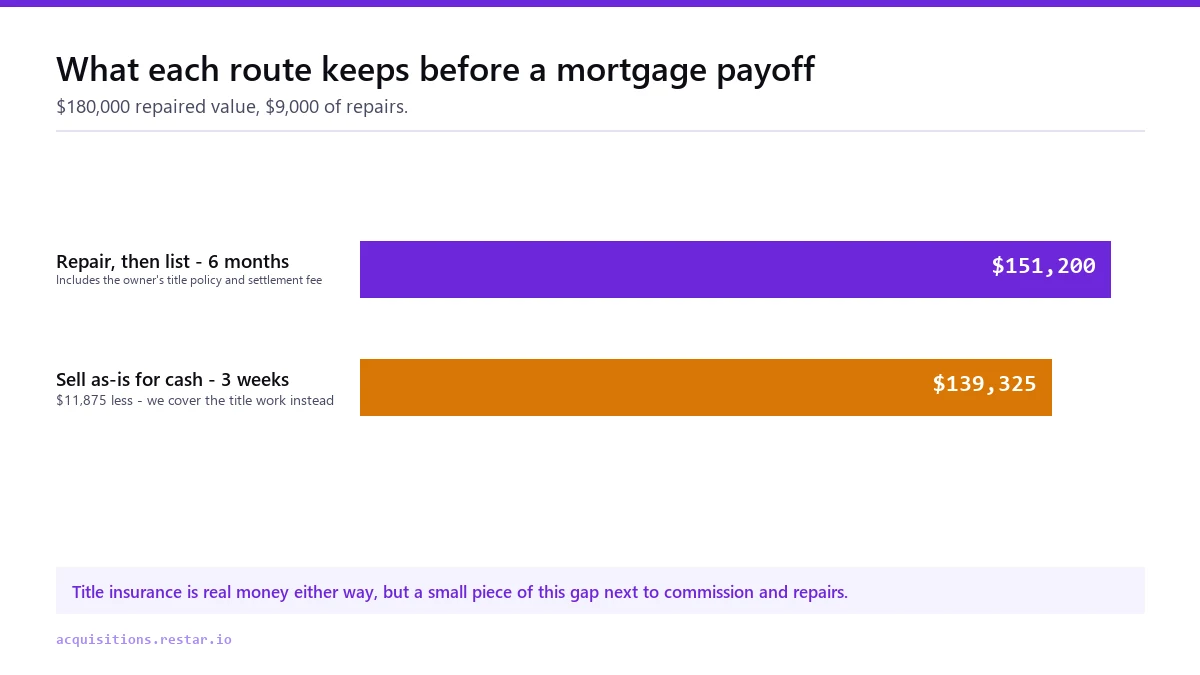
Listing wins by $11,875 in this example. Title insurance cost is real money either way it is priced, but it is a small piece of the gap next to commission, repairs and holding time — the full breakdown of every line is covered in seller closing costs.
On a sale to us, the title search, the owner's policy and the settlement fee are part of the standard closing costs we cover — the same commitment described on our seller closing costs page. You are not asked to shop title companies or negotiate who pays what.
If your sale has years to run and a buyer who can qualify for financing, listing with an agent is very often the better math, and title costs are a small piece of that comparison next to commission and repairs. Our worked example below shows the real numbers. Send us the property here if you would rather skip the shopping.
All guides · Seller closing costs · Cash offer vs. listing net proceeds · Land contract forfeiture
Step 1 of 5
No obligation, no fees, no repairs. We respond the same day.
You’ll talk to Trevor McAmis, Owner & Acquisitions Lead
(313) 710-6129
Takes about two minutes. Or call (313) 710-6129 — we answer.