A land contract lets a seller finance the sale directly, holding legal title until the buyer finishes paying. When the buyer stops, getting the property back is not the same everywhere. Michigan lets a vendor forfeit the contract in weeks, largely regardless of how much the buyer already paid. Ohio and Indiana do not — past a point measured in either time or money paid in, both require the slower, court-supervised process used for an ordinary mortgage.

Step 1 of 5
Send the address once title is clear. We buy it as-is, repairs and all, no listing required.
You’ll talk to Trevor McAmis, Owner & Acquisitions Lead
(313) 710-6129
Takes about two minutes. Or call (313) 710-6129 — we answer.
Educational only. This explains how these situations generally work. It is not legal, tax or financial advice, and the rules differ by state — talk to an attorney or CPA about your own situation before you act on any of it.
Land contract forfeiture is how a vendor reclaims a house after the buyer stops paying, instead of foreclosing a mortgage. Michigan allows it quickly regardless of the buyer's equity. Ohio and Indiana require a slower judicial foreclosure once the buyer has paid enough into the deal, protecting the equity a fast forfeiture would otherwise erase.
This is educational information, not legal advice. Land contract terms vary, and the choice between forfeiture and foreclosure has real consequences. Talk to a real estate attorney licensed in your state before filing or responding to either.
In a land contract, the vendor never transfers the deed at closing the way a mortgage lender does. The vendor keeps legal title and the buyer gets equitable title — the right to possess and eventually own the house once the contract is paid off, alongside the vendor's own ongoing legal ownership. That structure is what makes land contract forfeiture possible at all: because the vendor still legally owns the property, a default can in theory just end the contract and return possession, without the sale, auction and redemption machinery a mortgage foreclosure requires.
In theory is doing real work in that sentence. Courts in most of the country have grown uncomfortable with a remedy that can erase years of a buyer's payments overnight, and the three states this site buys houses in — Michigan, Ohio and Indiana — have each drawn the line between "fast forfeiture" and "slow foreclosure" in a different place.
| State | Governing rule | When forfeiture is available | When foreclosure is required instead |
|---|---|---|---|
| Michigan | MCL 600.5726 et seq. | Almost always — the vendor's choice, regardless of equity paid | Only if the vendor chooses foreclosure to pursue a deficiency judgment |
| Ohio | ORC 5313.05 – .07 | Vendee paid under 20% of the price and under 5 years | Vendee paid 20%+ of the price or 5+ years of payments |
| Indiana | No statute — Skendzel v. Marshall and its progeny | Only a truly minimal payment, or an abandoning vendee | Any "substantial" equity — courts have found 29.7% substantial |
The pattern behind land contract forfeiture across all three states: the more a buyer has paid, the less willing the law is to let a vendor simply keep it all and take the house back for free. Michigan is the outlier — it protects equity through longer redemption periods rather than blocking forfeiture outright.
Under MCL 600.5726, a Michigan vendor can forfeit a defaulted land contract as long as the contract itself gives that right, after serving a notice of forfeiture with a 15-day cure period. If the buyer does not cure, the vendor files a summary proceeding for possession in district court — weeks, not the many months a circuit-court mortgage foreclosure takes.
One real limit: a forfeiture judgment recovers possession, not money. The statute specifically excludes "accelerated indebtedness by reason of breach," meaning a vendor cannot also get a judgment for the full remaining contract balance the way a foreclosure allows. You get the house back; you do not additionally get to sue for what was still owed on it.
Equity still matters to the timeline. Under MCL 600.5744(4), the buyer gets 90 days to redeem after judgment if they paid less than 50% of the price, or 6 months if they paid 50% or more. A vendor two years into collecting payments from a buyer who built real equity is not getting the house back next month, even in Michigan — the redemption window alone can run half a year.
Ohio starts the same way Michigan does: under ORC 5313.05, forfeiture can only be enforced after 30 days from default, and the buyer can cure at any point in that window by paying what is currently due.
Past that point, Ohio splits. If the buyer has paid under 5 years and under 20% of the purchase price, the vendor can still repossess through the land-contract forfeiture process. But under ORC 5313.07, once either threshold is crossed — 5 years of payments or 20% of the price, whichever comes first — forfeiture is off the table entirely. The vendor's only remaining route is "a proceeding for foreclosure and judicial sale," the same court process used to foreclose a mortgage: filing suit, a judgment, a sheriff's sale, and the buyer's equity (if any, after the vendor is paid what is owed) returned as sale proceeds rather than simply forfeited.
A vendor who assumes the fast process still applies because "it's my land contract, I hold title" is the person most often surprised in Ohio. Once either threshold is crossed, the contract's own forfeiture clause stops being enforceable no matter what it says.
Indiana has never codified a land-contract-specific statute the way Ohio and Michigan have. Instead, the controlling law is the Indiana Supreme Court's 1973 decision Skendzel v. Marshall, which held that forfeiture is "offensive to our concepts of justice and inimical to the principles of equity" once a buyer has built real equity, and ordered judicial foreclosure instead — treating the vendor's retained title as functionally a mortgage lien rather than true ownership.
The court left forfeiture available for "an abandoning, absconding vendee" or genuinely minimal payment, and later cases put numbers on where that line sits. In Morris v. Weigle, the Indiana Supreme Court treated 29.7% of the purchase price as substantial equity, and follow-on cases have applied the same reasoning to figures in the 30–40% range. There is no bright-line percentage in a statute — an Indiana court decides case by case whether what was paid in is "minimal" or "substantial," which means a vendor cannot know for certain which process applies without a lawyer reviewing the actual payment history.
Assume the process finishes and the property is legally yours again. Two things are worth planning for before you think about selling it.
Condition, almost always. A vendee who stopped paying was usually also stretched on maintenance, insurance and utilities before the default. Deferred repairs — a roof past due, a furnace that was never serviced, months of an unheated house in a cold-climate market — are the norm, not the exception, in a reclaimed land-contract property.
Other liens do not disappear. Forfeiture or foreclosure clears the vendee's interest in the contract; it does not erase a code-enforcement lien the city recorded while the vendee was in possession, a contractor's lien from unpaid repair work, or delinquent property taxes that accrued during that time. Those liens ride with the property and come off the top of any future sale — the general mechanics are the same as any other lien, covered fully in selling a house with a lien on it.
The wrap risk. If you, the vendor, still owe your own mortgage on the property — a common setup called a wraparound land contract, where the buyer's payments were meant to cover your own loan payment plus a spread — that obligation does not pause while the buyer is in default. A vendor collecting $1,400 a month from a vendee while paying $950 a month to their own lender nets $450; the day the vendee stops, the $950 does not. Vendors who fall behind on their own mortgage while pursuing a slow Ohio or Indiana foreclosure against a defaulting buyer can end up facing their own lender's foreclosure at the same time.
A house worth $150,000 repaired, needing roughly $20,000 of work after a vendee's deferred maintenance.
| Line | Repair, then list | Sell as-is for cash |
|---|---|---|
| Sale price | $150,000 | $99,500 |
| Repairs | −$20,000 | $0 |
| Agent commission (5.5%) | −$8,250 | $0 |
| Seller closing costs (1.5%) | −$2,250 | $0 — we cover standard closing costs |
| Buyer concessions (1%) | −$1,500 | $0 |
| Holding, 6 months at $1,000 | −$6,000 | −$750 (3 weeks) |
| Before any liens or your own mortgage | $112,000 | $98,750 |
The cash figure follows the same four-term formula published in how cash home buyers calculate offers: $150,000 after-repair value, minus $20,000 of repairs, minus $16,500 of resale and holding costs, minus $14,000 of margin.
A worked illustration on one hypothetical property. Not a quote, not a prediction about your house, and not a fixed formula we apply.
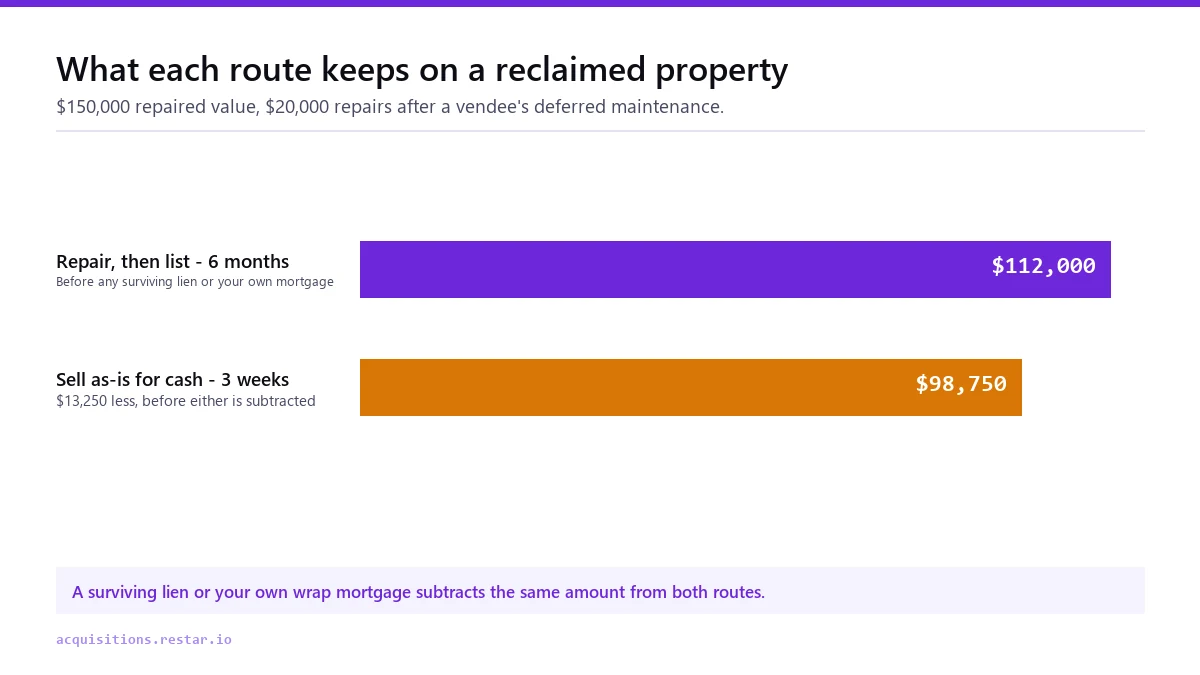
Listing wins by $13,250 in this example, before subtracting any lien that survived forfeiture or your own remaining mortgage — both come off either number identically, same as on any other sale. Where a cash sale earns its lower price here is specific: no repair budget to fund up front on a house you did not plan to own again, and no months of carrying a second property while your own mortgage, insurance and taxes keep running.
A handful of options can resolve a default without land contract forfeiture ever reaching a courtroom.
We buy real property with marketable title — not a land contract receivable, and not a house still tied up in an open forfeiture or foreclosure case. Once the court process is finished and the deed or judgment is recorded in your name, send us the address. We will send a written cash offer within 24 hours and cover standard closing costs, whatever condition the vendee left the house in.
If you have the time and cash to fund repairs and would rather list it, our worked example below shows what that route is actually worth. We would tell you to take it if the numbers favor it — they often do.
All guides · Selling a house with a lien on it · Cash offer vs. listing net proceeds · Should I repair before selling?
Step 1 of 5
No obligation, no fees, no repairs. We respond the same day.
You’ll talk to Trevor McAmis, Owner & Acquisitions Lead
(313) 710-6129
Takes about two minutes. Or call (313) 710-6129 — we answer.