Starting July 1, 2026, Texas sellers using a standard TREC contract must deliver a new, separate water notice, TREC Form 61-0, covering wells, ponds, surface water rights, and groundwater conservation districts. Most sellers without a well or water issue can sign a short exemption statement instead.
Step 1 of 5
Tell us about the property, well and water history included. No repairs, no commissions, you pick the closing date.
You’ll talk to Trevor McAmis, Owner & Acquisitions Lead
(313) 710-6129
Takes about two minutes. Your address is never shared.
Educational only. This explains how these situations generally work. It is not legal, tax or financial advice, and the rules differ by state. Talk to an attorney or CPA about your own situation before you act on any of it.
TREC Form 61-0, officially titled the Seller's Disclosure about Groundwater and Surface Water Rights, became mandatory on July 1, 2026. It's built into the two contracts most Texas residential and rural sales use: the One to Four Family Residential Contract (Form 20-19, Paragraph 7(I)) and the Farm and Ranch Contract (Form 25-17, Paragraph 7(K)). TREC adopted it after a Sunset Advisory Commission review found buyers weren't getting clear information about water rights tied to the land they were buying.
The form asks sellers to disclose, in plain terms:
This is a standalone TREC form, not part of Property Code §5.008's Seller's Disclosure Notice. That distinction matters more than it sounds like it should, because it changes who has to fill it out.
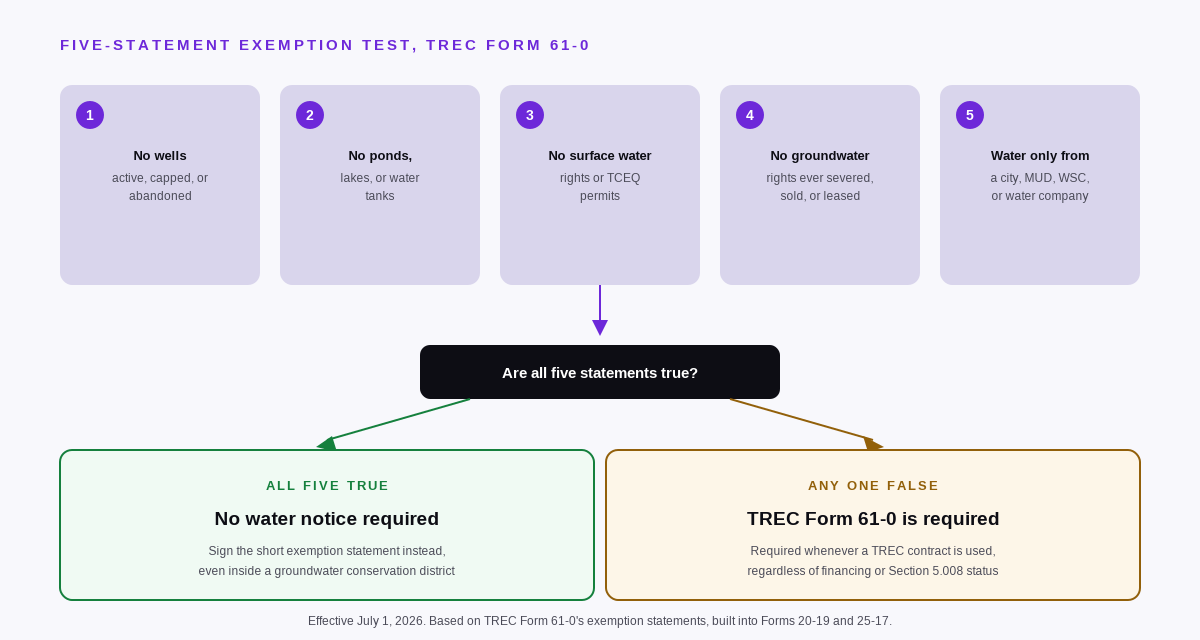
A seller doesn't have to complete TREC Form 61-0 if every one of these five statements is true:
All five have to hold, not most of them. A property inside a groundwater conservation or subsidence district still qualifies for this exemption if the five statements are true; being inside a district doesn't by itself force the full form. What forces the full form is a well, a tank, a surface water right, a severed groundwater interest, or a water source that isn't a utility hookup. If a seller isn't sure whether an old well on the back of the lot still counts as a well (it almost always does, even capped and unused), that uncertainty usually means the five-statement exemption isn't available.
Property Code §5.008 lists its own exemptions from the standard Seller's Disclosure Notice: transfers under a court order or foreclosure sale, transfers by a bankruptcy trustee, a mortgagee reselling property it took back through foreclosure or a deed in lieu of foreclosure, and transfers by a fiduciary administering a decedent's estate, guardianship, conservatorship, or trust, among others. Sellers in those situations have long assumed they're off the hook for seller disclosure paperwork entirely.
That assumption doesn't carry over to TREC Form 61-0. The water notice isn't created by Texas Property Code §5.008; it's created by the TREC contract forms themselves. The requirement attaches because the parties are using a TREC contract, not because a statute says so. A sale that's fully exempt under §5.008(e) can still require the water notice if a TREC contract is the document being signed. The two exemption tests run on separate tracks, and a sale can be exempt from one, the other, both, or neither. If you're not sure which applies, a title company or real estate attorney can confirm it before you sign anything.
If TREC Form 61-0 is required under the contract and it's never delivered, the buyer can terminate the contract any time before closing and get their earnest money back. Once it is delivered, on time or late, the buyer gets a window, commonly seven days, to terminate for any reason, earnest money refunded. Beyond the contract remedy, a seller who answers the form inaccurately on a known issue, a well they knew about, a water right they'd already leased away, is exposed to the same kind of claims as any other disclosure misstatement: misrepresentation and related causes of action tied to a known, undisclosed defect. None of that requires a buyer to prove much more than that the seller knew and didn't say.
Say a seller lists a house at $280,000 and an old capped well turns up in the backyard during inspection, something the seller forgot was even there. One well, capped or not, means the five-statement exemption is gone and TREC Form 61-0 is required.
Retail path: the buyer's lender wants a licensed water well driller's letter confirming the well's condition before funding, and the estimate to properly document and cap it to code comes back at $4,500, which the seller agrees to credit. Add the standard 6% commission ($16,800), closing costs around 1.5% ($4,200), and roughly two months of carrying costs while the lender sorts out the paperwork ($900 at $450 a month). That's $280,000 minus $16,800 minus $4,500 minus $4,200 minus $900, for a net of about $253,600, assuming the loan still funds on schedule. If the driller's report comes back worse than expected or the lender won't close until the well is fully plugged, the seller may need to front that $4,500 before there's any certainty the sale closes at all.
Cash path: a cash buyer not using financing has no lender to satisfy on the well before closing. Restar's written offer on the same house, as-is, reflecting the well work still needed, comes in at $245,000, no commission, no repair credit, no closing costs to the seller. Net is about $244,800 after a small prorated tax adjustment, closing in about 14 days with no financing contingency to fail.
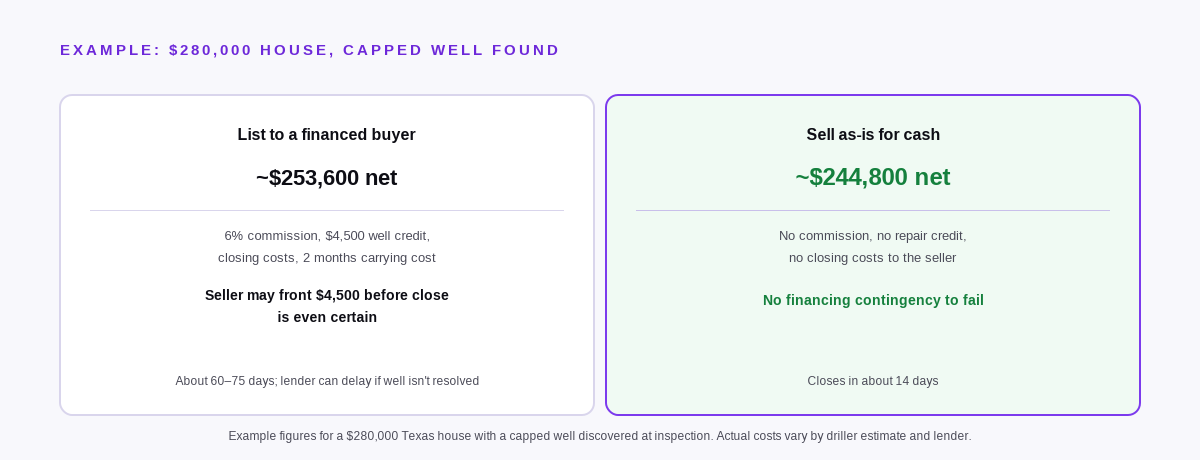
The retail path nets roughly $8,800 more on paper. The cash path trades that gap for speed, certainty, and not having to pay $4,500 out of pocket before knowing whether the deal survives. Which one makes sense depends on how much that seller needs the certainty versus the extra dollars; there's no universal right answer.
A few moves reduce the risk on either path:
For sellers weighing their options generally, the Texas Real Estate Research Center at Texas A&M has a plain-language writeup of this form worth reading alongside TREC's own published version of Form 61-0.
Restar Acquisitions buys houses as-is for cash across 69 markets in Alabama, Arizona, Florida, Georgia, Indiana, Maryland, Michigan, Missouri, Nevada, New York, North Carolina, Ohio, Pennsylvania, and Texas, including wherever TREC Form 61-0 applies. Tell us about the property, including any well, pond, or water-rights history, and we'll give you a written offer within 24 hours. No repairs to make, no commissions to pay, and you pick the closing date.
Step 1 of 5
No obligation, no fees, no repairs. We respond the same day.
You’ll talk to Trevor McAmis, Owner & Acquisitions Lead
(313) 710-6129
Takes about two minutes. Your address is never shared.