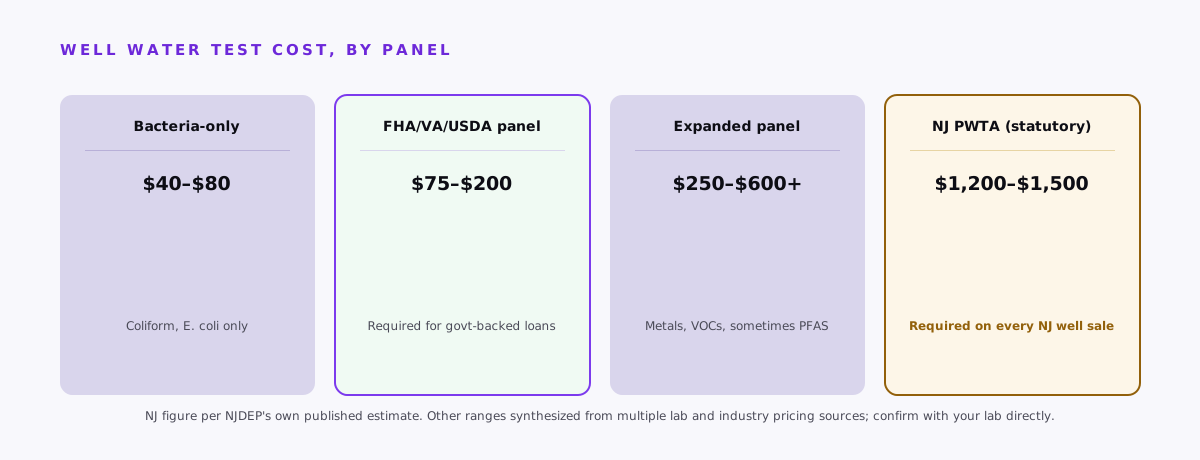
A standard well water potability test runs roughly $50–$200 at a certified lab, or $1,200–$1,500 for a full state-mandated panel like New Jersey's. Government-backed loans (FHA, VA, USDA) require one before closing. The federal government doesn't regulate private wells at all — testing and paying for it is largely up to you and your buyer to work out.
Step 1 of 5
Tell us about your well and whether a test has been done. We'll give you a straight cash number — no test contingency to fail.
You’ll talk to Trevor McAmis, Owner & Acquisitions Lead
(313) 710-6129
Takes about two minutes. Or call (313) 710-6129 — we answer.
Educational only. This explains how these situations generally work. It is not legal, tax or financial advice, and the rules differ by state — talk to an attorney or CPA about your own situation before you act on any of it.
The starting fact that explains everything else here: the federal government does not regulate private well water. The EPA says so directly on its own site: "the quality and safety of drinking water from private domestic wells are not regulated by the Federal Government under the Safe Drinking Water Act nor by most state governments." (EPA, Private Drinking Water Wells) The Safe Drinking Water Act only covers public systems serving 25 or more people — an individual household well falls outside it entirely. That's why there's no single federal "well test law," and why the requirement you actually run into depends entirely on how you're financing the sale and where the house sits.
Government-backed loans require a test as a condition of closing. VA loans require a water test on well-sourced properties before the loan can clear, with a minimum panel covering nitrate, nitrite, lead, E. coli/coliform bacteria, and arsenic, tested against local health authority standards or, absent those, EPA federal standards. (VA appraisal requirements, Pamphlet 26-7) The sample has to be collected by a disinterested third party — not the buyer, seller, or anyone connected to the transaction. FHA and USDA loans carry similar requirements in spirit: a water quality test meeting the local health authority's standard, or the EPA's National Primary Drinking Water Regulations if no local standard exists.
Some states or counties require testing regardless of financing. New Jersey is the clearest example: its Private Well Testing Act, signed into law in March 2001 with regulations taking effect in September 2002, requires testing of untreated well water for up to 43 parameters on the sale of any property with a potable private well, full stop — cash buyer, financed buyer, doesn't matter. (NJDEP, Private Well Testing Act) Several counties in New York and elsewhere impose their own point-of-sale testing ordinances independent of any statewide law. Where no state or county law applies and the sale isn't financed through a government-backed loan, whether a test happens at all is just a matter of what the purchase contract says.
| Test type | What it covers | Typical cost | Required by |
|---|---|---|---|
| Bacteria-only | Total coliform, E. coli | ~$40-$80 | Basic safety check, sometimes a lender minimum |
| Standard potability panel | Coliform, E. coli, nitrate, nitrite, lead, often arsenic | ~$75-$200 | FHA/VA/USDA baseline |
| Expanded panel | Adds metals, VOCs, pesticides, sometimes PFAS | ~$250-$600+ | Buyer request, local contamination concerns |
| New Jersey PWTA (statutory, all parameters) | Up to 43 parameters on untreated groundwater | $1,200-$1,500 | Required by NJ state law on every well-property sale |
New Jersey's own Department of Environmental Protection states that average PWTA testing cost runs $1,200 to $1,500 — and notably, the statute does not assign that cost to the seller by default. The DEP's own guidance is explicit: "when there is a sale of a property, the costs are negotiated between the buyer and the seller." That's worth knowing if you're in New Jersey and assuming the law puts this expense on you — it doesn't; your contract does.
Who pays is negotiable almost everywhere, including in New Jersey's statutory scheme. Market convention leans toward the buyer ordering and paying for it as part of a general inspection contingency, with the seller sometimes supplying a recent test upfront to keep the house competitive — but that's custom, not law, in the overwhelming majority of places.
Bacteria results typically come back in 24-48 hours; a basic chemical panel (nitrate, metals, pH) in 3-5 business days; a comprehensive panel closer to 5-10 business days. New Jersey's own process, given the breadth of its required panel, is commonly budgeted at 6-8 weeks start to finish once you account for scheduling a certified sample collector, lab turnaround, and time to act if something needs retesting — the statute, in effect since September 2002, requires disclosure of results at least 30 days before closing.
A failed test doesn't automatically kill a sale, but it does change the math:
This is general information, not a substitute for your specific lender's or state's current requirements. Confirm exact testing scope, cost allocation, and timelines with your lender, your state or county health department, and your title company before you price a closing timeline around it.
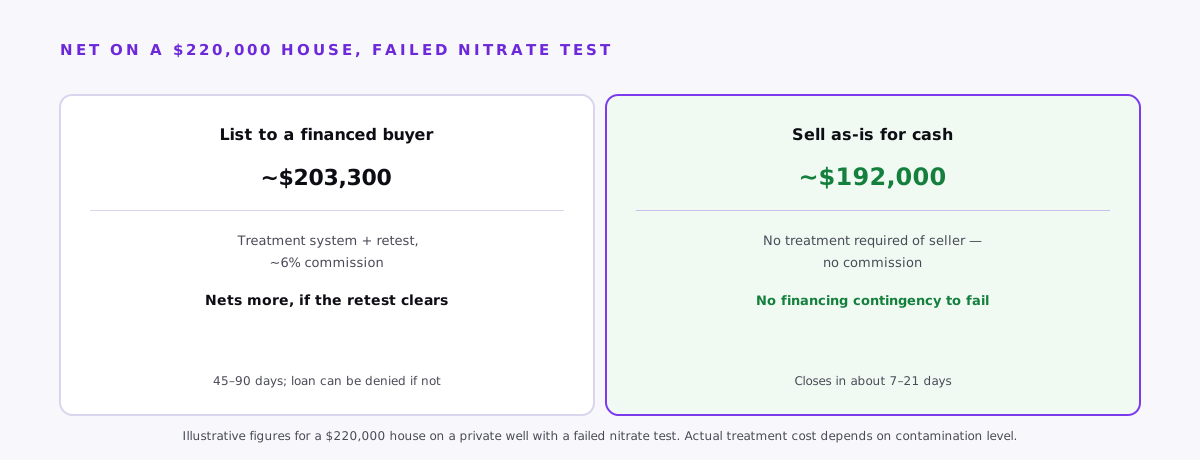
A failed or pending well test is one of the more disruptive things that can happen mid-escrow on a financed deal, because it can stall or kill the loan outright. Worked on a $220,000 house on a private well where the initial test comes back showing nitrate just over the EPA limit:
| Route | Gross price | Test + remediation | Commission/fees | Net to seller | Timeline |
|---|---|---|---|---|---|
| List with an agent, FHA/VA/USDA buyer | $220,000 | Treatment system + retest: −$3,500 | ~6% (−$13,200) | ~$203,300 | 45-90 days; loan can be denied outright if retest still fails before closing |
| List with an agent, conventional buyer (no test required by lender) | $220,000 | Buyer may still request one in inspection; negotiated credit: −$3,500 | ~6% (−$13,200) | ~$203,300 | 30-60 days; less lender risk, but buyer pool skews smaller in rural well markets |
| Sell as-is to a cash buyer | $192,000 (as-is discount; no financing contingency to fail) | Buyer accepts as-is; no treatment required of seller | $0 | ~$192,000 | 7-21 days; no lender-mandated retest to pass |
The financed routes net more on paper, but both carry a real failure mode a cash sale doesn't: a retest that still doesn't clear the lender's standard, which can mean a denied loan and a restarted search for a buyer, not just a delayed closing. A cash sale accepts a lower price in exchange for removing that specific risk entirely, since there's no loan underwriting a water test result could sink.
If your well tests clean, or a straightforward fix like shock chlorination resolves it, listing with an agent usually nets more — we'd tell you that directly.
Where a cash sale earns its place is when a failed test could sink a financed buyer's loan and you can't afford the retest cycle. Send the address and we'll send a written offer within 24 hours. No cost, no obligation.
All guides · Selling a house with a private well · Selling a house with a shared well agreement · Cash offer vs listing net proceeds
Step 1 of 5
No obligation, no fees, no repairs. We respond the same day.
You’ll talk to Trevor McAmis, Owner & Acquisitions Lead
(313) 710-6129
Takes about two minutes. Or call (313) 710-6129 — we answer.
