Every market page publishes the numbers behind its offer. See the math
Home › Guides › Selling a House With a Private Well
Guide
Selling a House With a Private Well
A house on a private well isn't harder to sell — but a water problem can quietly stall the specific kind of buyer who needs a government-backed loan, at exactly the moment you thought you were done negotiating. Here's what actually gets tested, what your state requires, what it costs to fix, and how that weighs against selling as-is.
Tell us about the well — test results, age, any known issues. We'll tell you honestly whether a cure makes sense or whether selling as-is nets you more once you count the cost and the time.
Takes about two minutes. Or call
(313) 710-6129 — we answer.
Educational only. This explains how these situations generally work. It is not legal, tax or financial advice, and the rules differ by state — talk to an attorney or CPA about your own situation before you act on any of it.
Selling a house with a private well: the short answer
A private well doesn't stop a sale by itself. What stops or delays a sale is a failed water test, and it mainly matters to financed buyers — FHA, VA, and USDA loans generally can't close without a passing test. Cash buyers aren't bound by that rule, though a known issue still affects what they'll offer.
This is educational information, not legal advice. Well-testing and disclosure requirements vary by state and sometimes by county — confirm the current rule for your property with a real estate attorney or your closing agent before you sign anything.
What actually gets tested, and why it's not optional for some buyers
Private wells aren't regulated the way public water systems are. The EPA is direct about this: private wells are "not regulated by the Federal Government under the Safe Drinking Water Act nor by most state governments," which means the owner carries full responsibility for testing and treatment. A 2,100-well USGS study the EPA cites found roughly 1 in 5 private wells contained a contaminant exceeding a health benchmark — most owners never test until a sale forces the question.
A standard test panel covers total coliform bacteria and E. coli (contamination from surface water or a septic system), nitrate and nitrite (agricultural runoff or septic proximity — an acute risk for infants), arsenic (naturally occurring in some geology, an EPA-classified carcinogen), and lead. Regional add-ons include iron, manganese, and volatile organic compounds depending on what's nearby. The EPA recommends annual testing for bacteria, nitrates, and pH at minimum, and immediately after any noticeable change in taste, color, or odor.
A failed result is a negotiation event, not an automatic dead deal — most purchase contracts include a water-quality contingency that pauses the sale for a cure-and-retest, rather than killing it outright.
FHA, VA, and USDA loans generally can't close without a passing test
This is the part that actually determines your timeline. Conventional financing may or may not require a well test, depending on the appraiser and lender. Government-backed loans are stricter:
FHA requires water quality to meet the local health authority's standard, or EPA standards if none exists, drawn by someone with no financial interest in the sale.
VA requires the same coliform/nitrate/lead testing plus a minimum separation between the well and any septic system — commonly cited at around 100 feet — and a test result that's typically only valid for a limited window before closing, often around 90 days.
USDA (Rural Development loans, common in the more rural parts of our markets) requires a satisfactory water test drawn by a disinterested third party, generally deferring to the same separation standards as FHA where no local rule exists.
If the well fails and the buyer is financing with one of these programs, the loan doesn't close until the well is cured and retested — full stop. That's the mechanic that makes a well issue expensive for a seller working with a financed buyer, and irrelevant to a buyer who isn't using one of these loans.
What your state actually requires
Most states have no statewide law forcing a well test at the point of sale — testing gets triggered by the loan type, not the state. A handful of our markets are the exception:
State
What's actually required
Maryland
Since October 2024, state law makes water-quality testing a required condition of any private-well sale contract — settlement can't happen until both sides receive and sign off on the results. Results are valid 3 years.
North Carolina
Sellers must disclose whether the well has ever been tested, and when — a disclosure-of-history requirement, not a mandate to test before you sell.
Texas
A newer disclosure form covers groundwater and surface water rights, including known well condition — disclosure, not a testing mandate.
Michigan, New York
No statewide rule — regulation is delegated to individual counties. Several Michigan and New York counties (Macomb and Isabella in Michigan; Westchester, Suffolk, Rockland, and Monroe in New York, among others) have their own time-of-sale testing ordinances with different contaminant panels. Check with your county health department directly.
Alabama, Arizona, Florida, Georgia, Indiana, Ohio
No statewide testing or disclosure-of-testing mandate found. Standard practice is to disclose known issues on the general property disclosure form; the loan program, not the state, is what actually forces a test.
Because this changes by county in two of our states, don't rely on a generic answer — a quick call to your county health department or your closing agent settles it in minutes.
What a failed test actually costs to cure
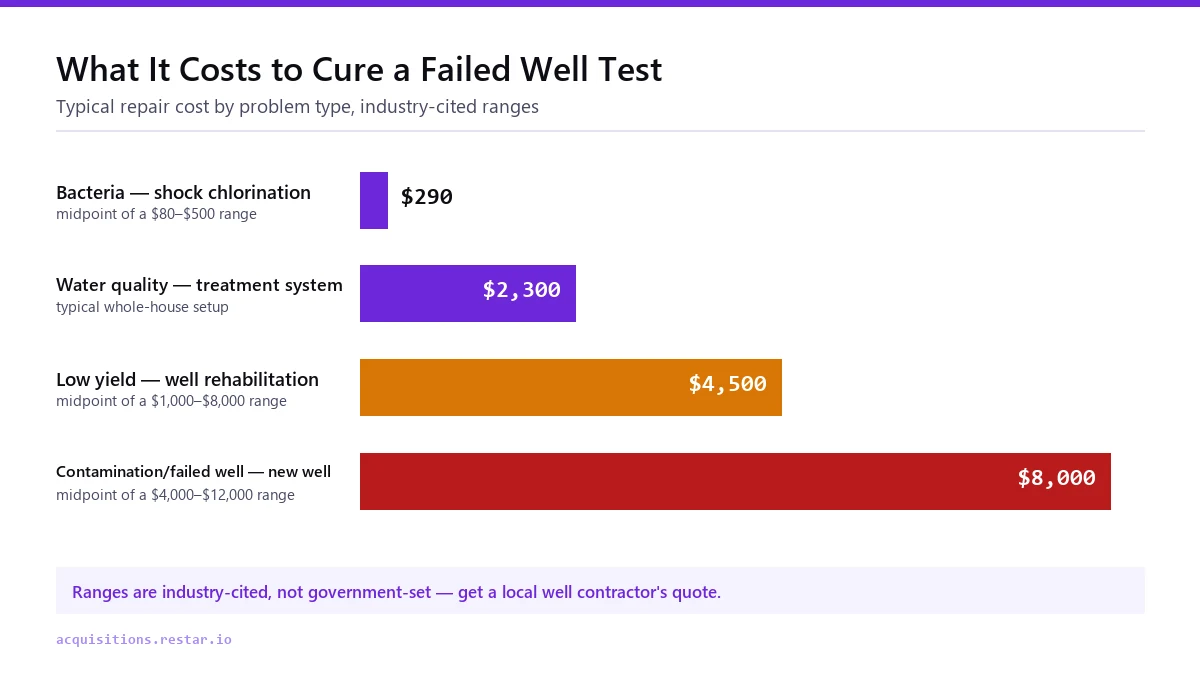
The fix depends entirely on what failed. These are commonly cited industry ranges, not government-set prices, and your local well contractor's quote is the number that actually matters:
Bacteria (coliform/E. coli) — shock chlorination: roughly $80–$500 professionally done, often the cheapest and fastest fix, typically cured with a retest within a couple of weeks.
Iron, manganese, or general water quality — treatment system: roughly $1,200–$3,600 for a typical whole-house setup; basic filtration starts under $500, advanced multi-stage systems can run $8,000+.
Low yield or structural well problems — rehabilitation: commonly 20–30% of the cost of a new well, roughly $1,000–$8,000, viable when the casing is sound and yield has only moderately declined.
Contamination that won't clear, or a failed well — new well: roughly $4,000–$12,000 for a typical 100–300 ft well, $10,000–$30,000+ for a deep or hard-rock well, plus pump and electrical.
What it costs to cure a failed well testRestar Acquisitions · industry-cited ranges, not a quote.
One thing worth knowing before you spend on a treatment system specifically to satisfy a buyer's lender: installing a filter doesn't automatically clear an FHA/VA/USDA requirement unless the water tests clean after the treatment — the loan program cares about the result at the tap, not the equipment in the basement.
If you'd rather fix it than sell as-is: connecting to municipal water
In some areas, tying into city water is a cleaner long-term fix than repeatedly treating a problem well. Typical hookup costs run roughly $25–$200 per linear foot of line plus a few hundred dollars for the meter, so total cost is almost entirely a function of how far the house sits from the nearest main — commonly landing somewhere between $1,000 and $6,000+ for a close connection, and considerably more for a rural property far from existing lines. Your city or county water department can give you an exact quote before you commit to anything.
The honest tradeoff: cure and list, or sell as-is
Curing the well and listing with an agent generally nets more once the house is on the open market — buyers using conventional financing or paying cash for a move-in-ready home aren't discounting for a water issue they never see. But that route costs real money upfront (see the ranges above), takes weeks to retest and coordinate around, and still leaves you carrying the mortgage, taxes, and insurance on a house you're not living in while it sits on the market. Selling as-is to a cash buyer skips the cure, the retest, and the wait — but the offer reflects that risk and is priced below what a cured, fully listed house would bring.
There's a middle path too: cure the cheap problems (a $150 chlorination job is a very different call than a $15,000 well replacement) and let the buyer's inspection settle the rest through a price adjustment instead of a full remediation before listing.
If you're not under time pressure and the fix is inexpensive relative to your equity, listing after curing the issue is usually the stronger financial move. If the fix is expensive, the well problem is one of several deferred issues, or you need certainty more than maximum price, an as-is cash sale trades some of that upside for speed.
Common questions
Do I have to disclose a well problem if I know about it?
In nearly every state, yes — known material defects generally must be disclosed on the standard property disclosure form regardless of whether your state mandates well testing itself. Not disclosing a known issue is a separate legal risk from the testing question.
Will a cash buyer require a passing water test?
Not as a condition of the loan, because there is no loan. A cash buyer may still ask for a test and price accordingly if there's a known issue, but nothing forces the deal to stop the way an FHA, VA, or USDA requirement does for a financed buyer.
My well failed for bacteria. Is that a big deal?
It's usually the cheapest problem to fix — shock chlorination followed by a retest commonly runs well under $500 and can often be resolved within a couple of weeks, though your well contractor's quote is the number to trust over any general estimate.
Does a water filter fix the problem for a buyer's loan?
Only if the water tests clean after the treatment. FHA, VA, and USDA underwriting look at the result at the tap, not whether a filtration system is installed — a filter alone doesn't automatically satisfy the requirement.
Is my state's well testing requirement the same everywhere in the state?
Not necessarily. Michigan and New York regulate private wells at the county level, so requirements can differ from one county to the next even within the same state. Maryland, by contrast, has a single statewide statute. Check with your county health department if you're unsure.
What's the fastest way to sell if I don't want to deal with the well at all?
A cash, as-is sale is the most direct route since it removes the financing contingency that ties a passing water test to closing. Whether it's the better financial move depends on how expensive the actual fix is — get a well contractor's quote before assuming the cash route is cheaper.
If curing the well isn't worth the cost or the wait, we can buy it as-is
We buy houses on private wells the way they sit — a failed test, low yield, an old casing, whatever the issue is. No test has to pass for our offer to close, because there's no lender requiring one. Send us the address and we'll tell you honestly how a cash offer compares to fixing the well and listing.
If the fix is cheap enough that listing nets you more, we'll say that too.
Every offer on this site is underwritten by a person, not a form. If the
numbers do not work for you, say so and I will tell you what would.
Also from Restar
Want the data behind all of this?
Restar Acquisitions is the acquisitions arm of Restar — a housing-market analytics
platform tracking 180+ metrics across every U.S. market, with composite scores and 12-month
price forecasts. The numbers on this page come from the same work.