If your manufactured home park is closing for redevelopment, you own the home but not the land under it, and several states require the park owner to give you months of written notice and pay toward relocating. The amounts are usually modest, often a few thousand dollars, and many older or single-wide homes can't be economically moved at all. Here's what the real notice periods and relocation payments look like, and what your actual options are.
Step 1 of 5
Send the details. We'll give you a straight number for the home as-is, whether or not moving it makes sense.
You’ll talk to Trevor McAmis, Owner & Acquisitions Lead
(313) 710-6129
Takes about two minutes. Your address is never shared.
Educational only. This explains how these situations generally work. It is not legal, tax or financial advice, and the rules differ by state. Talk to an attorney or CPA about your own situation before you act on any of it.
About 7.2 million occupied homes in the US are manufactured housing, 5.4% of all occupied housing, according to the Census Bureau's American Housing Survey as reported by the National Association of Home Builders. Most of those homeowners own the home itself but lease the lot under it from a park owner. That arrangement works fine until the park owner decides to sell the land for redevelopment, at which point every resident is being relocated whether they want to move or not.
This is a forced situation, not a voluntary sale, and it comes with its own statutory notice and payment rules in a handful of states. Those rules vary a lot by state, and in several states there's no relocation payment at all, only a notice requirement.
Florida requires at least 6 months' written notice before a resident can be evicted due to a change in the land's use, under Florida Statute Section 723.061. On top of the notice, Florida funds an actual relocation program through the Florida Mobile Home Relocation Corporation, which administers the Florida Mobile Home Relocation Trust Fund under Sections 723.0611 and 723.06115.
The payment amount depends on what you do with the home. Moving the home: the lesser of your actual moving cost or $3,000 for a single-section home, $6,000 for a multi-section home, under Section 723.0612(1)(b). Abandoning the home and surrendering clean title to the park owner instead of moving it: $1,375 for single-section, $2,750 for multi-section, under Section 723.0612(7).
Notice the gap between those two numbers. The fund pays roughly double for moving the home versus walking away from it, which matters when you're deciding whether a move is worth attempting in the first place.
Arizona's Mobile Home Relocation Fund, under Arizona Revised Statutes Section 33-1476.01, pays more than Florida's. For a change-in-use relocation, the fund covers the lesser of actual moving cost or $22,500 for a single-section home, $30,000 for a multi-section home. If you abandon the home instead, Arizona pays 40% of that maximum moving-expense figure, roughly $9,000 single-section or $12,000 multi-section. Homes set on a permanent, non-wheeled foundation can qualify for up to $2,500 more on top of that.
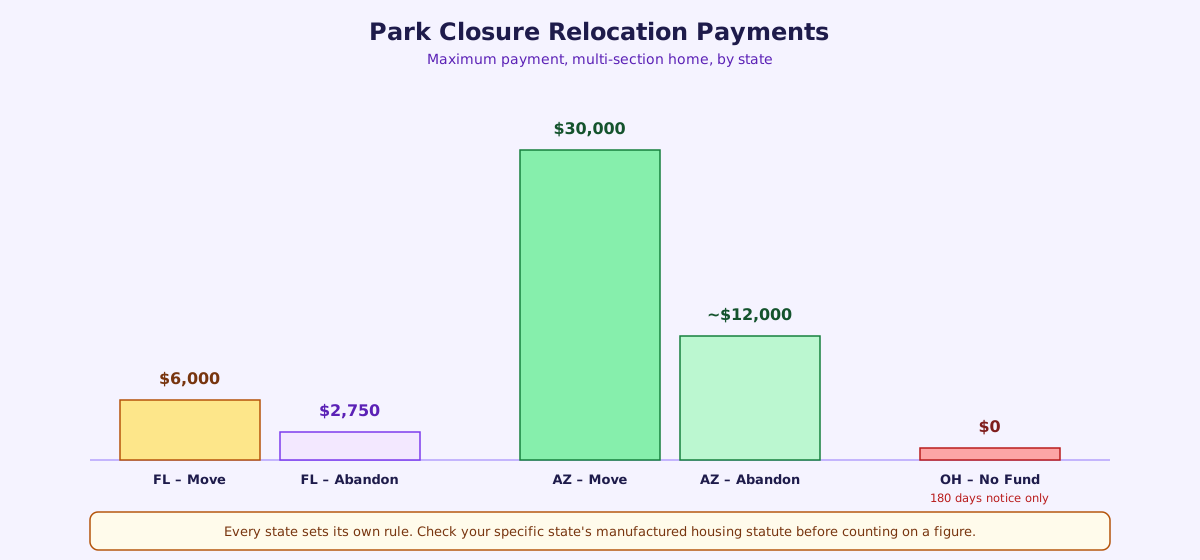
Ohio's park-closure statute, Revised Code Section 4781.40(A)(3), requires at least 180 days' written notice to homeowners before a non-park-use closure, 120 days for renting tenants. Unlike Florida and Arizona, Ohio's statute doesn't create a relocation-payment fund. If your park is in Ohio, the notice period is real and enforceable, but don't expect a check to go with it unless your specific park owner offers one voluntarily.
This pattern, strong notice requirements without a matching payment fund, is common. If your park is in a state not covered here, don't assume a Florida or Arizona-style fund exists. Check your state's manufactured housing statute directly, or ask your state's manufactured housing association, before counting on a specific dollar figure.
The relocation payment only matters if moving the home makes sense in the first place, and for a lot of older homes, it doesn't.
Moving a manufactured home costs roughly $5,000 to $20,000 depending on size and distance, according to published cost data, with a short move under 100 miles averaging around $7,000 and a longer move pushing toward $20,000 to $25,000. Compare that cost to the relocation payment you'd receive. In Florida, a $6,000 maximum payment on a multi-section home doesn't fully cover a longer move. In Arizona, the $30,000 maximum has more room.
Beyond cost, some homes simply aren't movable. A planning-industry report on park closures published in The Western Planner put it this way: some manufactured homes are worth so little that moving them isn't cost-effective, and some are old enough that they wouldn't structurally survive a move. Many communities also won't permit siting a pre-1976 home, built before the HUD code took effect, even if it could physically survive transport. If your home falls into either category, the relocation fund's moving payment isn't really available to you in practice, since there's nowhere to move it to and no way to move it safely.
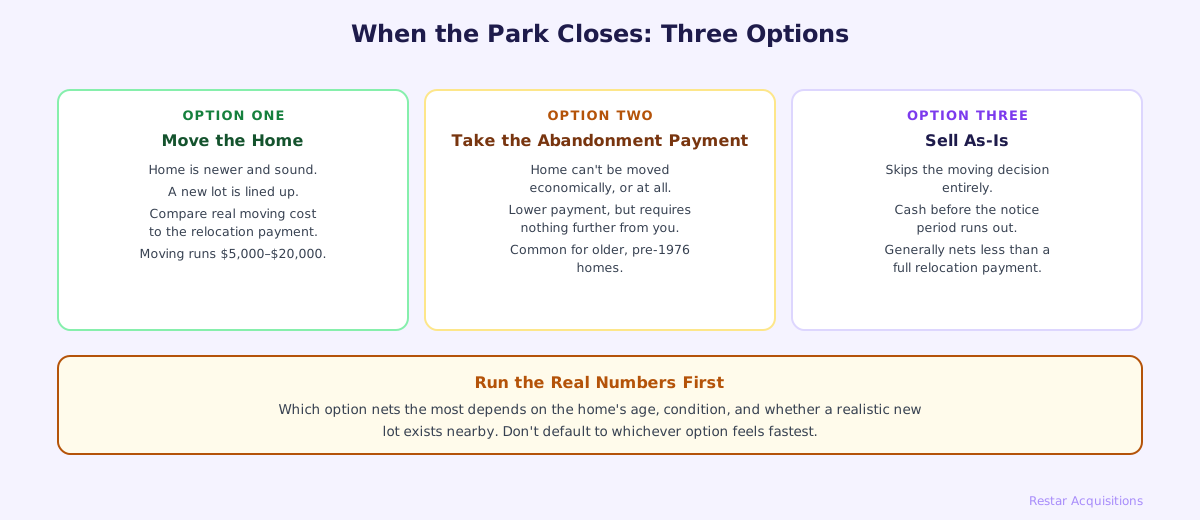
Which of those three nets you the most depends heavily on your home's age, condition, and whether a realistic new lot exists nearby. Run the real numbers for your situation before deciding, rather than defaulting to whichever option feels fastest.
This article is educational, not legal advice. Relocation-assistance programs and notice requirements vary significantly by state and change over time. Confirm the current rules for your specific state and park before making a decision.
A closure notice doesn't mean you have to figure out moving logistics under deadline pressure. We buy manufactured homes as-is, on a timeline that works around your park's closure date, and we'll tell you straight if moving or taking the relocation payment would net you more instead.
All guides · Selling a manufactured or mobile home · Selling a house in a manufactured home park · Holding costs of a vacant house
Step 1 of 5
No obligation, no fees, no repairs. We respond the same day.
You’ll talk to Trevor McAmis, Owner & Acquisitions Lead
(313) 710-6129
Takes about two minutes. Your address is never shared.