<b>If your manufactured home sits on rented land inside a park, you can sell the home itself, but your buyer usually can't move in as the new lot tenant without the park's separate approval.</b> That's a different problem from the title-and-financing question we've covered elsewhere for manufactured homes in general — this is specifically about selling when you own the structure but lease the ground under it. Five of our twelve states have a law governing that approval process; the rest leave it entirely to your park's own lease. Here's how the sale actually works, what each state requires, and the honest math on cash versus listing.
Step 1 of 5
Tell us your state and whether the park has approved a buyer before, and we'll give you a straight answer on timing.
You’ll talk to Trevor McAmis, Owner & Acquisitions Lead
(313) 710-6129
Takes about two minutes. Or call (313) 710-6129 — we answer.
Educational only. This explains how these situations generally work. It is not legal, tax or financial advice, and the rules differ by state — talk to an attorney or CPA about your own situation before you act on any of it.
Selling a manufactured home inside a land-lease community is really two transactions bundled together: a personal-property (chattel) sale of the home itself, which you're free to sell to whoever you choose, and the park's separate approval of that buyer as a new lot tenant under a new or assumed lease. Every state we checked that regulates this draws the same line — the park cannot force you to sell to a specific buyer and generally cannot refuse the sale outright, but it can screen your buyer the same way it would screen any new resident, and your buyer can't actually move onto the lot until that screening clears. This is why a leased-lot sale behaves differently from a site-built house sale even when the home itself is in good condition: the approval step sits between your signed sale and your buyer's move-in.
If you own both the home and the land it sits on, none of this applies to you — see our general guide to how manufactured home titling works for that situation instead. This article is specifically about the land-lease, lot-rent scenario.
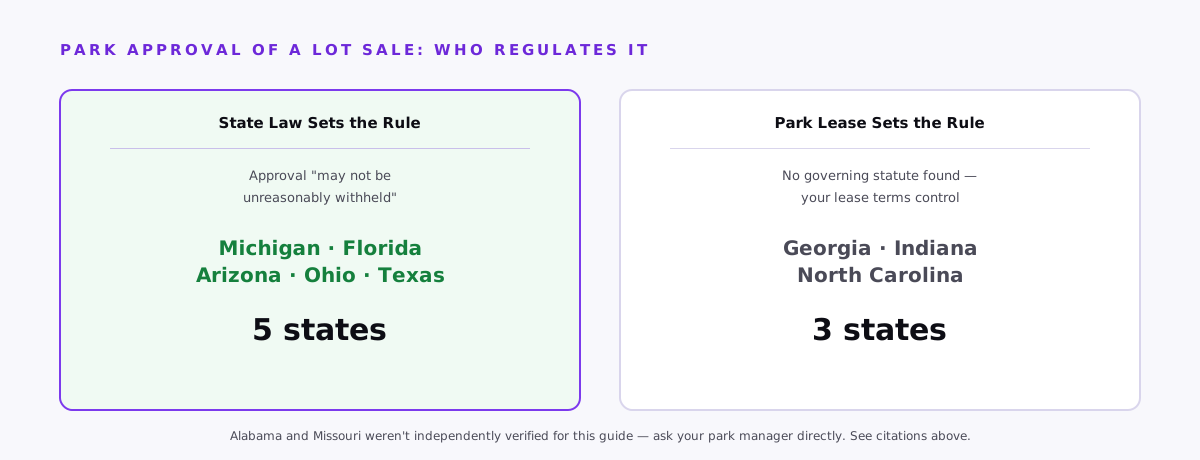
Five of our twelve states have a statute specifically addressing park approval of a lot sale; the other seven leave it to your park's own lease terms, for better or worse.
Michigan — under the Mobile Home Commission Act, MCL 125.2328a, a park cannot refuse to allow an in-park sale based solely on the home's age or size, and can charge an inspection fee of no more than $30 or the local building-permit fee, whichever is higher — no other sale-related fee is allowed.
Florida — under the Florida Mobile Home Act, a buyer "may become a tenant... subject to the approval of the park owner, but such approval may not be unreasonably withheld," per Chapter 723.059, Florida Statutes. A companion section, 723.058, bars the park from denying your right to sell or forcing removal of the home solely because of the sale, and bars the park from taking a sales commission unless it's acting as your agent under a written contract.
Arizona — under A.R.S. §33-1452(F)(3), a park may reserve the right to approve a buyer as a new tenant, but that approval "may not be unreasonably withheld," and the park must give written reasons for any disapproval within 10 days of a written request.
Ohio — under Ohio Revised Code §4781.40(H), a park can't deny your right to sell with 10 days' written notice, can't force removal of the home solely because of a sale, and can't "unreasonably refuse" to enter a rental agreement with your buyer; no transfer fee is allowed beyond actual moving and installation costs.
Texas — Property Code §94.252 requires the buyer to be approved in writing by the park and to sign a lease, and bars the park from requiring you to use it as your broker or pay it a commission unless you separately agreed to that in writing.
Georgia, Indiana, and North Carolina have no equivalent statute that we could find governing park approval of a lot sale — in those three states, this is purely a matter of your park's own lease and rules, not state law. (North Carolina has a bill, S518, that would add tenant protections including a right of first refusal, but as of this writing it's still sitting in committee and is not current law — don't rely on it yet.) Alabama and Missouri weren't independently verified for this guide; if you're in either state, ask your park manager directly what its written policy requires rather than assuming either way.
A land-lease home almost never qualifies your buyer for a traditional mortgage, because the buyer isn't purchasing any real estate — just the structure. The Consumer Financial Protection Bureau's analysis of lending data found that only 27% of manufactured-home loan applications are originated, compared with 74% for site-built homes, and that roughly 42% of manufactured-home loans overall are chattel loans secured by the home alone rather than a mortgage secured by land, per the CFPB's Manufactured Housing Finance report. For a buyer on a leased lot specifically, a chattel loan is typically the only option, which means a narrower buyer pool, higher interest rates, and shorter terms than a site-built home would see — on top of waiting for the park's approval.
The Urban Institute's research on manufactured-home appreciation found that homes on owned land appreciated almost identically to site-built homes from 2000 to 2024 (211.8% versus 212.6%), but notes that homes in land-lease communities have "likely not performed nearly as well," largely because the appreciation in owned-land cases comes from the land itself — land costs rose roughly 261% from 2012 to 2023, versus about 49% for the structure — and a leased-lot seller never owns that land to begin with, per the Urban Institute's analysis. The honest takeaway: a home you own on land you don't is priced and financed more like a vehicle than a house, even though it's where you live.
The industry itself is large: the Manufactured Housing Institute counts more than 43,000 manufactured home communities nationwide, representing almost 4.3 million home sites, per MHI's own data, and the CFPB's own report (cited above) separately notes manufactured housing makes up roughly 6% of occupied U.S. housing stock nationally — a figure the Census Bureau tracks in its own Manufactured Housing Survey, run jointly with HUD. This isn't a small or unusual situation; it's a meaningful share of housing in exactly the kind of older, affordable neighborhoods several of our markets include.
Worked example: a manufactured home on a leased lot, home value (structure only, no land) roughly $62,000, lot rent $450/month. A retail buyer is found who needs a chattel loan; park approval and loan underwriting together typically add 30 to 60 days beyond what a site-built closing would take.
| Retail listing (chattel buyer) | Cash sale | |
|---|---|---|
| Sale price (home only) | $62,000 | $52,500 |
| Agent commission (~6%, common for MH sales) | −$3,720 | $0 |
| Lot rent carried during 60–90 day approval/underwriting window | −$900 to −$1,350 | $0 (1–2 week close) |
| Risk the sale falls through at park approval or loan denial | Real — chattel approvals and park screening both can fail | None — no park approval needed for a direct buyer the park already knows, no chattel underwriting |
| Net to seller | ~$57,000 to $57,400, in 2–3+ months, if approval and financing both clear | ~$52,500, in 1–2 weeks, with certainty |
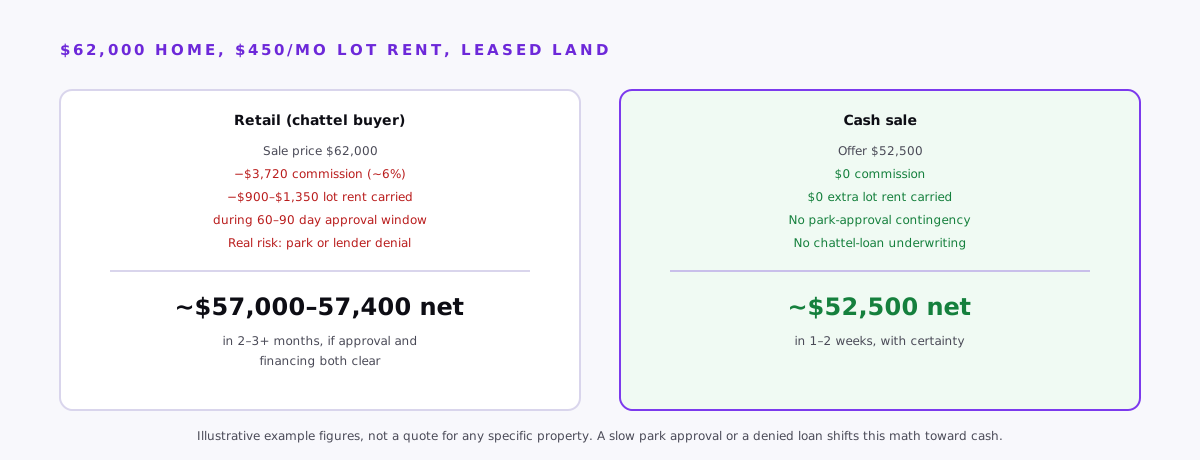
Retail nets more in this example when everything goes smoothly, and that's the honest result — a chattel-financed buyer who clears park approval genuinely pays more than a cash investor would. The math shifts toward cash when your park has a track record of slow or difficult approvals, when chattel lenders in your area are thin (narrower than mortgage lenders to begin with), when you're carrying lot rent you can't sustain for another two or three months, or when a prior buyer has already fallen through at the approval or financing stage. Our guide to land contract forfeiture covers a related Michigan/Ohio/Indiana-specific scenario if your situation involves a contract buyer rather than a straightforward sale.
Restar Acquisitions buys houses as-is for cash in 12 states, and where that includes manufactured homes on leased land, we deal directly with your park's approval process ourselves rather than leaving it to a buyer who's never done it before. We give a written offer within 24 hours, no repairs or commissions, and you pick the closing date. We're a direct buyer, not your real estate agent, and we don't represent you in the transaction.
Alternatives worth checking before you decide:
This article is for general education only and isn't legal advice. Park approval rules, lot-rent regulation, and chattel-lending availability vary by state, by park, and by lender, and change over time. Confirm your specific park's lease terms and your state's current law with a real estate attorney before making a decision.
If you can wait out the park's buyer-approval process and a financed buyer pool exists for a leased-lot home in your area, listing can net more — we'd tell you that directly.
Where cash earns its place is when you need certainty that doesn't depend on a park approving a stranger's financing, or a closing date that doesn't hinge on a chattel lender. Send the address and we'll send a written offer within 24 hours. No cost, no obligation.
All guides · Selling a manufactured or mobile home: how the title works · Land contract forfeiture: when your buyer stops paying · Cash offer vs. listing net proceeds
Step 1 of 5
No obligation, no fees, no repairs. We respond the same day.
You’ll talk to Trevor McAmis, Owner & Acquisitions Lead
(313) 710-6129
Takes about two minutes. Or call (313) 710-6129 — we answer.