Every market page publishes the numbers behind its offer. See the math
Home › Guides › Selling a Manufactured or Mobile Home: How the Title Works
Guide
Selling a Manufactured or Mobile Home: How the Title Works
A manufactured or mobile home usually isn't titled like a house at all — in most states, it starts out titled as personal property through the state's vehicle or manufactured-housing agency, the same system that titles a car, not a deed recorded at the county. That single fact changes how the sale closes, who can finance it, and why a cash sale is often the more realistic path.
Takes about two minutes. Or call
(313) 710-6129 — we answer.
Educational only. This explains how these situations generally work. It is not legal, tax or financial advice, and the rules differ by state — talk to an attorney or CPA about your own situation before you act on any of it.
Selling a manufactured or mobile home: the short answer
In most states, a manufactured or mobile home is titled as personal property by default — through the state's DMV or manufactured-housing division, not a deed — unless the owner has formally converted it to real property. That title status determines whether the sale transfers by certificate of title or by deed, and it directly limits which buyers can get financing.
This is educational information, not legal advice. Title and real-property conversion rules vary by state — confirm your home's exact status with your state's manufactured-housing division or a real estate attorney before you sign anything.
This isn't a technicality. It's the reason a manufactured home sale can look and feel completely different from selling a site-built house next door, even on the same street.
Personal property vs. real property: the distinction that runs the whole sale
A site-built house is always real property — it transfers by deed, recorded at the county. A manufactured or mobile home doesn't start that way. Per Fannie Mae's own underwriting guidance, most states title these homes as personal property through the state's motor vehicle or manufactured-housing agency, the same system that issues a car title, unless the owner has completed a formal process to convert the home to real property (see Fannie Mae: Titling Manufactured Homes as Real Property).
That conversion process generally requires three things: the owner has to own (or hold a qualifying long-term lease on) the land underneath the home, the home has to be permanently affixed to a foundation, and the owner has to file paperwork retiring the personal-property title and recording the home as real property at the county. Until all of that happens, the home stays titled like a vehicle — and sells like one.
Titled as personal property
Converted to real property
Transfers via
Certificate of title / statement of ownership (state DMV or manufactured-housing agency)
Deed, recorded at the county
Typical financing
Chattel loan (home only)
Real-estate mortgage (home + land)
Land included in sale?
Only if sold in a separate, linked transaction
Yes, as one property
How a handful of our states actually handle the conversion
The paperwork is state-specific, and the differences are real enough that what applies in one of our markets won't apply in another.
Texas uses a "Statement of Ownership" (SOL) issued by the Texas Department of Housing and Community Affairs, not a certificate of title. Electing real-property status requires TDHCA's Application for Statement of Ownership, lienholder consent, and county recording under Tex. Occ. Code §1201.2055.
Georgia converts using Form T-234, filed with the Clerk of Superior Court in the county where the home sits; the county tag office then forwards it to the state DOR Motor Vehicle Division to cancel the original title.
Florida only treats a mobile home as real property when the owner of the home also owns the land and the home is permanently affixed — per Fla. Stat. §320.015 — and requires purchase of a one-time real-property decal from the county tax collector.
North Carolina requires Form MVR-46G filed with the DMV to surrender the title, followed by recording with the county Register of Deeds.
Ohio, Michigan, Indiana, and Alabama each run a similar affidavit-plus-recording process (Ohio Rev. Code §4503.06; Michigan MCL 125.2330i; Indiana's ATRE, State Form 51408; Alabama Forms MVT 5-1E and 5-39E) — the mechanism differs by state, but the shape is the same: retire the title, record it as real property.
If your home is in Arizona, Maryland, or New York, the same general two-track system applies, but confirm the exact form and process with your state's manufactured-housing division or DMV — the specific paperwork differs enough state to state that it's not worth guessing.
Why this shrinks your buyer pool — and what it means for financing
A home titled as personal property is typically financed with a chattel loan, not a mortgage — a loan secured by the home alone, the same structure as a car loan. Per the Consumer Financial Protection Bureau's 2021 analysis of manufactured-housing lending, roughly 42% of all manufactured-home purchase loans nationally are chattel loans, and even among owners who own their land and could qualify for a mortgage, about two-thirds still ended up with a chattel loan instead (see CFPB: Manufactured Housing Loan Borrowers Face Higher Interest Rates, Risks, and Barriers to Credit).
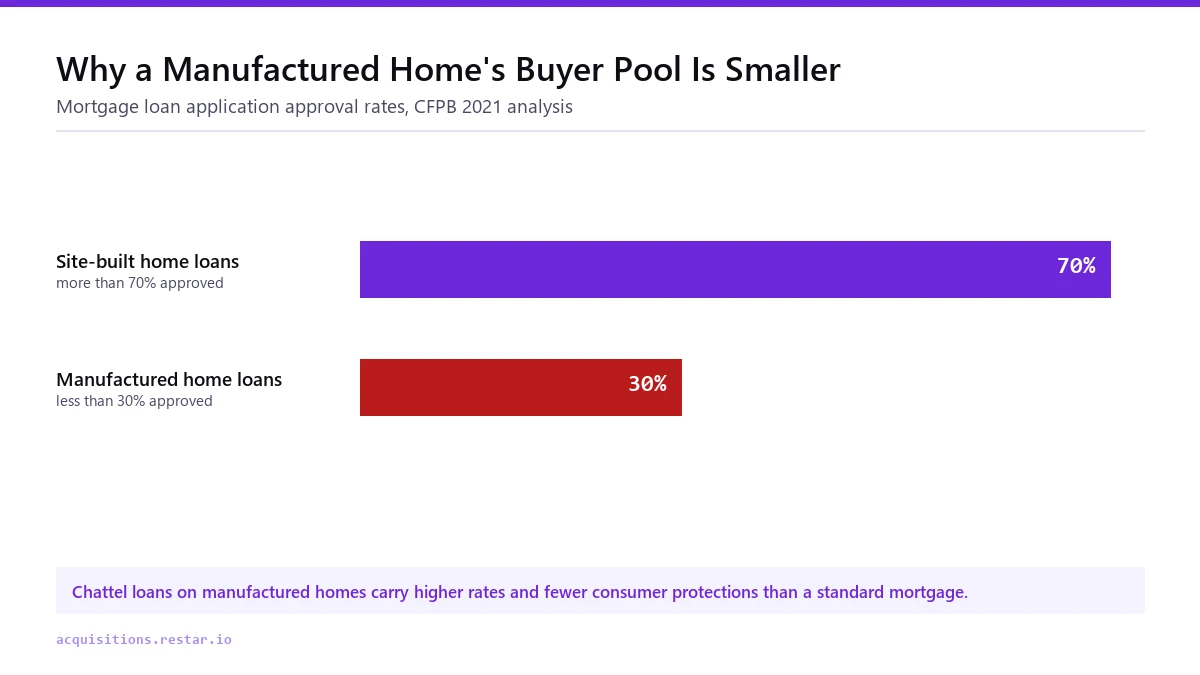
The same CFPB analysis found manufactured-home loan applications get approved at a much lower rate than site-built home loans — less than 30%, compared to more than 70% for site-built homes — and chattel loans carry higher interest rates with fewer of the consumer protections a standard mortgage comes with.
Why a manufactured home's buyer pool is smallerRestar Acquisitions · CFPB 2021 manufactured-housing finance analysis
There's also a hard age cutoff that matters for financing: manufactured homes built after June 15, 1976 must carry a HUD Certification Label showing they comply with the federal Manufactured Home Construction and Safety Standards, 24 CFR Part 3280 — and Fannie Mae's Selling Guide makes that same date a hard eligibility cutoff for conventional financing (see Fannie Mae Selling Guide B5-2-01). A pre-1976 home is effectively excluded from conventional mortgage financing altogether, which narrows an already-narrow buyer pool down further to cash or specialty lenders willing to finance older stock.
Two federal loan programs exist specifically for manufactured housing: HUD's Title I program is a personal-property/chattel-style FHA-insured loan that doesn't require owning the land (used for homes on leased lots, with lease protections built in), while Title II is a real-property FHA mortgage requiring the home be permanently affixed to land the borrower owns.
If your home is on a leased lot in a mobile home park
If your home sits on rented land in a manufactured-home community, only the home itself is part of the sale — the land is never included, because you don't own it. HUD's Title I program materials build in specific lease protections for exactly this situation: a minimum initial lease term of three years and at least 180 days' notice before any lease termination.
In practice, most parks also require some form of approval before a new resident moves in and typically expect the buyer to either take over your lot-rent lease or sign a new one. That's a standard operational reality in these communities, though the specifics are governed by your individual park's lease and, in some states, mobile-home-park landlord-tenant law — not a single uniform federal rule. Confirm your park's exact transfer process with the property manager before you list, so it doesn't surprise a buyer mid-sale.
The honest tradeoff: cash sale vs. financed retail sale
None of this means a manufactured or mobile home can't sell retail — it means the retail path is narrower and slower than it is for a site-built house, and that's worth being honest about before you choose a path.
If your home qualifies for MH Advantage-style conventional financing (real-property status, specific construction standards) or your local chattel-lender market is strong, listing retail can net you more before closing costs — the same tradeoff that applies to any house: a longer timeline and financing risk in exchange for a potentially higher price. Our guide on cash offer vs listing net proceeds walks through that math in more detail.
If your home is titled as personal property, is a pre-1976 unit, sits on leased land, or you simply need certainty in days rather than the 30 to 60-plus days a chattel loan or specialty mortgage underwriting can take, a cash sale sidesteps the financing bottleneck entirely — not because cash is always the better deal, but because it removes the single biggest constraint on who can actually buy your home. See how cash home buyers calculate offers for how that number gets built, or how a fast, as-is sale works if certainty is the priority.
Common questions
Is my mobile home titled like a car or like a house?
In most states, it starts out titled like a car — as personal property through the state's DMV or manufactured-housing division — unless you've completed a formal process to convert it to real property, which requires owning the land, permanently affixing the home to a foundation, and recording the conversion at the county.
Does a manufactured home come with the land it's sitting on?
Only if you own that land and it's included in the same transaction. If the home sits on a leased lot in a mobile home park, the land is never part of the sale — only the home itself transfers, and the buyer separately takes over or signs a new lot-rent lease.
Why is it harder to get a mortgage on a manufactured home?
Because most manufactured homes are titled as personal property, they're typically financed with a chattel loan rather than a mortgage. Per CFPB data, chattel loans carry higher rates, fewer protections, and get approved less than 30% of the time, compared to over 70% for site-built home loans — which shrinks the pool of buyers who can actually finance a purchase.
Does the age of my manufactured home affect who can finance it?
Yes. Homes built after June 15, 1976 carry a HUD Certification Label showing they meet the federal HUD Code construction standards, which conventional lenders like Fannie Mae require for standard financing. Homes built before that date are generally excluded from conventional mortgage financing entirely.
Can I sell my manufactured home for cash if it's titled as personal property?
Yes. A cash sale doesn't depend on chattel-loan or mortgage underwriting either way, so a home's title status — personal property or converted real property — doesn't block a cash transaction the way it can block a financed one.
Selling a manufactured or mobile home? We buy them as-is, however they're titled
Whether your home is titled as personal property, converted to real property, or sitting on a leased lot in a mobile home park, we can make a cash offer without waiting on chattel-loan underwriting or a buyer who needs conventional financing that may not apply to your home at all.
We buy houses and manufactured homes as-is across 30 markets in Alabama, Arizona, Florida, Georgia, Indiana, Maryland, Michigan, New York, North Carolina, Ohio, and Texas. You tell us the situation, we make a written cash offer within 24 hours, and you pick the closing date.
Every offer on this site is underwritten by a person, not a form. If the
numbers do not work for you, say so and I will tell you what would.
Also from Restar
Want the data behind all of this?
Restar Acquisitions is the acquisitions arm of Restar — a housing-market analytics
platform tracking 180+ metrics across every U.S. market, with composite scores and 12-month
price forecasts. The numbers on this page come from the same work.