Every market page publishes the numbers behind its offer. See the math
Home › Guides › Selling a House With Two Mortgages: The Payoff Waterfall
Guide
Selling a House With Two Mortgages: The Payoff Waterfall
Selling a house with two mortgages does not split the proceeds evenly, by how much you owe each lender, or by which loan carries the higher rate — it splits by lien priority: first mortgage first, second mortgage or HELOC after, everyone else after that. When the math does not stretch far enough to pay everyone in full, selling a house with two mortgages means the shorted lienholder has to agree to accept less than it is owed before the sale can close at all.
Takes about two minutes. Or call
(313) 710-6129 — we answer.
Educational only. This explains how these situations generally work. It is not legal, tax or financial advice, and the rules differ by state — talk to an attorney or CPA about your own situation before you act on any of it.
Selling a house with two mortgages: the short answer
Sale proceeds pay off liens strictly in priority order — the first mortgage first, then a second mortgage or HELOC, then any other liens — and if the sale price does not cover everything, the junior lienholder must voluntarily accept a reduced "short payoff" to release its lien before the sale can close, regardless of what the purchase contract says.
This is educational information, not legal or financial advice. Lien priority rules and short-payoff approval processes vary by state and by lender — confirm your specific payoff figures with a title company or closing attorney.
The order proceeds actually get paid in
Most liens follow "first in time, first in right": whichever lien recorded first at the county gets paid first, regardless of the loan balance. A first mortgage almost always outranks a second mortgage or home equity loan or HELOC simply because it was recorded first, usually at the same closing the home was purchased.
Two categories of lien jump this line regardless of when they were recorded. Property tax liens are treated as superior to every other lien in most states — Florida law, for one, states plainly that property taxes are "a first lien, superior to all other liens" on the property, meaning an unpaid tax bill gets paid before a first mortgage that has been on record for twenty years. HOA liens sometimes carry limited "super-lien" priority for a capped amount, which is covered in more depth in selling a house with an HOA lien.
Priority
Typical lien
1
Unpaid property taxes (superior in most states, regardless of recording date)
2
First mortgage
3
Second mortgage or HELOC
4
HOA lien (sometimes partially senior, capped by state law)
5
Judgment liens, in the order recorded
Worked example: what a second lienholder actually sees
A house worth $220,000 as-is, needing about $10,000 of repairs, with a $150,000 first mortgage and a $45,000 HELOC — $195,000 of total secured debt against $220,000 of value, before any selling costs are subtracted.
Line
Repair, then list
Sell as-is for cash
Sale price
$220,000
$175,840
Repairs
−$10,000
$0
Agent commission (5.5%)
−$12,100
$0
Seller closing costs (1.5%)
−$3,300
$0 — we cover it
Buyer concessions (1%)
−$2,200
$0
Holding, 6 months at $960
−$5,760
−$720 (3 weeks)
Before either mortgage
$186,640
$175,120
First mortgage payoff
−$150,000
−$150,000
Left for the HELOC ($45,000 owed)
$36,640
$25,120
Short payoff the HELOC lender must approve
$8,360 forgiven
$19,880 forgiven
The cash figure follows the four-term formula from how cash home buyers calculate offers: $220,000 after-repair value, minus $10,000 repairs, minus $21,160 of resale commission, resale closing costs and six months of carry, minus $13,000 of margin, minus three weeks of the seller's own holding at $720.
A worked illustration on one hypothetical property. Not a quote, not a prediction about your house, and not a fixed formula we apply.
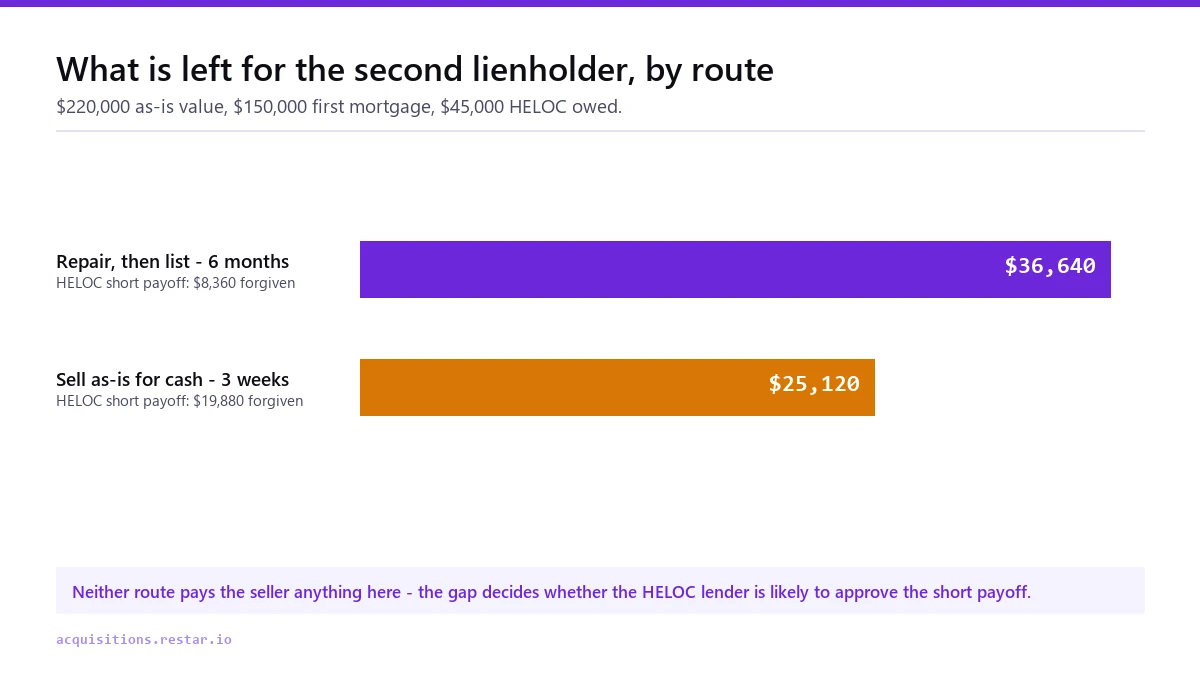
What is left for the second lienholder, by routeRestar Acquisitions · worked example from this page
Neither route puts a dollar in the seller's pocket in this example — every dollar of proceeds is spoken for by the two mortgages. But the routes are not equivalent to the HELOC lender, who is the one that actually has to say yes. Listing leaves it $11,520 more than a cash sale does, which is exactly the kind of gap that decides whether a short-payoff request gets approved or rejected. Listing usually wins the negotiation with a reluctant second lienholder for that reason — the tradeoff is the extra months a listing takes, against a foreclosure clock that does not pause for either process.
How a short payoff actually gets approved
A short payoff is not automatic just because the numbers do not stretch far enough — the junior lienholder has to affirmatively agree to release its lien for less than it is owed, and it can refuse. Loss mitigation guidance from Fannie Mae's own servicing rules acknowledges this dynamic directly: its Mortgage Release program caps what a servicer will pay subordinate lienholders to obtain a release at $6,000 in aggregate, in a different but related workout — a sign of how routinely these negotiations are capped, contested, or delayed rather than automatic.
In practice, a second lienholder weighs a short-payoff offer against its own alternative: getting nothing at all if the first mortgage forecloses and wipes out the junior lien entirely. A small offer is still often better than that outcome, which is why short payoffs get approved more often than sellers expect — but approval typically takes weeks, not days, because the file has to route through a separate loss mitigation department at the second lienholder, independent of whatever is happening with the first mortgage.
Why speed can matter more than price here
If you are current on both loans and simply have thin equity, the choice between listing and a cash sale is mostly a question of how much the HELOC lender will accept and how long you can wait for that approval. If you have also fallen behind on the first mortgage, the calculation changes: a foreclosure timeline on the first mortgage does not pause for a second lienholder's loss mitigation review, so a faster closing — even one that gives the HELOC lender less — can be the only way to close before a scheduled sale date forecloses out the junior lien anyway and the HELOC lender is left with nothing.
This is the honest version of the price-versus-speed tradeoff on a two-mortgage house: more time generally buys a better outcome for the second lienholder, but only if there is actually time left on the clock.
What to do before you list or accept an offer
Get a written payoff statement from both lenders, not just your online balance — a payoff statement includes per-diem interest and fees that a balance figure does not, and is covered in more detail in mortgage payoff statement explained.
Ask your title company to run the numbers before you accept any offer, so you know whether a short payoff will be needed at all.
Contact the second lienholder's loss mitigation department early if a short payoff looks likely — this process routinely takes weeks, and starting it late is the most common reason a closing date slips.
If you are also behind on the first mortgage, tell every party that up front — the foreclosure timeline on the first loan is the real deadline the second lienholder's approval has to beat.
Common questions
What order do mortgages get paid off when you sell a house?
Liens are paid in priority order, not by loan amount or interest rate. Unpaid property taxes come first in most states regardless of recording date, then the first mortgage, then a second mortgage or HELOC, then other liens like judgments, in the order they were recorded.
What happens if selling my house won't cover both mortgages?
The junior lienholder — usually the second mortgage or HELOC — must voluntarily agree to a short payoff, accepting less than it is owed, before the sale can close. This is not automatic; the lienholder can refuse, though many approve a short payoff because the alternative, a first-mortgage foreclosure wiping out their lien entirely, is often worse for them.
Do I need permission from my second mortgage lender to sell my house?
You always need the lien released to deliver clear title, whether or not there's enough to pay it in full. If the sale fully pays off the second mortgage, releasing the lien is routine paperwork. If it doesn't, you need the lender's affirmative approval of a short payoff, which typically takes weeks to process.
Does a HELOC get paid off when you sell your house?
Yes, if there is enough equity — the HELOC balance is paid at closing from sale proceeds, after the first mortgage, before any money reaches the seller. If there isn't enough equity to cover it, the HELOC lender must agree to a short payoff or the sale cannot close with clear title.
Do property taxes get paid before a mortgage when you sell a house?
Yes, in most states. Unpaid property taxes are typically given super-priority status ahead of every other lien on the property, including a first mortgage, regardless of which was recorded first — Florida law, for example, states that property tax liens are superior to all other liens.
Is it better to list with an agent or sell for cash when I have two mortgages and thin equity?
It depends on how much time you actually have. A repaired retail listing typically leaves more money for a second lienholder to approve a short payoff against, which can make that lienholder more likely to say yes. But if you are also behind on the first mortgage, a faster cash closing can matter more than the larger amount a listing would eventually leave, because a foreclosure timeline does not wait for a second lienholder's approval.
We handle the short-payoff negotiation, not just the sale
When a second mortgage or HELOC will not be paid in full at closing, someone has to get that lienholder to agree to release the lien anyway — a short payoff. Send us the property and we will work that negotiation as part of getting to a closing date, not leave it for you to chase down mid-transaction.
If a retail listing would leave the second lienholder enough that they are likely to simply approve it, we will tell you that plainly — our worked example below shows exactly when that math favors listing over a cash sale.
Every offer on this site is underwritten by a person, not a form. If the
numbers do not work for you, say so and I will tell you what would.
Also from Restar
Want the data behind all of this?
Restar Acquisitions is the acquisitions arm of Restar — a housing-market analytics
platform tracking 180+ metrics across every U.S. market, with composite scores and 12-month
price forecasts. The numbers on this page come from the same work.