Selling a house with an HOA lien is not one debt to untangle — it is usually two, unpaid assessments and unpaid fines, and they do not behave the same way when you try to sell. Whether the association can foreclose quickly, slowly, or barely at all depends entirely on your state, and the document that actually controls your closing date is a $250 piece of paper called an estoppel certificate, not the number on your last HOA statement.

Step 1 of 5
Send the address. We order the estoppel certificate and work the payoff into the closing — you do not chase the board yourself.
You’ll talk to Trevor McAmis, Owner & Acquisitions Lead
(313) 710-6129
Takes about two minutes. Or call (313) 710-6129 — we answer.
Educational only. This explains how these situations generally work. It is not legal, tax or financial advice, and the rules differ by state — talk to an attorney or CPA about your own situation before you act on any of it.
An HOA lien from unpaid assessments almost always gets paid off at closing out of your proceeds, the same as a mortgage, and rarely stops a sale outright — but a disputed fine, an expired estoppel certificate, or a state that lets the association foreclose fast can each derail a specific closing date.
The debt itself is usually small next to your equity. The risk is timing: the wrong paperwork on the wrong day is what actually causes a closing to slip.
This is educational information, not legal advice. HOA lien and foreclosure rules vary by state and by your community's own governing documents. Talk to a real estate attorney about your specific lien and timeline.
Most HOA statements bundle two very different obligations into one balance, and the distinction matters more than the total.
Regular and special assessments are dues you agreed to pay under the community's recorded declaration when you bought the house. They are a contractual debt, and every state that has looked at the question treats a lien for unpaid assessments as enforceable.
Fines — for an unapproved paint color, a parking violation, an unmowed lawn — are a different animal. They are a penalty the board imposed, not a debt you agreed to in advance, and several states either cap how fines can be collected or forbid using the same fast lien-and-foreclosure process on a lien made up purely of fines. North Carolina is explicit about it: under N.C. Gen. Stat. § 47F-3-116, an association cannot foreclose a lien under the state's power-of-sale statute if the lien consists solely of fines, interest on fines, or the attorney's fees tied to those fines — it has to sue you in court instead, a slower and more expensive road for the association.
The practical upshot: if your balance is mostly dues, expect the association to treat it like any other debt at closing. If it is mostly fines, you may have more leverage to negotiate a reduction or a waiver than the letter implies, and it is worth asking for a hearing before you assume the number is fixed.
The single most repeated piece of misinformation online is that an HOA lien is a "super lien" that can wipe out your mortgage and take your house in weeks, nationwide. That is true in a handful of states — mostly ones we do not buy in — and it is not the general rule.
| State | How the lien is foreclosed | Notable rule |
|---|---|---|
| Texas | Judicial only — the association must sue and get a court order | Non-judicial HOA foreclosure was banned in 2011; you also have a right to request a payment plan before a lien is even filed |
| Georgia | Judicial, by court action | The association cannot foreclose at all until the lien reaches $2,000, and the lien itself expires after 4 years if unenforced |
| Florida | Judicial, like a mortgage foreclosure | Must wait 45 days after a written demand before even filing suit |
| North Carolina | Non-judicial power of sale — except pure-fines liens, which require a lawsuit | The lien is extinguished if the association does not act within 3 years |
| Michigan | Non-judicial, by advertisement, or by court action | You keep a 6-month right of redemption after the sale, shortened to 1 month only if the property is legally determined abandoned — a specific test, not simply an empty house |
Sources: Texas Property Code Ch. 209, O.C.G.A. § 44-3-232, Fla. Stat. § 720.3085, N.C. Gen. Stat. § 47F-3-116, MCL § 559.208.
The pattern that actually matters for you: every one of these processes takes time — weeks of notice, a filed lien, often a lawsuit — before an HOA lien alone can take your house. A sale that closes before any of those deadlines almost always makes the question moot, which is the practical reason most HOA-lien sellers never see a foreclosure filing at all.
Priority decides who gets paid first if there is ever a shortfall, and it is where the "super lien" fear actually comes from. In most of the states we buy in, an HOA assessment lien sits behind your first mortgage and behind property taxes — it does not jump the line.
Georgia is a partial exception worth naming specifically: under O.C.G.A. § 44-3-232, the association's lien is prior and superior to every other lien except property taxes and a first mortgage recorded before the lien attached. That means it can outrank a second mortgage, a HELOC, or a judgment recorded later — not your first mortgage, but everything junior to it.
For a straightforward sale with equity, priority rarely changes the outcome: the title company pays every recorded lien in order out of the proceeds before you see a dollar, regardless of where each one sits in line. Priority only starts to matter the way it is discussed online when the proceeds do not cover everything — the same threshold covered in selling a house with a lien on it, which walks through that math and how liens of any kind subtract identically from a retail sale and a cash sale.
Your last HOA statement is not what a title company uses to close. They order an estoppel certificate (sometimes called a resale certificate) directly from the association or its management company — a sworn statement of exactly what is owed on a specific date, and it is what actually gets paid at the table.
Florida regulates this document closely enough to put real numbers on it. Under Fla. Stat. § 720.30851, an association has 10 business days to issue one after a written request, the fee is capped at $250 if the account is current (an extra $150 if it is not), and a rush request delivered within 3 business days can carry a $100 surcharge on top. The certificate is only good for 30 days hand-delivered or emailed, 35 days by mail — after that, the title company has to order a new one.
That expiration is the part that catches sellers off guard. A closing that slips past the estoppel certificate's effective window does not just need updated numbers — it needs a whole new certificate, another request, another several business days, and another fee. On a retail sale where the closing date has already moved twice, that can mean ordering the same document three times before anyone signs anything.
There is a real protection buried in this rule, worth knowing regardless of which route you take: an association that waives the right to collect anything beyond what the certificate states, from anyone who relied on it in good faith. If the board later claims you owed more than the certificate said, that claim generally does not survive a closing that already relied on the number.
Other states run a looser version of the same process — sometimes called a "letter of good standing" or simply a payoff letter from the management company — with no statutory fee cap or turnaround deadline at all. Ask for the estoppel or resale certificate the same week you decide to sell, not after you have a buyer, because in a state without Florida's deadline the association can take as long as it likes.
A house worth $195,000 repaired, needing about $15,000 of work, with a $110,000 first mortgage. The HOA statement shows $4,850 owed: 18 months of $130 dues ($2,400), $1,800 in accumulated fines for a fence project done without architectural approval, and $650 of the association's own attorney and collection fees.
| Line | Repair, then list | Sell as-is for cash |
|---|---|---|
| Sale price | $195,000 | $141,350 |
| Repairs | −$15,000 | $0 |
| Agent commission (5.5%) | −$10,725 | $0 |
| Seller closing costs (1.5%) | −$2,925 | $0 — we cover standard closing costs |
| Buyer concessions (1%) | −$1,950 | $0 |
| Holding, 6 months at $1,200 | −$7,200 | −$900 (3 weeks) |
| Before debts | $157,200 | $140,450 |
| First mortgage payoff | −$110,000 | −$110,000 |
| HOA lien (dues + fines + fees) | −$4,850 | −$4,850 |
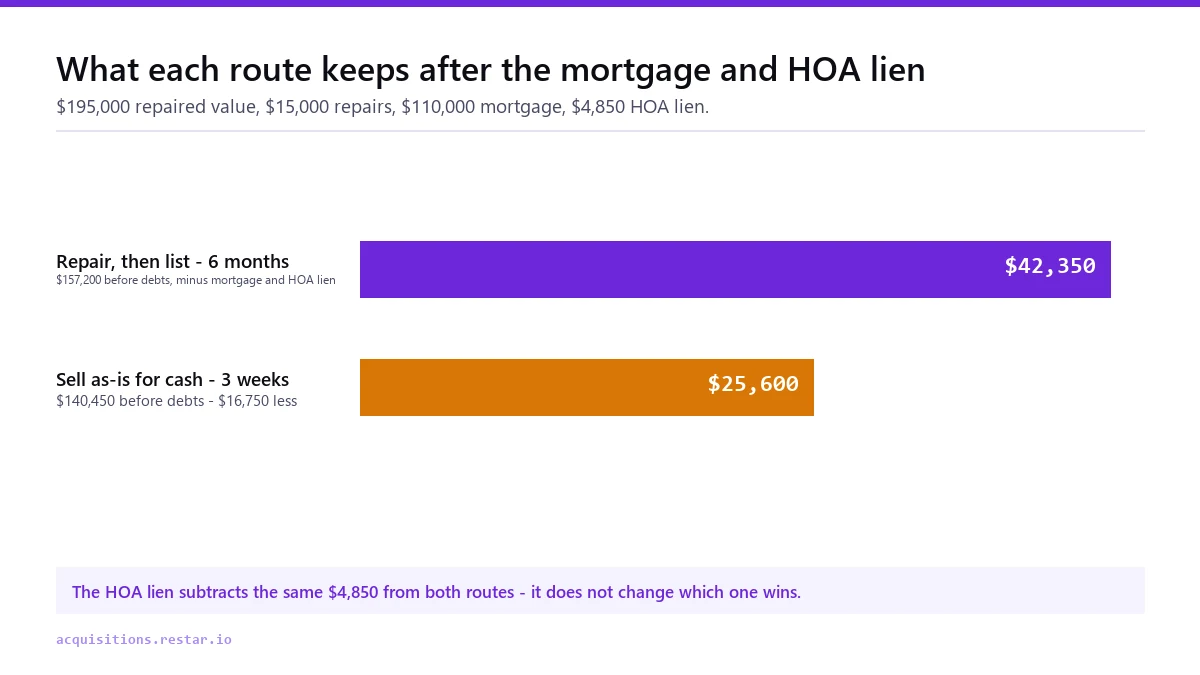
| You keep | $42,350 | $25,600 |
The cash figure is built the same way as how cash home buyers calculate offers: $195,000 after-repair value, less $15,000 of repairs, less $22,050 of resale and holding costs — resale commission $10,725, resale closing $2,925, purchase closing $1,200 and six months' carry at $1,200, $7,200 — less $16,600 of margin.
A worked illustration on one hypothetical property. Not a quote, not a prediction about your house.
Listing wins by $16,750 in this example, and the HOA lien itself is not why — it subtracts the identical $4,850 from both routes and changes neither number relative to the other. What it does change is how much room each route has before the debt eats all the equity: this house could carry an HOA lien up to about $30,450 before the cash route nets zero, versus about $47,200 before listing does. A cash offer is lower to begin with, so a large lien reaches its floor first — the same lien-cliff mechanic explained in full in selling a house with a lien on it.
Send us the address and we will put a written cash offer in front of you within 24 hours, then order the estoppel certificate and handle the payoff at closing ourselves. We cover standard closing costs on our purchases, but the HOA debt itself — like your mortgage — comes off your proceeds either way, whether you sell to us or list with an agent.
If the lien is small relative to your equity and you have weeks to spare, paying it down yourself and listing with an agent is very often the better math — our worked example below shows exactly when that is true. Send us the property here if the timeline or the board's paperwork is the part you want off your plate.
All guides · Selling a house with a lien on it · Seller closing costs · How cash home buyers calculate offers
Step 1 of 5
No obligation, no fees, no repairs. We respond the same day.
You’ll talk to Trevor McAmis, Owner & Acquisitions Lead
(313) 710-6129
Takes about two minutes. Or call (313) 710-6129 — we answer.