<b>A bankruptcy discharge wipes out your personal obligation to pay most debts, but it does not automatically erase a recorded lien.</b> A mortgage, judgment, IRS tax lien, or HOA lien can still sit on your property's title after discharge, and you'll generally need to pay it off, negotiate it down, or sell to a buyer who accounts for it directly in the price. Whether a lien can be removed through the bankruptcy case itself, rather than paid at closing, depends heavily on the lien type, your chapter, and your jurisdiction — it is not automatic.

Step 1 of 5
Tell us about the property and we'll send a written cash offer within 24 hours that accounts for the lien directly, no repairs, no commissions, and you pick the closing date.
You’ll talk to Trevor McAmis, Owner & Acquisitions Lead
(313) 710-6129
Takes about two minutes. Or call (313) 710-6129 — we answer.
Educational only. This explains how these situations generally work. It is not legal, tax or financial advice, and the rules differ by state — talk to an attorney or CPA about your own situation before you act on any of it.
No, not by itself. A discharge under the Bankruptcy Code releases you from personal liability for the debts it covers, meaning a creditor can no longer sue you, garnish you, or call you to collect. But discharge is a remedy aimed at your personal liability, not at property rights a creditor already recorded against your house before the case. The U.S. Courts' own explanation of Chapter 7 is direct about this: a bankruptcy discharge “does not extinguish a lien on property,” and secured creditors “may retain some rights to seize property securing an underlying debt even after a discharge is granted.”
That's why a title search run after your discharge will usually still show the lien recorded against the house, exactly as if the bankruptcy had never happened. The underlying debt and the lien are legally two different things: discharge kills your personal obligation to pay, but it takes a separate, specific legal step — a payoff, a negotiated release, or a court-approved lien avoidance — to clear the lien itself off the title.
A lien survives discharge because bankruptcy law treats “in rem” rights (rights attached to specific property) differently from “in personam” rights (rights to collect from you personally). The discharge injunction stops personal collection, but it does not, on its own, void a validly recorded security interest or judgment lien that attached to your property before the case.
There is a narrower tool that can remove certain liens, but it has to be used affirmatively, inside the bankruptcy case, and it doesn't apply to every lien. Under 11 U.S.C. § 522(f), a debtor can move to avoid certain judicial liens (and some non-purchase-money security interests in household goods and tools) to the extent the lien impairs an exemption you're entitled to claim on the property. Some Chapter 13 cases have also allowed debtors to strip wholly unsecured junior liens, such as a second mortgage with zero equity behind it, through the plan itself. Neither of these is automatic, neither is guaranteed to apply to your lien, and both vary significantly by bankruptcy court and federal circuit — some circuits read Chapter 7 lien-stripping much more narrowly than Chapter 13 plan treatment. If a § 522(f) motion or a lien-stripping request was never filed during your case and the case has already closed, the lien in most circumstances is still sitting on your title today, and reopening a closed case to try is its own legal process with no guaranteed result.
A mortgage lien behaves the same way: if you discharged your personal liability on the note but never surrendered the house or had the lien avoided, the mortgage lien typically remains attached to the property, and the lender can still foreclose on the house itself even though it can no longer sue you for the balance. An IRS federal tax lien follows a similar pattern — the IRS's own Bankruptcy Tax Guide (Publication 908) confirms that a discharge does not extinguish an attached federal tax lien or invalidate a Notice of Federal Tax Lien filed before the case, and the IRS can still enforce the lien against your pre-bankruptcy property even after your personal tax debt is discharged. HOA liens for unpaid assessments generally follow the same in rem logic, though the specific priority and payoff rules vary by state and by your association's governing documents.
Here's the arithmetic, worked out on a realistic example. Say your house would sell for roughly $240,000 in good condition on the retail market, and a judgment lien recorded against it — discharged as a personal debt, but still attached to the title — carries a current payoff, with accrued post-judgment interest, of $26,000.
Listing with an agent and paying the lien off at closing. The sale price has to absorb the commission, any repairs needed to compete on the retail market, the months of carrying costs while you prep and wait for a buyer, and the full lien payoff, which the closing agent or title company will require be satisfied out of proceeds before they'll issue clear title to the buyer. On $240,000: roughly $13,200 in commissions (5.5%), $10,000 in repairs to list competitively, about $3,600 in holding costs across a typical 60-to-90-day prep-and-escrow window, and the $26,000 lien payoff. That nets you around $187,200, but only after several months and only if the lien is paid in full, or a negotiated reduced amount is accepted, at the closing table.
Selling as-is to a buyer who accounts for the lien directly. A direct cash buyer who isn't relying on a lender doesn't need the retail polish, and the lien payoff gets built into the offer number itself rather than stacked on top of a retail price. On the same property, an as-is cash offer might land around $165,000, closing in 1 to 3 weeks with no repair costs, no commission, and the lien payoff handled directly from proceeds at the closing table alongside everything else.
| Retail listing (agent) | Cash sale (as-is) | |
|---|---|---|
| Sale/offer price | $240,000 | $165,000 |
| Agent commission (~5.5%) | −$13,200 | $0 |
| Repairs to list competitively | −$10,000 | $0 |
| Holding costs (prep + escrow) | −$3,600 | Minimal |
| Lien payoff at closing | −$26,000 | Already reflected in offer |
| Net to seller | ~$187,200 | ~$165,000 |
| Typical timeline | 3–6 months | 1–3 weeks |
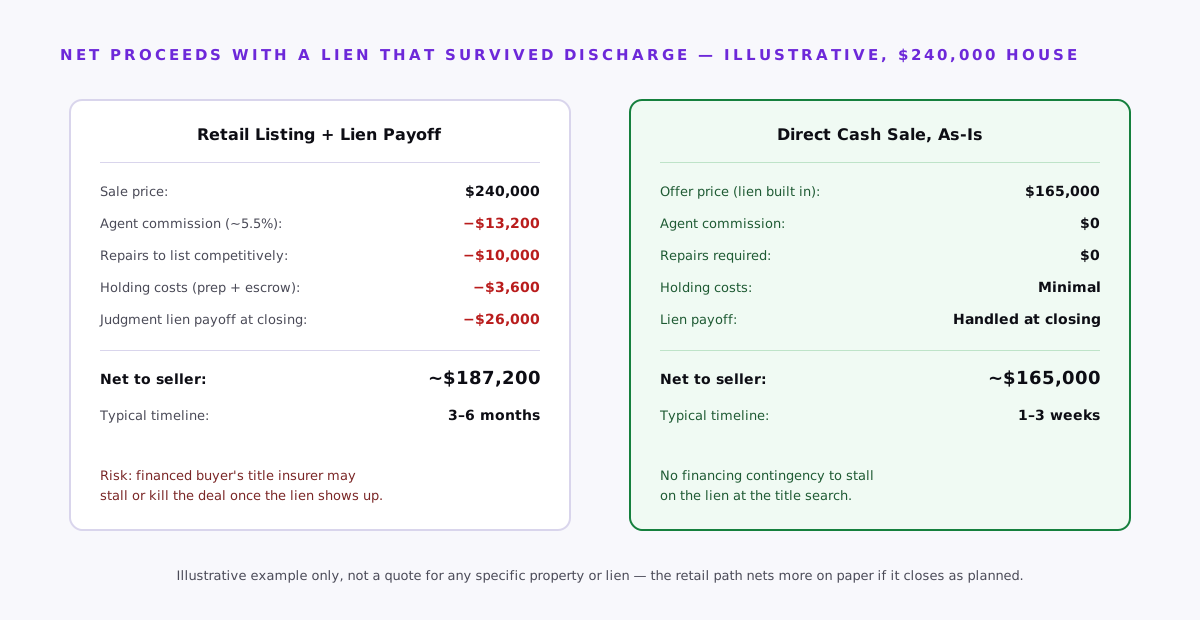
The retail path nets more money on paper if it works — that's the honest comparison, and we're not going to pretend otherwise. What it costs you is time, repair cash up front, and the risk that a buyer's lender balks once the title search turns up the lien, since financed buyers' title insurers generally want it cleared or escrowed before closing, which can stall or kill a financed deal. The cash path trades some of that dollar amount for speed and certainty, with the lien handled as part of the transaction instead of a separate scramble before it.
You generally have four paths, and they aren't mutually exclusive — it's reasonable to pursue more than one at the same time.
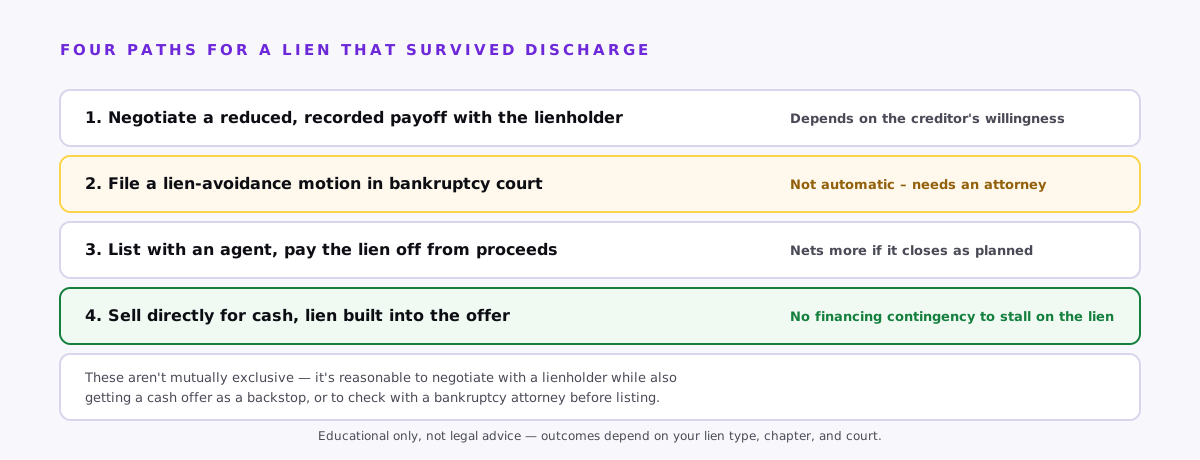
Negotiate directly with the lienholder or judgment creditor. Many judgment creditors and even some mortgage servicers will accept less than the full recorded payoff, especially on an older judgment with accrued interest or a junior lien with weak collateral behind it. Get any reduced-payoff agreement in writing and recorded as a satisfaction or release before closing — a verbal agreement to work something out does not clear title.
Go back to bankruptcy court for a lien-avoidance motion, if the facts might support one. If the lien was never addressed during your case, it may be possible to reopen it and move to avoid a judicial lien under 11 U.S.C. § 522(f), or to pursue junior-lien stripping if you were in a Chapter 13 and the lien was wholly unsecured. This does not apply to every lien (it generally does not reach a first-position purchase-money mortgage, for instance), the standards differ sharply between Chapter 7 and Chapter 13 and from one federal circuit to another, and reopening a closed case has its own cost and uncertainty. This is not something to attempt without a bankruptcy attorney evaluating your specific lien, chapter, and court.
List with an agent and pay the lien off from sale proceeds. This is the traditional route covered in the retail column above: it typically nets more if the sale closes, but it requires the home to show well, a cooperative buyer and lender, and a title company willing to close once the payoff is satisfied.
Sell to a direct cash buyer who accounts for the lien in the offer. Skips the financing contingency that a recorded lien tends to complicate, and the payoff is handled at closing as part of the transaction rather than as a separate hurdle before you can even list.
This is educational only — talk to a bankruptcy attorney about your situation before relying on any of this to decide how to handle a specific lien. The right move depends on the lien's type and position, your bankruptcy chapter, your district's case law, and whether the lien was ever addressed during your case.
If your bankruptcy case is still open and you're trying to sell before it's resolved, that's a different situation than this one — see our guides on selling a house during bankruptcy, selling a house with a judgment lien, and selling a house with an IRS tax lien for the mechanics specific to each.
A direct cash offer accounts for a recorded lien in the number itself, so you're not stuck choosing between a payoff negotiation, a trip back to bankruptcy court, or listing and hoping a buyer's lender tolerates the title exception.
You'll get a written offer within 24 hours, no repairs or commissions required, and you pick the closing date. We're a direct buyer, not an attorney, agent, or broker, and nothing here is legal advice — talk to a bankruptcy attorney about your specific lien and case.
All guides · Selling a house during bankruptcy · Selling a house with a judgment lien · Selling a house with an IRS tax lien
Step 1 of 5
No obligation, no fees, no repairs. We respond the same day.
You’ll talk to Trevor McAmis, Owner & Acquisitions Lead
(313) 710-6129
Takes about two minutes. Or call (313) 710-6129 — we answer.