Every market page publishes the numbers behind its offer. See the math
Home › Guides › Selling a House During Bankruptcy: What the Trustee Controls
Guide
Selling a House During Bankruptcy: What the Trustee Controls
Selling a house during bankruptcy is not automatically off the table, and it is not automatically allowed either. What actually happens depends on which chapter you filed, how much equity is in the property relative to your state or federal exemption, and whether the trustee assigned to your case decides the house is worth pursuing at all. Most of what gets said about selling a house during bankruptcy online is either too scary or too reassuring, because the honest answer is entirely case-specific.
Takes about two minutes. Or call
(313) 710-6129 — we answer.
Educational only. This explains how these situations generally work. It is not legal, tax or financial advice, and the rules differ by state — talk to an attorney or CPA about your own situation before you act on any of it.
Selling a house during bankruptcy: the short answer
You generally cannot close on a home sale during an open Chapter 7 or Chapter 13 case without the trustee's written consent or a court order, since the house becomes property of the bankruptcy estate the moment you file. Once the trustee abandons the property or the case discharges, you are free to sell.
This is educational information, not legal advice. Bankruptcy law is federal, but exemption amounts and procedure vary by state and by district — talk to a bankruptcy attorney before listing, signing a purchase agreement, or accepting any offer while a case is open.
What the automatic stay actually stops
The moment you file a bankruptcy petition, the automatic stay under 11 U.S.C. § 362 takes effect immediately, without a judge signing anything. It halts foreclosure sales already scheduled, collection calls, wage garnishment, and most lawsuits against you. This is the single biggest reason people file: a foreclosure auction set for next week is stopped the moment the petition is filed.
What the automatic stay does not do is hand you back control of the house. Under Section 362, your home becomes property of the bankruptcy estate the instant you file, and the estate is administered by a trustee — a court-appointed official whose job is to account for your assets on behalf of your creditors. Selling estate property without permission, even a house that is unambiguously yours, is not something the stay authorizes you to do.
Chapter 7: the equity math that decides whether the trustee sells, abandons, or ignores your house
In a Chapter 7 case, the trustee's interest in your house comes down to one comparison: your equity against your exemption. Every state lets a filer protect a certain amount of home equity from creditors, either through its own state homestead exemption or, in states that allow it, the federal exemption under 11 U.S.C. § 522(d)(1), currently $31,575 for a single filer and $63,150 for a married couple filing jointly, adjusted every three years for inflation. State exemptions vary enormously — some states protect a few thousand dollars, others protect an entire home's value regardless of size.
Equity vs. exemption
What usually happens
Equity is below the exemption
Trustee has no financial reason to sell. Property is typically abandoned back to you.
Equity exceeds the exemption, but only slightly
Sale costs and the trustee's own commission often consume most of the nonexempt slice — frequently abandoned anyway.
Equity clearly exceeds the exemption
Trustee may file a motion to sell under 11 U.S.C. § 363 to convert the nonexempt equity into cash for creditors.
Here is why marginal cases usually get abandoned rather than sold. Take a house worth $170,000 as-is, with a $120,000 mortgage balance — $50,000 of equity on paper. A forced sale still costs money: a realistic 7.5% for a real estate commission and closing costs on a $170,000 sale is $12,750, leaving $37,250 for the estate after the mortgage and sale costs. Subtract the $31,575 federal exemption and only $5,675 is left over for unsecured creditors. But the trustee is also entitled to a statutory commission under 11 U.S.C. § 326(a) — 25% of the first $5,000 disbursed ($1,250) and 10% of the next bracket ($67.50) — which on that $5,675 works out to roughly $1,318, leaving around $4,358 for creditors after the trustee is paid. Many trustees look at that math, weigh it against the time and liability of managing a real estate sale, and file a notice of abandonment instead.
Chapter 13: you likely keep the house, but selling it still needs the court's sign-off
Chapter 13 works differently. You keep your property and repay creditors, in whole or in part, over a three-to-five-year plan — there is no trustee liquidating your assets in the background. But the house is still property of the estate for the life of the case, so selling it mid-plan requires a motion to the bankruptcy court, not just your own decision. Courts approve these routinely when the sale pays creditors what the plan promised and there is a legitimate reason (relocation for work, a house that no longer fits the household, an unaffordable payment) — but routine approval is not the same as no approval.
A Chapter 13 sale motion typically needs to show the proposed sale price, how the proceeds will be distributed among the mortgage, any other liens, and the trustee, and confirmation that the transaction is arm's length. Expect this process to add real time to a closing — often several weeks for the motion, notice period, and any objection window — something to plan around if you are also racing a foreclosure sale date on a mortgage that fell behind before you filed.
Selling before you file often beats selling during the case
If you have not filed yet and you already know a house sale is coming, selling first — either on the retail market or to a cash buyer — before you file can be simpler than selling inside a bankruptcy case, because a completed sale converts the house into cash and the exemption question becomes about cash on hand rather than a home the trustee has to evaluate, market, or approve a motion for. It is not automatically the right move for every filer; a bankruptcy attorney needs to look at your full asset picture first, because converting home equity into cash can itself raise questions if it happens too close to a filing date.
Once your case has fully discharged — typically a few months after filing for a Chapter 7, or three to five years later for a completed Chapter 13 plan — the automatic stay has served its purpose and the house is yours to sell without needing anyone's permission, the same as if you had never filed.
The honest tradeoff once you are cleared to sell
Once the trustee has abandoned the property, the court has approved your motion, or your case has discharged, the sale decision is the same one every seller faces: repair and list, or sell as-is for cash. A house worth $190,000 repaired, needing roughly $12,000 of work.
Line
Repair, then list
Sell as-is for cash
Sale price
$190,000
$146,300
Repairs
−$12,000
$0
Agent commission (5.5%)
−$10,450
$0
Seller closing costs (1.5%)
−$2,850
$0 — we cover it
Buyer concessions (1%)
−$1,900
$0
Holding, 6 months at $900
−$5,400
−$675 (3 weeks)
Before any mortgage payoff
$157,400
$145,625
The cash figure follows the same four-term formula published in how cash home buyers calculate offers: $190,000 after-repair value, minus $12,000 of repairs, minus $18,700 of resale commission, resale closing costs and six months of holding, minus $13,000 of margin.
A worked illustration on one hypothetical property. Not a quote, not a prediction about your house, and not a fixed formula we apply.
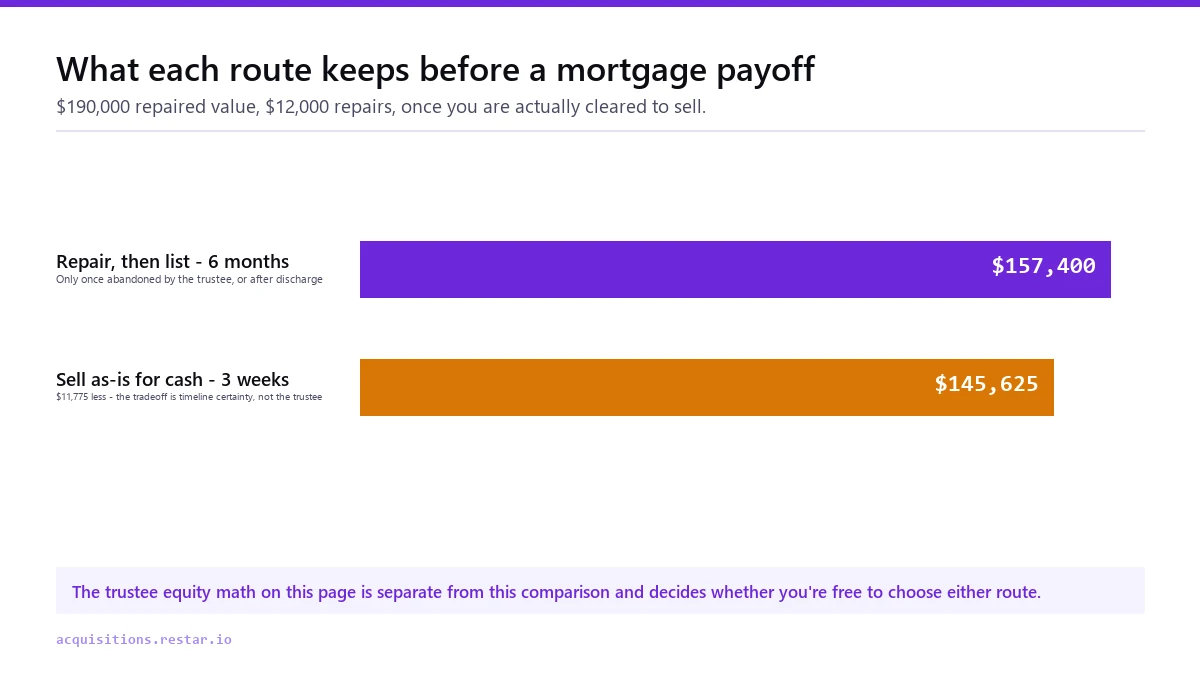
What each route keeps before a mortgage payoffRestar Acquisitions · worked example from this page
Listing wins by $11,775 in this example, once you are actually free to list. The reason many people in bankruptcy still choose a cash sale is not that it pays more — it is that a court-approved timeline, an agent's showing schedule, and financing contingencies do not always fit a case where the trustee, the court, or a looming plan deadline is watching the calendar.
Alternatives to selling, inside a bankruptcy case
Reaffirming the mortgage. In Chapter 7, you can sign a reaffirmation agreement to keep the mortgage debt outside the discharge and continue owning the home under the original loan terms.
Loan modification during the case. Many courts and trustees permit borrowers to pursue a modification with their servicer while a case is pending, particularly in Chapter 13.
Converting Chapter 7 to Chapter 13, or vice versa. If keeping the house becomes realistic with a repayment plan, or a Chapter 13 plan becomes unaffordable, converting the case is sometimes the better fit than forcing a sale.
Surrendering the property instead of selling it. If there is no equity to protect, some filers simply surrender the house in the bankruptcy rather than manage a sale at all, letting the mortgage lender foreclose after the stay lifts as to that property.
A bankruptcy attorney, not a real estate company, is the right person to weigh these against each other — each has different consequences for your credit, your other debts, and how much of the home's value you keep.
What to watch for
Selling a house during bankruptcy safely comes down to confirming your case status in writing before you do anything else.
Do not sign a purchase agreement before confirming your case status. A sale agreed to without trustee or court authority can be unwound, costing everyone time and the buyer's trust.
Get abandonment or discharge confirmed in writing before listing or accepting an offer — a docket entry from the bankruptcy court, not a verbal assurance.
Be wary of buyers who push you to sign quickly and skip the bankruptcy question entirely. A legitimate buyer, cash or retail, will ask about your case status before writing an offer, not after.
If you have real equity, get a second opinion on listing versus a fast cash sale once you are cleared — the gap in this page's example, $11,775, is exactly the kind of money worth a conversation with your attorney before you decide.
Common questions
Can I sell my house while my Chapter 7 bankruptcy is still open?
Not without the trustee's permission. Your house becomes property of the bankruptcy estate the moment you file, so a sale during an open case generally requires the trustee's written consent or a court order. Once the trustee abandons the property or your case discharges, you can sell freely.
Can I sell my house during a Chapter 13 bankruptcy?
Usually, but only with court approval through a motion to sell — you keep the house during a Chapter 13 case, but it remains part of the bankruptcy estate for the life of the plan. Courts routinely approve sales that pay creditors what the plan promised, though the motion and notice period add real time to closing.
What happens to home equity in a Chapter 7 bankruptcy?
The trustee compares your equity to your state or federal homestead exemption. If equity is below the exemption, the trustee typically abandons the property back to you. If equity clearly exceeds the exemption, the trustee may sell the house to convert the nonexempt portion into cash for creditors — though thin nonexempt equity is often abandoned anyway once sale costs and the trustee's own commission are factored in.
What is the federal homestead exemption in bankruptcy?
Under 11 U.S.C. § 522(d)(1), the federal homestead exemption is currently $31,575 for a single filer and $63,150 for a married couple filing jointly, adjusted every three years. Many states require or allow their own, often larger, homestead exemption instead — which one applies depends on your state.
Does filing bankruptcy stop a foreclosure sale?
Yes, immediately. The automatic stay under 11 U.S.C. § 362 takes effect the moment a bankruptcy petition is filed, halting a scheduled foreclosure sale, collection calls and most lawsuits against you without a judge needing to sign anything first.
Is it better to sell my house before or after filing bankruptcy?
It depends on your full financial picture, which is why a bankruptcy attorney should review it before you decide. Selling before filing converts home equity into cash and avoids the trustee approval process entirely, but converting equity to cash too close to a filing date can itself raise questions in the case.
We can work within a bankruptcy case, not around it
If a trustee has abandoned the property, your case has discharged, or your Chapter 13 plan calls for a sale, we can move on the timeline that requires — without asking you to list, show the house, or wait on financing. Send us the property here and we will tell you plainly whether a cash sale is the better math for your situation, or whether it is not.
If you have real equity in the house, talk to your bankruptcy attorney before signing anything. In many cases — ours included — listing with an agent once the trustee has cleared the way puts more money in your pocket than any as-is cash sale, and we would rather tell you that than let you find out later.
Every offer on this site is underwritten by a person, not a form. If the
numbers do not work for you, say so and I will tell you what would.
Also from Restar
Want the data behind all of this?
Restar Acquisitions is the acquisitions arm of Restar — a housing-market analytics
platform tracking 180+ metrics across every U.S. market, with composite scores and 12-month
price forecasts. The numbers on this page come from the same work.