Every market page publishes the numbers behind its offer. See the math
Home › Guides › Selling a House With a Judgment Lien
Guide
Selling a House With a Judgment Lien
Selling a house with a judgment lien is usually possible — the lien is typically paid out of your sale proceeds at closing, like a mortgage payoff, once it's confirmed valid. The bigger wrinkle: a few states, including Texas and Florida, have homestead protections strong enough to block the judgment from attaching to your house at all. A judgment lien has a different feel than a mortgage or a tax bill — it didn't come from anything you signed, it came from a lawsuit, and now there's a stranger's name attached to your house's title. That's disorienting, especially if the judgment is old, disputed, or for an amount that seems disconnected from anything you remember owing. This guide focuses specifically on what makes a judgment lien different from other liens: how a court judgment actually converts into a lien on real estate, why homestead protection matters so much here, how long these liens last, what it takes to clear one once it's paid, and what happens if the amount is disputed.
Takes about two minutes. Or call
(313) 710-6129 — we answer.
Educational only. This explains how these situations generally work. It is not legal, tax or financial advice, and the rules differ by state — talk to an attorney or CPA about your own situation before you act on any of it.
How Selling a House With a Judgment Lien Actually Works
A mortgage attaches to your house automatically the day you sign it, because you agreed to pledge the property as collateral. A judgment lien works differently, and understanding that difference matters because it's also why homestead law can block it entirely in some states.
A money judgment — the result of a lawsuit over an unpaid debt, a contract dispute, an injury claim, or similar — starts out as a personal debt against you, not a claim on any specific property. It only becomes a lien on your house once the creditor takes an additional legal step: recording (sometimes called “docketing”) a certified abstract of the judgment with the county where your property sits. Cornell Law School's Legal Information Institute describes a judgment lien as one that attaches to a debtor's real property once that abstract is filed and indexed in the county records (Cornell LII: Judgment Lien). Until that filing happens, the judgment is just a court record against you personally — it isn't yet a cloud on your specific house's title. Once it's recorded, it generally attaches to real estate you own in that county, and, depending on the state, potentially to property you acquire there later, for as long as the lien stays valid.
For a broader survey of how mortgages, tax liens, mechanic's liens, and HOA liens all stack up against each other at closing, see our general guide on selling a house with a lien on it — this article goes deeper on judgment liens specifically.
Homestead Exemption: The Biggest Wrinkle in Judgment Lien Cases
This is the single most important thing that makes judgment liens different from a mortgage or a mechanic's lien, and it's also the thing that varies the most by state.
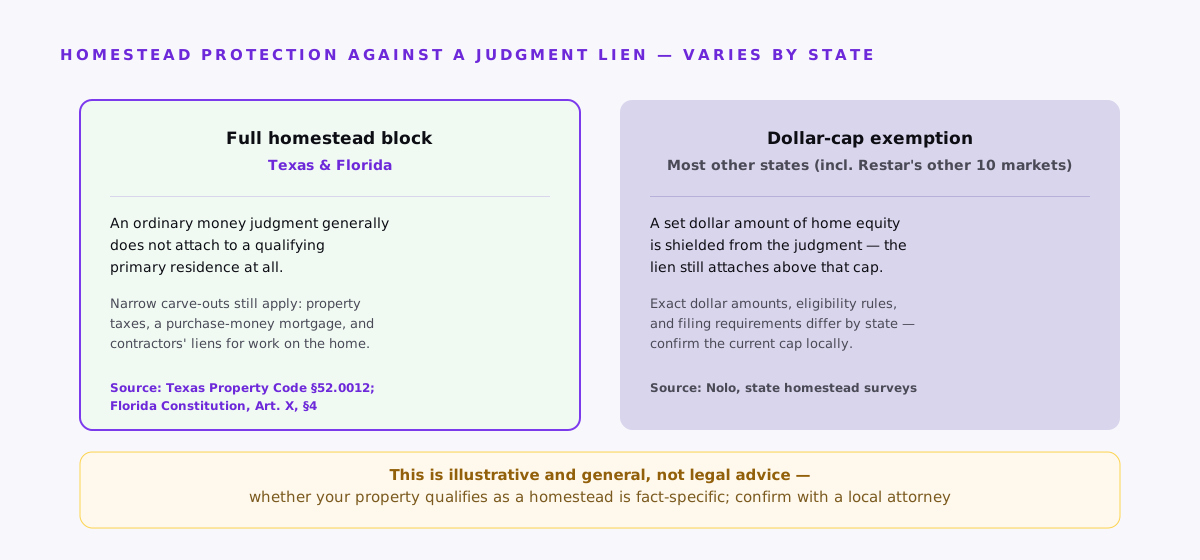
Homestead protection against a judgment lien varies enormously by stateRestar Acquisitions · sourced from Texas Property Code §52.0012 and Florida Constitution Art. X §4
In most states, a homestead exemption protects some amount of the equity in your primary residence from general creditors, but that protection is usually a dollar cap — a specific amount of equity shielded, with a judgment lien still attaching to the property for anything above it (Nolo: Can a Judgment Lien Force the Sale of My Home?). Texas and Florida are unusual, and Restar operates in both, so it's worth naming specifically. Texas Property Code §52.0012 provides that a judgment lien “does not attach to, and does not constitute a lien on” a judgment debtor's homestead property (Texas Property Code, Chapter 52). Florida's protection is written directly into its constitution: homestead property is “exempt from forced sale under process of any court, and no judgment, decree or execution shall be a lien thereon,” with narrow carve-outs for property taxes, a purchase-money mortgage, and contractors' liens for work actually done on the home (Florida Constitution, Article X, Section 4).
That doesn't make every Texas or Florida homeowner automatically safe. The exemptions above apply specifically to money judgments from ordinary debts and lawsuits — they generally don't block a mortgage, an IRS lien, a mechanic's lien for work on the home, unpaid HOA dues, or child support, and the property still has to actually qualify as your homestead under that state's rules. In Restar's other markets — Alabama, Arizona, Georgia, Indiana, Maryland, Michigan, Missouri, New York, North Carolina, and Ohio — homestead exemptions exist too, but they typically function as a capped dollar amount of protected equity rather than a full block on the lien attaching, and the specific dollar amounts and rules differ from state to state. This is genuinely one of the most fact-specific, state-specific corners of real estate law. If a judgment has been recorded against you, a local real estate or consumer-debt attorney — not this article — is the only reliable way to know whether it actually attached to your house, whether your property currently qualifies as a homestead, and what it will take to clear title.
How Long Does a Judgment Lien Last?
A judgment lien isn't permanent. Most states put a shelf life on how long a recorded judgment stays enforceable as a lien on real estate, after which the creditor generally has to take an affirmative step — renewing or re-recording the judgment — to keep the lien alive.
Exactly how many years that shelf life lasts, and exactly what renewal requires, varies significantly from state to state (Cornell LII: Judgment Lien), and getting it wrong in either direction is a real risk: paying off a lien that had already quietly expired, or assuming an old-looking lien is dead when the creditor actually renewed it on time. If a judgment lien turns up in your title search, don't estimate its status from how old it looks — a title company or real estate attorney can pull the actual court and county record and tell you definitively whether the lien is current, expired, or has been renewed.
Satisfaction of Judgment: Clearing the Lien When It's Paid
When the underlying debt is paid off — in full, through a negotiated settlement, or out of your sale proceeds at closing — the creditor is expected to sign a document generally called a Satisfaction of Judgment (sometimes an Acknowledgment of Satisfaction), confirming the debt is resolved.
Filing that with the court that issued the judgment is only half the job for real estate purposes. To actually clear the lien off your property's title, the satisfaction typically also needs to be recorded with the county where the original abstract of judgment was filed — the same office that made the lien public in the first place. Title and escrow companies handle this as a routine part of clearing title in a sale, so if you're closing with a judgment lien in the mix, this step is built into the process. If you've already paid off a judgment outside of a sale, it's worth double-checking that the satisfaction was actually recorded at the county level — a paid-but-unrecorded judgment can still surface as a cloud on title later, sometimes years afterward.
What Happens at Closing If the Judgment Amount Is Disputed?
Sometimes the number attached to the lien is wrong, outdated (interest may have accrued, or a partial payment isn't reflected), or the underlying judgment itself is disputed entirely — a case of mistaken identity, a debt the seller believes was already settled, or a default judgment entered without the seller's knowledge. A disputed judgment doesn't automatically kill a closing, but it does complicate it.
In practice, title and escrow companies generally won't release sale proceeds against a lien that's actively in dispute without some form of resolution first. That can mean the seller and creditor negotiate an agreed payoff figure before the closing date, it can mean escrowing the disputed amount with a neutral third party until the dispute is resolved, or it can mean the seller's attorney formally challenges the judgment's validity ahead of the sale. If you believe a judgment against you is wrong, out of date, or was entered without proper notice, get a real estate or consumer-debt attorney involved before you're under contract and racing a closing date — options for challenging a judgment tend to narrow the longer it sits on the record.
A Worked Example: Cash Offer vs. Retail Listing With a Judgment Lien Payoff
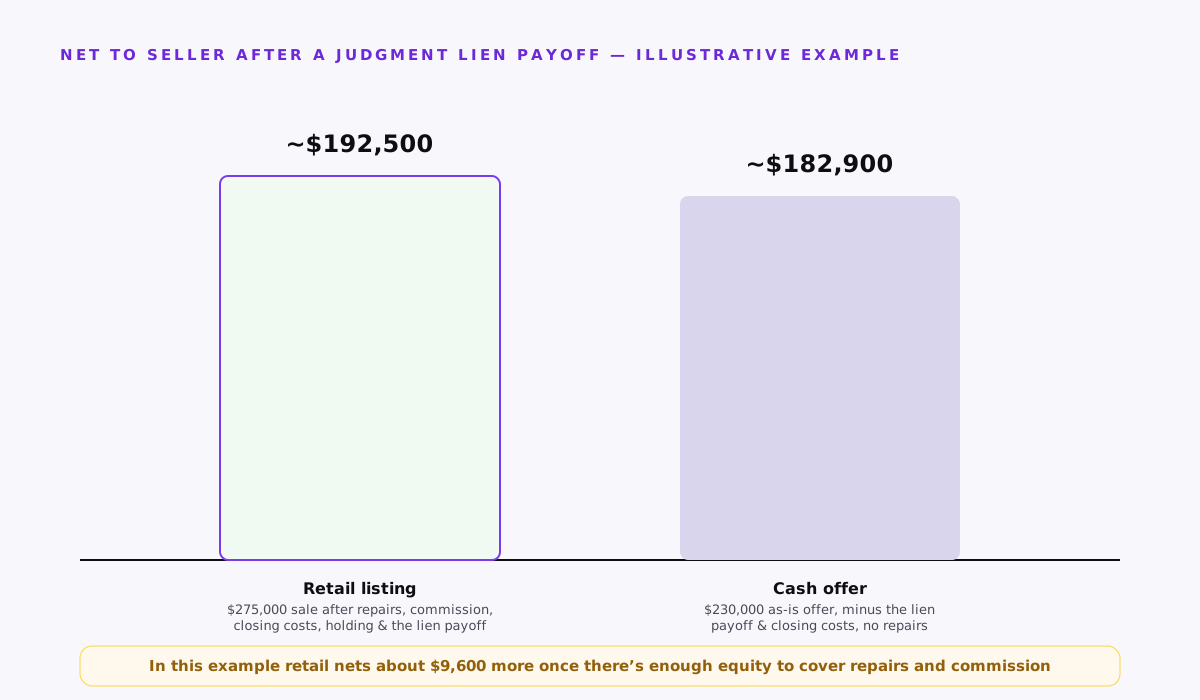
These are illustrative example figures only, not a quote for any specific property. Say a seller has a $42,500 judgment lien recorded against a house that needs about $15,000 in repairs to be competitive on the retail market.
Retail nets about $9,600 more once there is enough equity to cover repairs and commissionRestar Acquisitions · worked example from this page
Retail listing (after repairs)
Cash offer (as-is)
Estimated sale price
$275,000
$230,000
Repair costs before listing
−$15,000
$0 (sold as-is)
Agent commissions (~6%)
−$16,500
$0
Seller closing costs (~2%)
−$5,500
−$4,600
Time on market / carrying costs (est.)
−$3,000
$0
Judgment lien payoff
−$42,500
−$42,500
Estimated net to seller
$192,500
$182,900
In this illustrative example, the retail listing nets more — roughly $9,600 more — because a fully repaired, agent-marketed sale usually commands a higher price even after commissions, repairs, and carrying costs are subtracted. That's the honest tradeoff: a fast, as-is cash sale skips the repair bill and the waiting, but it typically nets less than a well-executed retail listing when there's enough equity left after the judgment lien to make listing worthwhile. If the judgment and repair costs eat most of the equity, the gap narrows — and if a Texas or Florida homestead exemption means the judgment never attached to the property at all, the math changes again. Run your own numbers before deciding — see our cash offer vs. listing net proceeds breakdown and seller closing costs guide for more on what actually comes out of a sale.
Alternatives
Selling isn't the only way to deal with a judgment lien, and it isn't always the right first move. A few real alternatives worth discussing with an attorney:
Negotiating or settling the judgment for less than face value. Older, hard-to-collect judgments are frequently negotiable — a creditor holding a judgment that's difficult to enforce may accept a lump-sum settlement below the recorded amount, especially when a closing is the only realistic path to getting paid at all.
Checking whether homestead protection applies. If your property is in Texas, Florida, or another state with meaningful homestead protection, and it genuinely qualifies as your homestead, the judgment may not be a valid lien on the house at all — worth confirming with an attorney before you assume it has to be paid at closing.
Disputing an invalid or outdated judgment. If the judgment is wrong, was entered without proper notice, or has already expired without renewal, an attorney may be able to get it corrected, vacated, or formally cleared from the record rather than paid.
Listing with a real estate agent. If there's meaningful equity left after the judgment, repairs, and selling costs, a traditional listing will generally put more cash in your pocket than a fast cash sale, as the worked example above shows — it also takes longer and asks more of your time and money upfront.
If your property has other liens stacked on it too — a mortgage, a tax lien, an HOA balance — our guide on selling a house with a lien on it covers how multiple liens get sorted out and paid in order at closing.
A Note on How We Fit In
Restar Acquisitions buys houses directly, as-is, for cash, in 45 markets across Alabama, Arizona, Florida, Georgia, Indiana, Maryland, Michigan, Missouri, New York, North Carolina, Ohio, and Texas. If your property is in one of those markets, we can typically give a written offer within 24 hours of seeing it, require no repairs, and charge no commissions — you also pick the closing date. We work directly with title and escrow on judgment lien payoffs, satisfactions, and recordings so a lien doesn't derail your closing timeline.
We are not real estate agents or brokers, and we do not represent you as a seller — we're a direct buyer, and our interests in a transaction are our own, not yours. As the worked example above shows, a cash sale usually nets less than a well-executed retail listing when there's enough equity to make repairs and a full listing worthwhile, and if a homestead exemption means the judgment isn't even a valid lien on your house, that changes your options too. If your numbers work out better with an agent — or if you don't need to sell at all — we'll say so. A fast sale isn't the right fit for everyone.
This article is for general educational purposes only and is not legal, tax, or financial advice. Judgment lien rules, homestead protections, and renewal periods vary significantly by state. Talk to a real estate attorney or consumer-debt attorney about your specific situation before making a decision.
Common questions
Can you sell a house with a judgment lien on it?
Usually, yes. If there's enough equity, the judgment lien is paid out of the sale proceeds at closing, similar to a mortgage payoff. If the property qualifies as a homestead in a state like Texas or Florida, the judgment may not have validly attached to the house at all — an attorney can confirm.
How does a judgment become a lien on my house?
A money judgment from a lawsuit starts as a personal debt, not a property claim. It becomes a lien on your specific house only when the creditor records (dockets) a certified abstract of the judgment with the county where the property is located.
Does a judgment lien attach to a homestead?
It depends heavily on the state. In Texas and Florida, strong homestead protections generally block an ordinary money judgment from attaching to a qualifying primary residence at all. In most other states, homestead protection exists but works as a dollar-amount cap rather than full protection. Confirm your state's rule with a local attorney.
How long does a judgment lien last?
It varies by state — most states set a fixed number of years before a judgment lien expires, and creditors can often renew or re-record it to extend it. A title search will show whether a specific recorded judgment is still current or has already expired.
What happens when a judgment lien is paid off?
The creditor signs a Satisfaction of Judgment, which generally needs to be filed with the court and separately recorded with the county where the original judgment was docketed. Title and escrow companies handle this as a standard step when a sale closes with a judgment lien in the payoff chain.
What if I don't agree with the amount of the judgment?
Disputed judgments don't automatically stop a closing, but title and escrow typically won't release funds against a disputed lien without a negotiated payoff, an escrow holdback, or a court resolution. Talk to an attorney before you're under contract if you believe a judgment is wrong or invalid.
Want to see your own numbers with the judgment lien factored in?
We'll give you a written offer within 24 hours and work directly with title/escrow on the judgment lien payoff and satisfaction so it doesn't hold up your closing date — and if listing nets you more, we'll say so.
Every offer on this site is underwritten by a person, not a form. If the
numbers do not work for you, say so and I will tell you what would.
Also from Restar
Want the data behind all of this?
Restar Acquisitions is the acquisitions arm of Restar — a housing-market analytics
platform tracking 180+ metrics across every U.S. market, with composite scores and 12-month
price forecasts. The numbers on this page come from the same work.