Every market page publishes the numbers behind its offer. See the math
Home › Guides › Selling a House With an IRS Tax Lien
Guide
Selling a House With an IRS Tax Lien
Selling a house with an IRS tax lien is possible in most cases — the lien attaches to the property, not just to you, so it typically gets paid out of your sale proceeds at closing, either in full or through an IRS-approved discharge. The catch is timing: start the paperwork weeks before you expect to close. An IRS tax lien on your home can feel like a dead end, especially if you're already juggling a move, a life change, or a house that needs more repairs than you can afford. It isn't a dead end — the IRS has a defined process for letting a sale go through, and title and escrow companies handle lien payoffs like this regularly, just not as often or as fast as a routine mortgage payoff. This guide walks through what a federal tax lien actually is, how it differs from a county property tax lien, what it takes to get the IRS paid at closing, what happens if the lien is bigger than your equity, and the realistic timeline you should plan around — along with an honest comparison of a cash sale against a traditional listing once the lien is subtracted from your proceeds either way.
Takes about two minutes. Or call
(313) 710-6129 — we answer.
Educational only. This explains how these situations generally work. It is not legal, tax or financial advice, and the rules differ by state — talk to an attorney or CPA about your own situation before you act on any of it.
Can I Sell My House If I Have an IRS Tax Lien?
In most cases, yes. A federal tax lien attaches to your property, but it doesn't stop you from selling it — when there's enough equity, the IRS is paid out of the sale proceeds at closing, the same way a mortgage payoff works, so the deed can transfer clear.
The IRS's own guidance confirms this: when there's equity, “the tax lien is paid (in part or in whole depending on the equity) out of the sales proceeds at the time of closing” (IRS: What if there is a federal tax lien on my home?). The transaction just has an extra party — the IRS — that needs to be paid or formally released before the deed can transfer clear.
What's the Difference Between an IRS Tax Lien and a Property Tax Lien?
An IRS tax lien and a county property tax lien are not the same problem, even though both show up as a cloud on title. A federal tax lien (formally a Notice of Federal Tax Lien, or NFTL) is filed by the IRS for unpaid federal income tax debt and attaches to “all of your assets (such as property, securities, vehicles) and to future assets acquired during the duration of the lien,” according to the IRS (Understanding a Federal Tax Lien).
A county or state property tax lien, by contrast, comes from unpaid local property taxes and follows a different legal track, including potential tax foreclosure through the county, not the IRS. The IRS doesn't run a foreclosure auction on your house the way a county does; if it isn't paid, its main enforcement tool is a levy, which is a separate and later step. If your issue is actually back property taxes owed to your county, see our guides on selling a house with delinquent property taxes or selling a house facing tax foreclosure instead — this article is specifically about the federal IRS lien.
How Does the IRS Get Paid When You Sell a House With a Lien?
The IRS gets paid through the title or escrow company at closing, the same escrow process used to pay off a mortgage, using either a straight payoff or a formal Certificate of Discharge. If your equity covers the lien, escrow simply cuts the IRS a check from the sale proceeds.
If the sale price is less than what's owed, the seller (or a title company on their behalf) applies for a Certificate of Discharge of Property from Federal Tax Lien using Form 14135, which removes the lien from that specific property so the sale can close, even though the underlying tax debt may still exist against the seller personally (IRS Publication 783). This is a real, published IRS process, not a workaround.
How Long Does an IRS Lien Payoff Take at Closing?
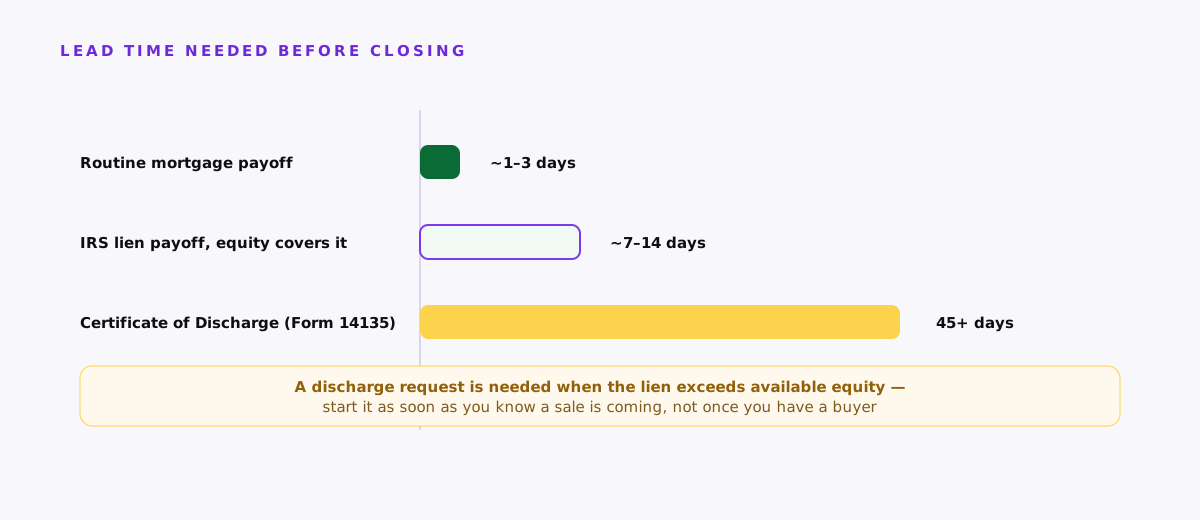
An IRS lien payoff takes significantly longer than a typical mortgage payoff, so it needs to start well before your target closing date. The IRS's own instructions for the discharge application are explicit: “Please submit your application at least 45 days before the transaction date that the certificate of discharge is needed” to allow time for review, determination, and notification (IRS Publication 783). In practice, many closing attorneys and title companies plan for 30–45 days at minimum, and sometimes longer if the IRS needs more documentation or the case is backlogged. That's the single biggest scheduling risk in a sale like this — not whether the lien can be resolved, but whether there's enough lead time before your buyer's closing date to resolve it.
A discharge request needs far more lead time than a routine mortgage payoffRestar Acquisitions · sourced from IRS Publication 783
What If the Lien Exceeds the Home's Equity?
When the lien is bigger than the equity in the house, the sale doesn't automatically fall apart — but it does take more coordination with the IRS. This is exactly the scenario the discharge process under Form 14135 and Publication 783 is designed for: the IRS can agree to release its claim on that specific property in exchange for the net proceeds available, even if that's less than the full lien balance, because the alternative — a stalled sale generating nothing — doesn't help either side. A separate, longer-term option — settling the underlying tax debt itself for less than what's owed through an Offer in Compromise — exists, but it's a distinct process from a property sale, generally takes much longer to resolve, and isn't something to count on as a quick fix for a pending closing.
A Worked Example: Cash Offer vs. Retail Listing With a Lien Payoff
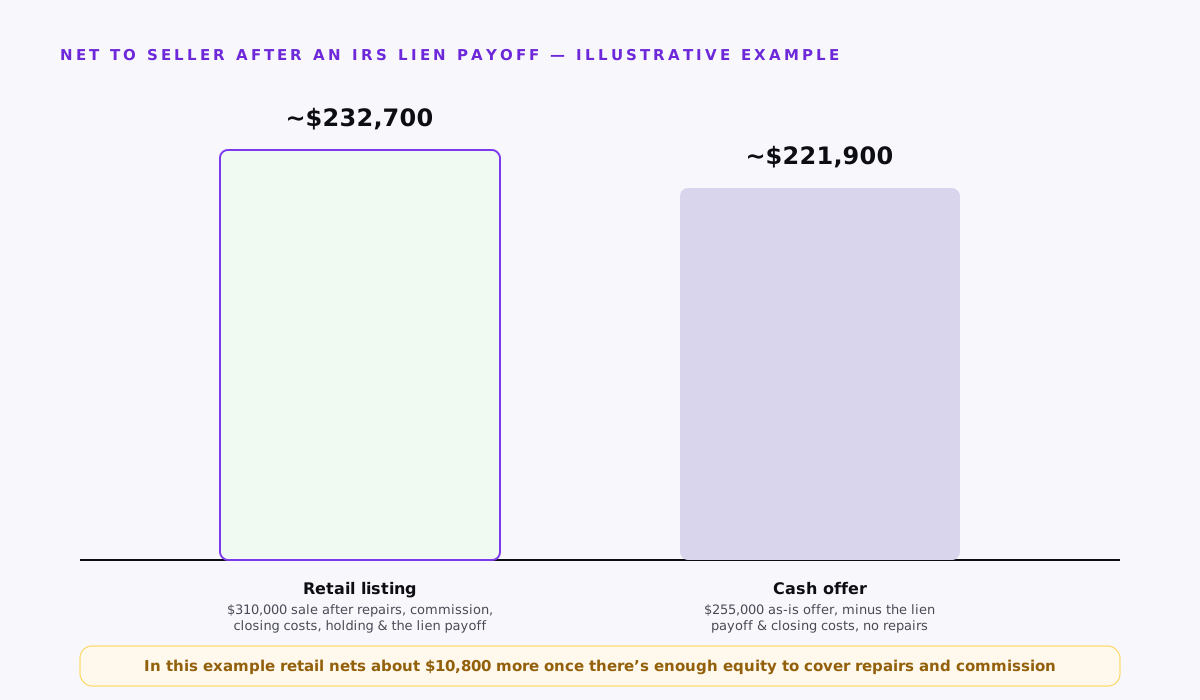
These are illustrative example figures only, not a quote for any specific property. Say a seller owes $28,000 on a federal tax lien and is weighing a retail listing against a cash offer on a home that needs about $20,000 in repairs to be market-ready.
Retail nets about $10,800 more once there's enough equity to cover repairs and commissionRestar Acquisitions · worked example from this page
Retail listing (after repairs)
Cash offer (as-is)
Estimated sale price
$310,000
$255,000
Repair costs before listing
−$20,000
$0 (sold as-is)
Agent commissions (~6%)
−$18,600
$0
Seller closing costs (~2%)
−$6,200
−$5,100
Time on market / carrying costs (est.)
−$4,500
$0
IRS lien payoff
−$28,000
−$28,000
Estimated net to seller
$232,700
$221,900
In this illustrative example, the retail listing nets more — roughly $10,800 more — because a fully repaired, agent-marketed sale usually commands a higher price even after commissions and repair costs. That's the honest tradeoff: a fast, as-is cash sale is convenient and doesn't require fronting repair money, but it typically nets less than a well-executed retail listing when there's enough equity to make listing worthwhile. If the lien and repair costs are close to eating all the equity, the gap between the two paths narrows or can even flip. Run your own numbers before deciding — see our cash offer vs. listing net proceeds breakdown and seller closing costs guide for more on what actually comes out of a sale.
Alternatives
Selling isn't the only way to deal with a federal tax lien, and it isn't always the right first move. A few real alternatives worth discussing with a tax professional:
Lien subordination (Form 14134). If you're trying to refinance rather than sell, the IRS can agree to move its lien behind a new lender's lien instead of removing it, which can let a refinance close without paying off the tax debt first (IRS Publication 784).
IRS payment plan (installment agreement). Spreading the tax debt over monthly payments doesn't remove an existing lien, but it can stop further collection escalation while you decide your next step (IRS Payment Plans).
Negotiating directly with the IRS Advisory group. The office that processes discharge and subordination requests can sometimes work out partial-payment or phased arrangements, particularly when equity is thin.
Listing with a real estate agent. If there's meaningful equity after the lien, repairs, and selling costs, a traditional listing will generally put more cash in your pocket than a fast cash sale, as the worked example above shows — it also takes longer and requires more of your time and money upfront.
If the property has other liens stacked on it too, our guide on selling a house with a lien on it covers the general mechanics of multiple liens at closing.
A Note on How We Fit In
Restar Acquisitions buys houses directly, as-is, for cash, in 45 markets across Alabama, Arizona, Florida, Georgia, Indiana, Maryland, Michigan, Missouri, North Carolina, New York, Ohio, and Texas. If your property is in one of those markets, we can typically give a written offer within 24 hours of seeing it, require no repairs, and charge no commissions — you also pick the closing date. Because an IRS lien payoff can take 30–45+ days to process through Advisory, we work directly with title and escrow on lien payoff timing so a lien doesn't hold up your closing date.
We are not real estate agents or brokers, and we do not represent you as a seller — we're a direct buyer, and our interests in a transaction are our own, not yours. As the worked example above shows, a cash sale usually nets less than a well-executed retail listing when there's enough equity to make repairs and a full listing worthwhile. If your numbers work out better with an agent, we'll say so — a fast sale isn't the right fit for everyone, and it especially isn't necessary if you have time and equity to work with.
This article is for general educational purposes only and is not legal, tax, or financial advice. Every lien situation is different. Talk to a tax attorney, a CPA, or the IRS directly about your specific situation before making a decision.
Common questions
Can you sell a house with an IRS tax lien on it?
Yes, in most cases. If there's enough equity, the lien is paid out of the sale proceeds at closing like a mortgage payoff. If not, the IRS has a formal discharge process (Form 14135) that lets the sale proceed.
Does an IRS tax lien show up in a title search?
Yes. A Notice of Federal Tax Lien is a public record filed with the county, so it will appear in a standard title search just like a mortgage or judgment lien.
How is an IRS tax lien different from unpaid property taxes?
An IRS tax lien comes from unpaid federal income tax and is a federal matter; unpaid property taxes are owed to your county or state and can lead to a separate tax foreclosure process run locally, not by the IRS.
How long does it take to clear an IRS lien before closing?
The IRS advises submitting a discharge or payoff request at least 45 days before your closing date, and title companies often build in extra time beyond that for Advisory to review the file.
What if I owe more on the lien than the house is worth?
You can still apply for a Certificate of Discharge, which can release the lien from that specific property for the available net proceeds even if it's less than the full balance. Talk to a tax professional about whether an Offer in Compromise or a payment plan makes more sense for the remaining debt.
Will Restar pay off my IRS lien for me?
No, we don't pay off your debts. At closing, the lien payoff is handled through title/escrow out of the sale proceeds, the same way it would be in any sale, provided there's enough value in the transaction to cover it.
Want to see your own numbers with the lien factored in?
We'll give you a written offer within 24 hours and work directly with title/escrow on IRS payoff timing so the lien doesn't hold up your closing date — and if listing nets you more, we'll say so.
Every offer on this site is underwritten by a person, not a form. If the
numbers do not work for you, say so and I will tell you what would.
Also from Restar
Want the data behind all of this?
Restar Acquisitions is the acquisitions arm of Restar — a housing-market analytics
platform tracking 180+ metrics across every U.S. market, with composite scores and 12-month
price forecasts. The numbers on this page come from the same work.