<b>Cast iron drain pipe commonly lasts 50 to 100 years but often starts failing in the 50 to 60 year range, corroding from the inside out in a way you usually can't see from outside the pipe.</b> It's a different problem than the galvanized or polybutylene supply-pipe issues we've written about elsewhere — this is the waste line, not the water line, and it fails quietly until a sewer-scope camera or a backed-up drain forces the question. Selling a house with cast iron pipes mostly comes down to three things: what a repair actually costs, whether it blocks a buyer's financing, and what you're required to tell them. Here's the honest version of all three, plus the math on fixing it yourself versus selling as-is.

Step 1 of 5
Tell us what a sewer scope turned up, if you've had one, and we'll walk through the real numbers.
You’ll talk to Trevor McAmis, Owner & Acquisitions Lead
(313) 710-6129
Takes about two minutes. Or call (313) 710-6129 — we answer.
Educational only. This explains how these situations generally work. It is not legal, tax or financial advice, and the rules differ by state — talk to an attorney or CPA about your own situation before you act on any of it.
Cast iron was the standard material for drain, waste, and vent (DWV) piping in most U.S. homes built before PVC became the dominant choice in the mid-1970s, which puts it under a large share of the older housing stock in several of our Rust Belt markets — Flint, Saginaw, Lansing, Grand Rapids, and Kalamazoo in Michigan; Cleveland, Akron, Toledo, Youngstown, Canton, Dayton, and Lorain in Ohio; and older neighborhoods in Baltimore and Rochester. There's no single, verified statistic on exactly what share of pre-1975 homes still have their original cast iron DWV piping, and we're not going to invent one — but the material was standard practice long enough, and the pipe lasts long enough, that it's common to find original cast iron still in place in houses from that era.
The failure mechanism is specific to how sewage gas behaves inside the pipe. Hydrogen sulfide gas rises to the crown — the top interior surface of the pipe — where condensation and bacteria convert it into sulfuric acid, which eats through the iron from the inside out. Plumbers sometimes call the result "cast iron pipe cancer." The pipe can also develop tuberculation, a buildup of rust and mineral scale that narrows the interior and slows drainage long before the wall actually fails. Both processes are invisible from outside the pipe, which is exactly why they usually aren't found until someone runs a camera through the line or a backup forces the issue.
Lifespan figures are widely cited across plumbing-industry sources as 50 to 100 years, with real-world failures more commonly showing up in the 50 to 60 year window — sooner in acidic soil, under heavy household use, or where venting was never adequate. Those are industry-consensus figures from trenchless-plumbing contractors, not a single government or standards-body number we were able to independently verify, so treat them as a reasonable planning range rather than a guarantee for your specific pipe.
The first step for almost any suspected cast iron problem is a sewer-scope inspection: a waterproof camera on a flexible cable, fed through a cleanout or a drain, that live-streams video as it travels to the city connection or septic tank. The camera run itself typically takes 5 to 10 minutes, with the full visit under an hour, and Redfin's breakdown for home shoppers puts the typical cost at $125 to $350 — cheap insurance against finding out about a failed line after closing instead of before it.
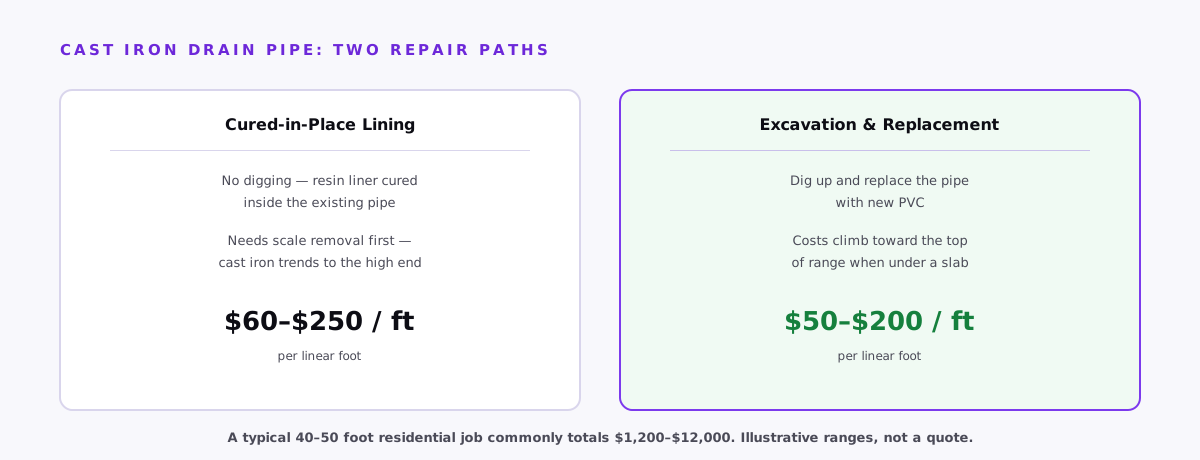
If the scope finds a problem, you generally have two repair paths. Cured-in-place pipe (CIPP) lining — a resin-saturated liner inflated inside the existing pipe, cured in place, forming a new pipe within the old one without digging — runs roughly $60 to $250 per linear foot, with cast-iron-specific jobs trending toward the higher end of that range because the heavy tuberculation common in old cast iron has to be mechanically descaled before the liner will bond, per Bob Vila's sewer-line cost guide. Full excavation and replacement runs roughly $50 to $200 per linear foot, climbing toward the top of that range under a slab, per the same source and This Old House's sewer-line replacement breakdown, which also puts cast-iron material cost alone (separate from labor) at roughly $800 to $3,600 for a 40 to 48-foot run — noticeably more than PVC, which runs a few hundred dollars for the same length.
Put together, a typical residential job (one 40 to 50-foot lateral) commonly lands somewhere between $1,200 and $12,000 depending on whether it's a lining job or a full dig, with severe or long-run cases reaching $25,000 or more. The honest range is wide because the two repair methods have genuinely different cost structures, and because "how bad is it" only becomes clear once a camera or a contractor has actually looked.
FHA and VA financing. There's no FHA or VA rule that specifically targets cast iron pipe. The FHA appraisal standard, outlined in HUD Handbook 4000.1, is functional, not material-specific — the appraiser checks that water runs, drains clear, and nothing leaks, regardless of what the pipe underneath is made of. A sewer-scope inspection isn't an FHA requirement either; where one shows up as a condition of a loan, it's an individual lender's own overlay for older homes, not a federal mandate, per a direct explainer on FHA sewer-scope rules. In plain terms: a flagged defect from a failed line can become a lender-required repair, but the pipe material itself doesn't automatically block a loan.
Disclosure. None of the states we checked have a disclosure statute written specifically around cast iron or pipe material — this falls under the general duty to disclose known material defects that exists almost everywhere. New York's Property Condition Disclosure Act (Real Property Law §462) includes a direct plumbing-system question on its statutory disclosure form. Michigan's Seller Disclosure Act form, set out in MCL 565.957, is worth knowing about for a specific reason: its pipe-type checkboxes only list "copper," "galvanized," and "other" — there's no cast iron option, so a Michigan seller would mark "other" and rely on the form's general working-order question, not a dedicated line item. Texas's standard seller disclosure form asks directly whether the seller knows of any defect or malfunction in the plumbing or sewer system, and a buyer gets a right to terminate if the notice isn't delivered before the contract is signed, per Property Code §5.008. Alabama is the outlier in our footprint: it has no mandated disclosure form at all and generally follows common-law caveat emptor, with exceptions for known health-and-safety defects and for directly misleading a buyer who asks — see a summary of Alabama's caveat emptor rule. The practical takeaway across every state we checked is the same: if you know the drain lines are old cast iron and especially if a scope has already flagged corrosion or tuberculation, treat it as a known material fact and disclose it — the safe move is the same regardless of which exact form or statute applies to you.
Worked example: a $245,000 house where a pre-listing sewer scope finds a cast iron lateral with heavy tuberculation and one section showing active corrosion — a contractor quotes $7,800 for a CIPP lining job covering the affected 40-foot run.
| Retail listing | Cash sale | |
|---|---|---|
| List / offer price | $245,000 | $221,000 |
| Sewer line lining repair | −$7,800 | $0 (sold as-is) |
| Agent commission (~5.5%) | −$13,475 | $0 |
| Seller closing costs | −$2,700 | −$1,000 |
| Carrying costs during repair and marketing (6–9 weeks) | −$1,900 | $0 |
| Net to seller | ~$219,125, in 6–9+ weeks, if the repair clears inspection | ~$220,000, in 1–2 weeks, with certainty |
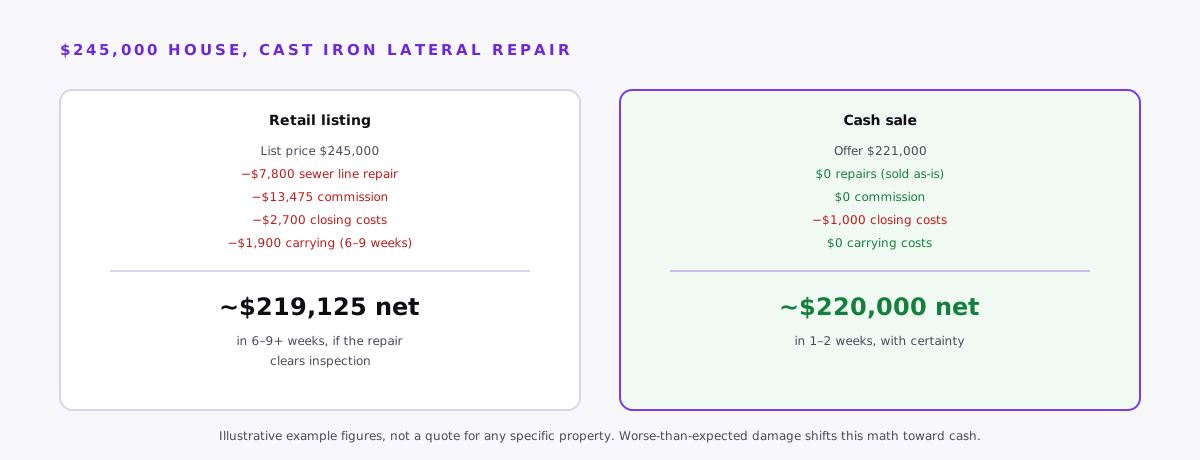
These numbers land within a few hundred dollars of each other, which is the honest result when the repair cost is already known and bounded by an actual contractor quote. The math tips toward cash when the scope wasn't done and the real damage turns out worse once a contractor digs in (common with old cast iron, since tuberculation can hide the true condition of the pipe wall underneath), when you don't have $7,800 sitting around before closing, or when the certainty of a fixed closing date matters more to you than squeezing out the last few thousand dollars. See our sewer line repair cost guide for the fuller range of what a worse-case lateral replacement can run.
Restar Acquisitions buys houses as-is for cash in 12 states, and we price in pipe condition the same way we price in any other repair item — before we give you a number, not after an inspection derails a financed deal. We give a written offer within 24 hours, no repairs or commissions, and you pick the closing date. We're a direct buyer, not your real estate agent, and we don't represent you in the transaction.
Alternatives worth checking before you decide:
This article is for general education only and isn't a quote, a legal opinion, or a substitute for a licensed plumber's inspection. Repair costs vary by region, pipe condition, and access. Disclosure rules vary by state and change over time — confirm your own state's current requirement with a real estate attorney or your state's licensing agency before you sign anything.
We factor pipe material and condition into our offer the same way we factor in any repair item — before we give you a number, not after a buyer's inspection blows up a financed deal.
You'll get a written offer within 24 hours, no repairs or commissions, and you pick the closing date.
All guides · Cost of a sewer line repair or replacement · Selling a house with galvanized or polybutylene plumbing · Cash offer vs. listing net proceeds
Step 1 of 5
No obligation, no fees, no repairs. We respond the same day.
You’ll talk to Trevor McAmis, Owner & Acquisitions Lead
(313) 710-6129
Takes about two minutes. Or call (313) 710-6129 — we answer.