USDA loan subsidy recapture is money USDA can require you to repay when you sell, transfer title, or stop living in a Section 502 Direct Loan home that carried payment assistance. The amount is the lesser of your total subsidy received or a share of the home's appreciation, calculated by your loan servicer, not a flat percentage. It's a different thing from a down payment assistance lien, an assumable mortgage, or your regular loan payoff.

Step 1 of 5
Tell us about the house and your USDA loan, and we'll give you a written cash offer within 24 hours that accounts for recapture once you've confirmed the figure with your servicer.
You’ll talk to Trevor McAmis, Owner & Acquisitions Lead
(313) 710-6129
Takes about two minutes. Your address is never shared.
Educational only. This explains how these situations generally work. It is not legal, tax or financial advice, and the rules differ by state. Talk to an attorney or CPA about your own situation before you act on any of it.
If your mortgage is a USDA Rural Development Section 502 Direct Loan, part of what made your payment affordable was a subsidy the government paid on your behalf. When you sell, that subsidy can come due.
USDA's Section 502 Direct Loan program is aimed at low- and very-low-income buyers in rural areas. To make the monthly payment affordable, USDA can reduce your effective interest rate and subsidize part of your payment over the years you hold the loan. That reduction isn't free. At closing, you signed a Subsidy Repayment Agreement (USDA Form RD 3550-12) that spells out how much of that help you'll owe back if certain things happen later.
Under 7 CFR § 3550.162, the actual federal regulation governing this, recapture applies to any Section 502 or 504 direct loan approved or assumed on or after October 1, 1979, where the borrower received payment subsidy or deferred mortgage assistance. It's separate from your loan balance. Paying off your mortgage principal does not make recapture go away.
The regulation is specific about the trigger. Recapture becomes due and payable when the borrower "transfers title or ceases to occupy the property," and that includes foreclosure or a deed in lieu of foreclosure. Three situations set it off: selling the home to anyone at any price, transferring title some other way (a gift deed or an inherited transfer where the new owner won't occupy it), or simply moving out and renting the home to someone else while keeping title.
That last point matters more than most sellers expect. Converting the house to a rental does not sidestep recapture. Occupancy, not ownership, is part of the trigger. Many homeowners assume renting is a workaround. It is not, under this rule.
There's also no fixed number of years after which the obligation disappears on its own. Down payment assistance recapture liens, like the one covered in our guide to selling with a DPA recapture lien, often forgive after a set window, 3 years, 7 years, and so on. USDA Section 502 subsidy recapture carries no such built-in expiration. It can apply whether you've had the loan for 4 years or 24, for as long as the loan still carries subsidy and you haven't yet sold, transferred title, or moved out.
This is the part worth getting exactly right, because the common assumption, that recapture is a flat percentage of the sale price, is wrong.
Per 3550.162(b), the recapture amount equals the principal reduction attributed to subsidy (this piece only applies to loans that received interest credit between October 1, 1979, and December 31, 1989, and does not apply in a foreclosure or deed in lieu), plus the lesser of: the total dollar amount of subsidy you received over the life of the loan, or a portion of the value appreciation of the property since you bought it.
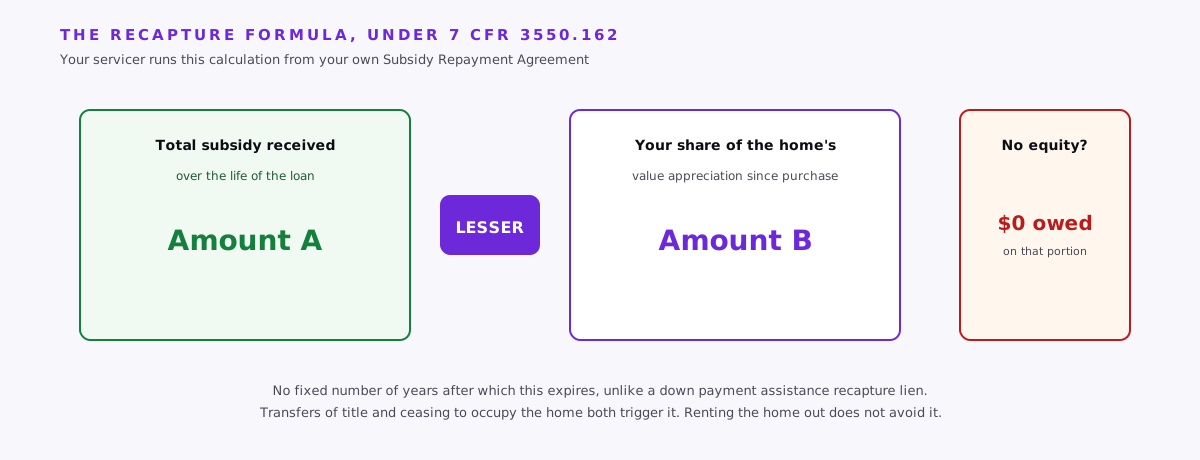
To figure out appreciation, USDA can ask you for a current appraisal or an arm's-length sales contract. Because the formula uses whichever number is smaller, your actual share of appreciation and your total subsidy received, your exact recapture number depends on your individual Subsidy Repayment Agreement, your income at the time you closed, and how your home's value has moved since then. There is no single published percentage that applies to every borrower. Your servicer runs this calculation using your own paperwork, and that is the number you should treat as real, not an estimate from a calculator or a forum post.
USDA's loan servicing center calculates your recapture figure, not your real estate agent and not a title company on its own. Once you have a sale under contract, your closing agent or title company requests a payoff statement from USDA. That statement covers two separate numbers, your remaining loan balance and your recapture amount, because they're legally distinct debts even though they get paid at the same closing table.
Ask for this number as early as you can, ideally before you set a listing price or accept an offer, not during the week of closing. If the figure surprises you, a CPA or real estate attorney can review your Subsidy Repayment Agreement with you and check the math against what the servicer is asking for before you sign anything.
The regulation builds in a real limit here, and it's the single most useful fact in this whole topic. Under 3550.162(b)(1), if there's no equity based on the recapture calculation, the amount of principal reduction attributed to subsidy is not collected. In plain terms: the formula is capped by the lesser of your subsidy received or your appreciation, so you cannot be forced to pay more recapture than your actual gain in the home supports.
There's a separate carve-out if the home goes to foreclosure or deed in lieu of foreclosure: recapture there is limited to the subsidy you received (not the principal-reduction piece), and it's collected only from the liquidation proceeds, after recoverable costs, accrued interest, and principal are already paid. It cannot turn into a personal debt chasing you after the property is gone.
If you refinance or pay the loan off in full without transferring title, and you keep living in the home, recapture can be deferred interest-free under 3550.162(c) until you eventually sell or move. That deferral does not help someone who is selling now and moving out, but it's worth knowing if staying put and refinancing turns out to be the better option for you.
Recapture gets paid at closing regardless of how you sell. What changes between a retail listing and a fast cash sale is everything around it: the price, the commission, the repair bill, and how many months pass before you see any money.
Example: A seller's Section 502 home would likely sell for $230,000 retail after agent prep and negotiation, or $192,000 as-is through a fast cash sale. The subsidy repayment agreement, confirmed with the servicer, shows total subsidy received over the years at $31,500, and since the home's appreciation share under the formula comes out higher than that, the full $31,500 is owed either way.
| Retail listing | Cash offer (as-is) | |
|---|---|---|
| Sale price | $230,000 | $192,000 |
| Agent commission (6%) | −$13,800 | $0 |
| Pre-listing repairs | −$7,500 | $0 |
| Seller concessions/closing costs (~2%) | −$4,600 | $0 |
| Holding costs | −$5,400 | −$150 |
| USDA subsidy recapture | −$31,500 | −$31,500 |
| Net to seller | $167,200 | $160,350 |
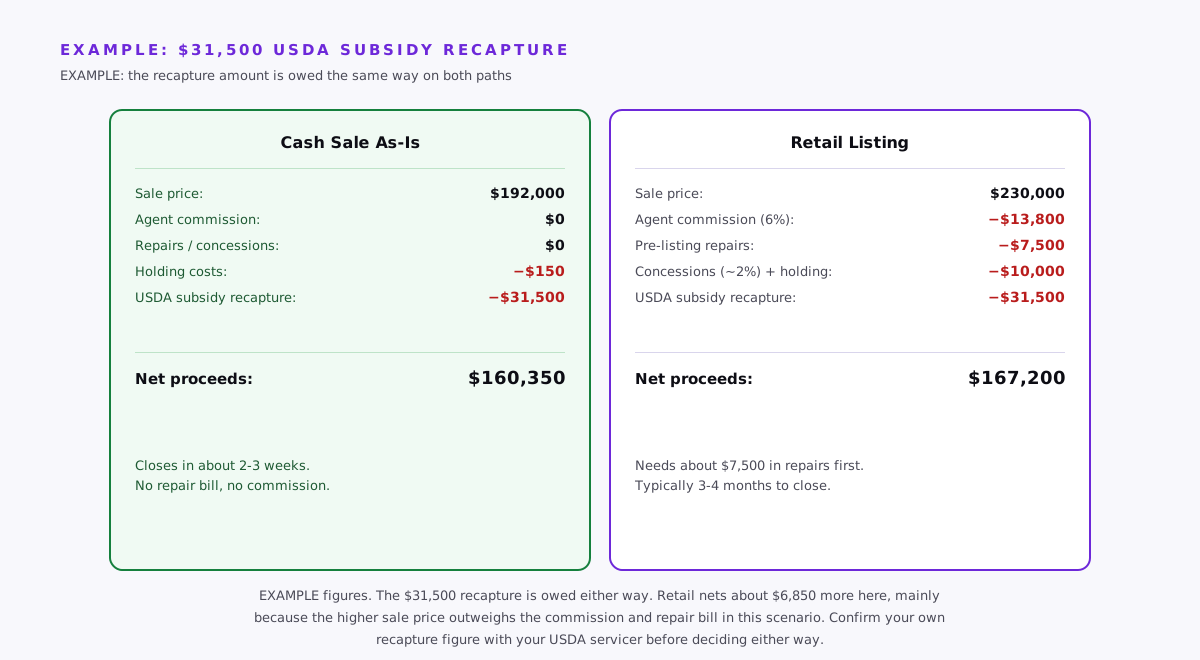
In this example, retail nets about $6,850 more. That's real money, and if you can carry four months of uncertainty, fund the repairs up front, and the local rural market supports a quick retail sale, listing is the better call on the numbers. A cash sale doesn't close that gap here, it closes it on time and certainty: a written offer in days instead of weeks of showings, no repair money due before closing, and no risk of a financed buyer's appraisal or inspection falling through midway. Run your own numbers, with your own confirmed recapture figure, before deciding either way.
List with an agent. If your home shows well and the local market is steady, retail can net more even after recapture is paid, as the example above shows.
Refinance and stay, if you don't need to move. Since recapture can be deferred interest-free under 3550.162(c) when you refinance without transferring title and keep living there, this is a real option if your reason for considering a sale is the loan terms rather than needing to relocate.
Ask the servicer about a hardship resolution. USDA's servicing rules allow compromise, adjustment, or cancellation of debts owed to the agency in limited circumstances. It costs nothing to call and ask what they can do before you assume the full number is fixed.
Renting it out is not an escape hatch. As covered above, ceasing to occupy the home is itself a recapture trigger, separate from selling or transferring title. Don't plan around renting as a way to avoid this.
Restar Acquisitions buys houses as-is across 65 markets in 14 states. We'll give you a written cash offer within 24 hours, there are no repairs and no commissions, and you pick the closing date. If your recapture figure and your numbers point to a retail listing netting you more, we'll tell you that directly.
All guides · Down payment assistance recapture liens · Selling a house in foreclosure · Seller closing costs breakdown
Step 1 of 5
No obligation, no fees, no repairs. We respond the same day.
You’ll talk to Trevor McAmis, Owner & Acquisitions Lead
(313) 710-6129
Takes about two minutes. Your address is never shared.
