If you bought your home with down payment assistance, there's a second lien on your title tied to that help, and it has to be resolved before or at closing. A down payment assistance recapture lien can mean a full payoff, a prorated payoff, or nothing at all, depending on your program's forgiveness schedule and how many years you've owned the home.
Step 1 of 5
Tell us about the property and we'll give you a written cash offer within 24 hours that accounts for the lien payoff directly, no surprises at closing.
You’ll talk to Trevor McAmis, Owner & Acquisitions Lead
(313) 710-6129
Takes about two minutes. Your address is never shared.
Educational only. This explains how these situations generally work. It is not legal, tax or financial advice, and the rules differ by state. Talk to an attorney or CPA about your own situation before you act on any of it.
When a buyer uses a state or local housing finance agency (HFA) program for down payment or closing cost help, that money usually doesn't come as a no-strings gift. It gets recorded as a second mortgage, often called a "soft second," sitting behind the first mortgage on the title. Some of these are forgivable loans that go away over time if the owner stays in the home. Others are full-recapture loans: the whole balance comes due the moment the home is sold, refinanced, or stops being the owner's primary residence.
Either way, the lien is real. A title search will find it, and a closing can't happen with an open lien unless it gets paid off, forgiven, or, less commonly, subordinated by the agency that holds it. That's the core fact every seller in this spot needs to plan around.
These programs are not standardized nationally. Each state's HFA writes its own note, so the only way to know what you're dealing with is to read your own program's terms. Here's how it breaks down, with real programs as examples.
Full-recapture loans. Florida Housing's Hometown Heroes down payment assistance is a clean example of this type. It's a 0% interest, non-amortizing second mortgage, deferred for up to 30 years, for up to 5% of the first mortgage (minimum $10,000, maximum $35,000). Florida Housing states directly that it "is not forgivable." The full balance becomes due if you sell, refinance the first mortgage, transfer the deed, or stop living there as your primary residence. Georgia's Dream Peach Advantage program works the same way: a 0% interest second mortgage that Georgia's Department of Community Affairs describes as "non-forgivable." You owe what you borrowed, whenever one of those trigger events happens.
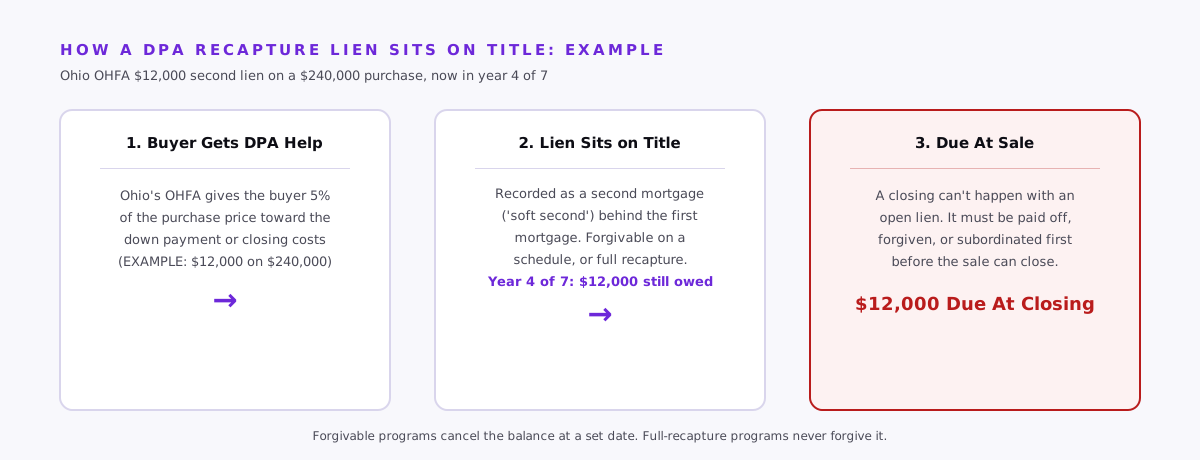
Forgivable loans on a schedule. Other programs do forgive the balance, but usually in one jump at a set date rather than gradually. Ohio's OHFA Your Choice! Down Payment Assistance gives buyers 2.5% or 5% of the purchase price as a 0% interest second mortgage. OHFA forgives it after seven years. Sell or refinance before that seven-year mark, and the agency's own language is blunt: you repay all of the assistance. Texas's TSAHC Homes for Texas Heroes program gives buyers a choice between a grant that's never repaid, or a second lien that's "completely forgiven after three years" of continued ownership and occupancy. Sell, refinance, or move out before year three, and the forgiveness cancels.
Notice what both of those forgivable examples have in common: neither prorates. There's no partial forgiveness at the halfway point. It's full forgiveness at the finish line, or full repayment if you leave early. Don't assume your program spreads forgiveness evenly across the years just because some do. Read your own note.
This is the part sellers get wrong most often: your first-mortgage servicer cannot tell you what the recapture lien balance is. That second lien is usually held or serviced by the HFA itself, or by a separate subservicer the HFA contracts with, not the bank that sends your regular mortgage statement. To get a real number, you (or your closing agent or title company) need to request a payoff statement directly from the HFA or its named subservicer. Your closing attorney or title company handling the sale can usually track this down if you give them the program name and loan number from your original closing documents.
If you can't remember which program you used, your original HUD-1 or Closing Disclosure from the purchase will list the second mortgage and who it's payable to.
Confirm your exact current payoff figure directly with the HFA or its subservicer before relying on any number here or elsewhere, and if there's a tax angle (forgiven debt, a federal mortgage credit recapture tax on certain bond-funded loans, and so on), run it past a CPA. Program terms and tax rules change, and only your lender and your accountant can give you figures specific to your loan and your return.
If your program is full-recapture (like Florida's or Georgia's examples above), the math is simple: whatever you borrowed is what you owe, minus any amount you've already voluntarily paid down, whenever you sell. There's no partial credit for time owned.
If your program is forgivable but cliff-based (like Ohio's or Texas's examples above), the math is just as simple but catches people off guard: until you hit the forgiveness date, you owe the full original balance, not a prorated slice of it. Someone who sells in year 6 of Ohio's 7-year window owes the same $12,000 as someone who sells in year 1. One more year of ownership would have erased the whole thing. That's a hard deadline, not a sliding scale, so check your own note for a specific forgiveness date before you set a closing date.
A few paths are worth thinking through before you commit to a timeline:
Wait out the forgiveness period, if that's realistic. If you're a year or two from your cliff date and staying put is workable, the lien disappears on its own and there's nothing to pay off.
Call the HFA and ask about subordination or a reduced payoff. Some agencies will subordinate a lien for an eligible refinance, and some will negotiate on a short sale or hardship basis. It's not guaranteed, but it costs nothing to ask before you list.
Consider renting instead of selling early, if the home can cash flow and the mortgage is current. This only works if you don't need the equity now and you're set up to be a landlord.
Keep this separate in your head from your regular mortgage payoff. The recapture lien is its own loan with its own servicer and its own rules. Paying off your first mortgage does not touch it.
The recapture lien itself costs the same dollar amount no matter how you sell. What changes between a retail listing and a cash sale is everything else: the price you get, the commission, the closing costs, and whether the buyer asks for repair money after inspection.
Example: a seller bought a home for $240,000 using Ohio's OHFA Your Choice! program for 5% assistance ($12,000), now in year 4 of the 7-year forgiveness window, so the full $12,000 is still owed. The first mortgage payoff balance is $176,000. The home would likely sell retail for $248,000 after negotiation, or the seller could take a cash offer of $210,000, as-is, with no agent and no repair back-and-forth.
| Line item | Retail listing | Cash offer (as-is) |
|---|---|---|
| Sale price | $248,000 | $210,000 |
| First mortgage payoff | −$176,000 | −$176,000 |
| DPA recapture lien payoff | −$12,000 | −$12,000 |
| Agent commission (6%) | −$14,880 | $0 (no agent) |
| Closing costs / title / recording | −$4,960 | −$1,500 |
| Repair credit after inspection | −$8,000 | $0 (sold as-is) |
| Net to seller | $32,160 | $20,500 |
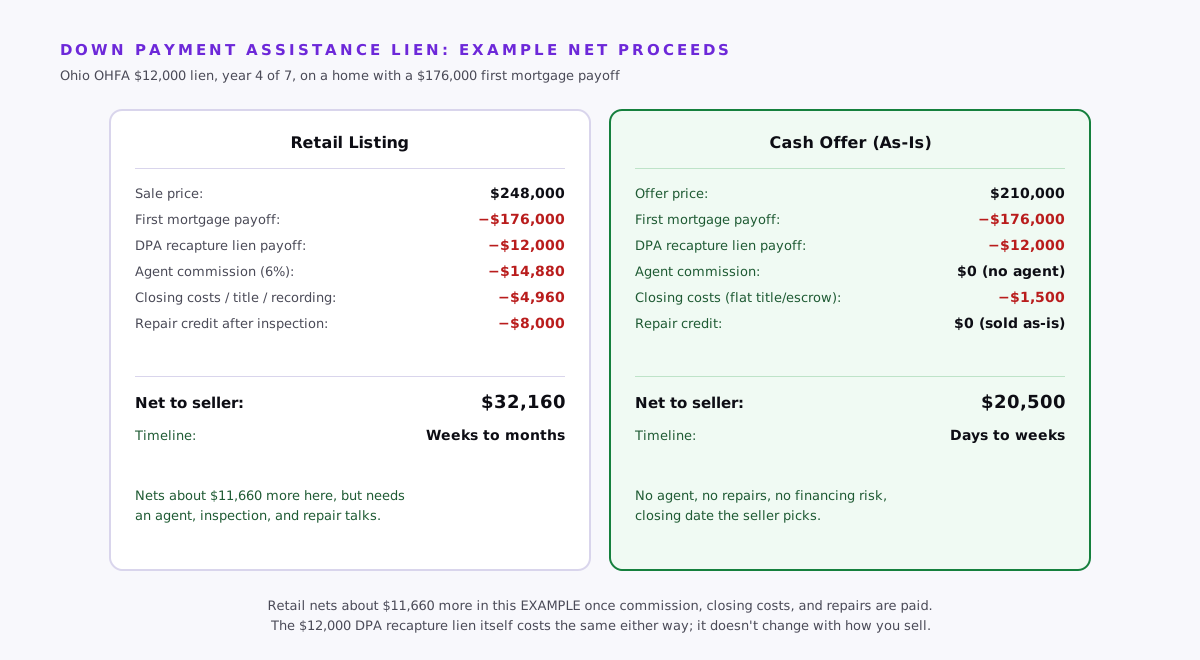
In this example, the retail listing nets about $11,660 more. If the home shows well, the market's steady, and the seller can carry both mortgages for the weeks or months a listing takes, retail can put more cash in hand after the recapture lien is paid. A cash offer wins on speed and certainty (no inspection renegotiation, no financing falling through, no commission, a closing date the seller picks), not on price. Run your own numbers with your real payoff figures before deciding; the gap narrows or flips depending on your home's condition, your market, and how close you are to a forgiveness date.
We buy houses as-is for cash, lien and all. Send the address and you'll have a written offer within 24 hours, no repairs, no commissions, and you pick the closing date. If a retail listing would net you more once the recapture balance is paid, we'll tell you that too.
All guides · How to read a mortgage payoff statement · Cash offer vs. listing: comparing net proceeds · How a cash sale works
Step 1 of 5
No obligation, no fees, no repairs. We respond the same day.
You’ll talk to Trevor McAmis, Owner & Acquisitions Lead
(313) 710-6129
Takes about two minutes. Your address is never shared.
