Selling a house with a stop-work order means selling while a building department's written halt on active construction is still in effect — usually triggered by work without a permit, work exceeding the permit's scope, or a safety issue. It must be formally rescinded, not just cleared by an inspector's nod, before most lenders will fund a purchase. A cash sale can close around it instead of waiting for that process to finish.
Step 1 of 5
Tell us what the order covers and where construction stands. We'll give you a straight answer, including when finishing the work and listing nets more.
You’ll talk to Trevor McAmis, Owner & Acquisitions Lead
(313) 710-6129
Takes about two minutes. Or call (313) 710-6129 — we answer.
Educational only. This explains how these situations generally work. It is not legal, tax or financial advice, and the rules differ by state — talk to an attorney or CPA about your own situation before you act on any of it.
A stop-work order (SWO) is a building or code department's written directive halting construction at a specific property, issued when an inspector finds work that's unpermitted, exceeds what the permit actually approved, or raises a safety concern. New York City's Department of Buildings — which publishes some of the clearest public guidance on the mechanics — issues two kinds: a full SWO, which halts everything except emergency safety work, and a partial SWO, which stops only the specific violating work or area. (NYC Department of Buildings)
Michigan — one of the states Restar buys in — handles it through a formal show-cause step most homeowners don't expect: under the state's Uniform Construction Code, enacted in 1972, a homeowner gets just 1 full working day to show cause before an enforcing agency can post a written stop-construction order. An agency that finds work violating the permit or the law first has to give written notice and let the person "appear and show cause why the construction should not be stopped." Continuing work after that — other than to fix a genuinely dangerous condition — violates the order outright, and the statute explicitly allows both a circuit-court injunction and criminal prosecution. (MCL 125.1512)
Across every jurisdiction's own published process, the triggers are consistent: construction started before a permit was pulled, work that goes beyond what was actually approved, a failed or skipped required inspection, or an unsafe condition an inspector documents on-site.
New York City publishes real numbers worth knowing even if you're not in that market, because they show how seriously a city can treat this: resuming work before an SWO is formally rescinded risks $6,000 for a first offense and $12,000 for each one after that — even if you've since pulled the correct permit. A separate civil penalty schedule applies on top of that for the underlying violation: for a one- or two-family home, the greater of six times the permit fee or $600, capped at $10,000; for other buildings, the greater of 21 times the permit fee or $6,000, capped at $15,000 — doubling for a repeat violation within a year. (NYC DOB; RCNY civil penalty schedule) Fee schedules vary significantly by city — we couldn't confirm a reliable dollar figure specific to Atlanta, Phoenix, Houston, or the other markets Restar actually buys in, so treat NYC's numbers as an illustration of how real the exposure can be, not as your market's rate card. Check with your own building department for the actual schedule that applies to you.
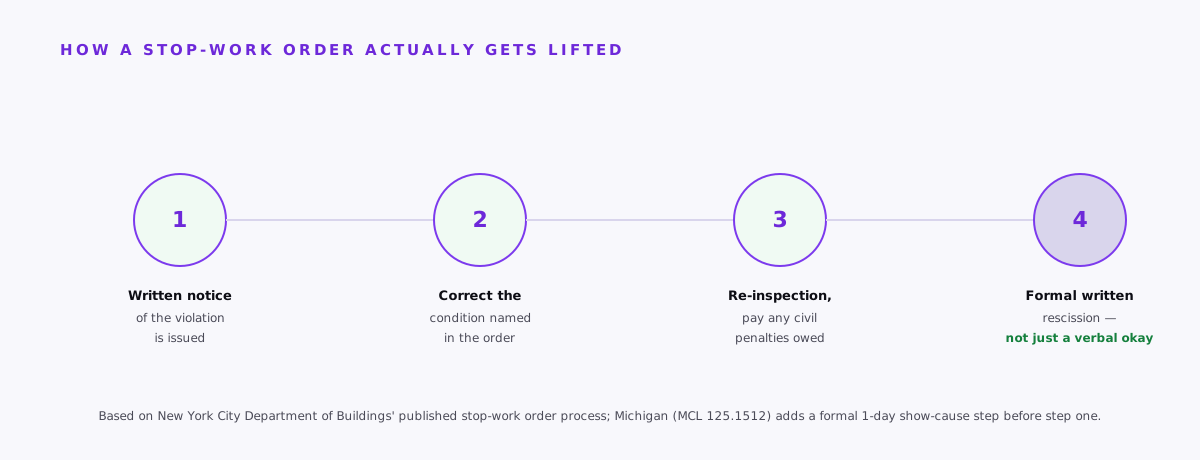
The process is the same shape almost everywhere, even where the specific forms differ: correct the condition the order named (sometimes through a corrective or after-the-fact permit, sometimes with a licensed engineer's safety sign-off), request a re-inspection, pay any civil penalties owed, and then get the issuing agency to formally rescind the order in writing. An inspector telling you verbally that it's fine is explicitly not the same thing — the order stays in effect on the public record until the agency actually records the rescission. (NYC DOB)
Palm Beach, Florida — one of Restar's operating states — shows how far this scrutiny can go for a repeat offender. In July 2025, its Town Council unanimously passed an ordinance requiring any construction team that racks up a strike under the town's "Three Strike Rule" — a building code violation, or a stop-work order — to enter a formal construction management agreement with the town: a locked-in schedule, mandatory progress updates, traffic and parking plans, and limits on when materials can even be delivered. An active SWO isn't necessarily a one-time inconvenience in every jurisdiction; some towns now treat it as the start of ongoing oversight.
A stop-work order usually isn't a recorded document, so a standard title search can miss it entirely. What actually surfaces it is a municipal lien search, which contacts the building department directly rather than relying on the county recorder's index — worth ordering specifically if you know a permit issue exists, since your title company's standard search might not catch it on its own.
If it does surface, or your buyer's lender finds out another way, Fannie Mae's own rule is unambiguous: "improvements, alterations, and repairs on the subject property must be complete when the loan is sold to Fannie Mae," verified through an appraisal update, a completion certificate, or an inspection report. There's a narrow exception for postponed improvements, under the version of Fannie Mae's Selling Guide most recently revised December 10, 2025: the remaining work must finish within 180 days, cost no more than 10% of the as-completed value, and the lender must escrow 120% of the estimated completion cost at closing. (Fannie Mae Selling Guide, B4-1.2-05) In plain terms: an active stop-work order on a half-finished addition takes most conventional buyers off the table until it's resolved, or at best confines you to the narrow group of lenders and buyers willing to work within that escrow structure.
This is educational information, not legal advice. Stop-work order procedures, penalties, and clearance requirements are set by each city and county — confirm your specific order and timeline with your building department and, if a licensed contractor's work triggered it, an attorney.
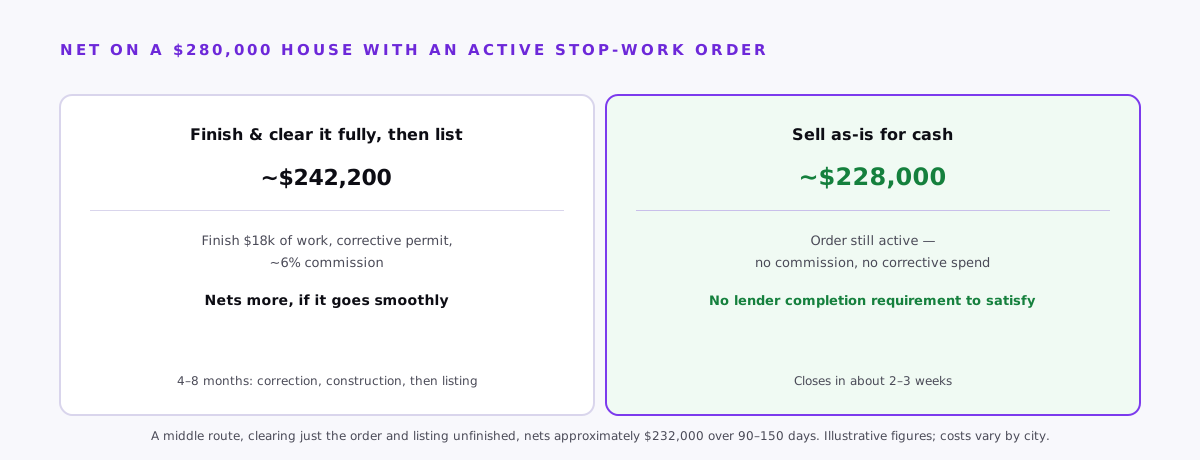
Worked on a $280,000 completed-value house with a $35,000 addition that's $17,000 into construction — $18,000 of work remaining — when the city posts a stop-work order for work exceeding the approved permit scope:
| Route | What it takes | Extra spend | Price | Commission | Net to seller | Timeline |
|---|---|---|---|---|---|---|
| Finish the addition and clear the order completely, then list | Corrective permit, re-inspection, finish remaining construction | −$21,000 (≈$18,000 to finish + ≈$3,000 permit/fine costs, which vary significantly by city) | $280,000 | ~6% (−$16,800) | ~$242,200 | 4-8 months |
| Clear just the stop-work order, leave the addition unfinished, then list | Corrective permit and re-inspection only | −$3,000 | $250,000 (discounted — buyer absorbs finishing the addition and the narrowed, often cash/rehab-leaning buyer pool) | ~6% (−$15,000) | ~$232,000 | 90-150 days |
| Sell as-is to a cash buyer, order still active | None required of you | $0 | $228,000 | $0 | ~$228,000 | 2-3 weeks |
Finishing the work and clearing the order fully nets the most — but it's real money and real months, and it assumes the corrective permit process goes smoothly, which isn't guaranteed. Clearing just the order without finishing the addition still leaves you with a half-built structure that scares off most financed buyers regardless of paperwork. A cash sale doesn't make the order disappear from the property's history, but it removes the requirement that anyone resolve it before you get paid.
If you can finish the work and clear the order completely, that route usually nets more — we'd tell you that directly.
Where a cash sale earns its place is when you can't afford months of corrective permits and construction, or the buyer pool for a half-finished house is too thin to wait on. Send the address and we'll send a written offer within 24 hours. No cost, no obligation.
All guides · Selling a house with an open or expired permit · Selling a house with code violations · How fast can you really close on a house
Step 1 of 5
No obligation, no fees, no repairs. We respond the same day.
You’ll talk to Trevor McAmis, Owner & Acquisitions Lead
(313) 710-6129
Takes about two minutes. Or call (313) 710-6129 — we answer.