A shared septic system serves two or more separately-owned properties from one tank and drain field, usually under a recorded easement. Several states require that easement to be recorded before a permit issues. Without it, a lender can refuse to finance a buyer's purchase. The system working fine doesn't resolve the paperwork problem — a cash sale can.

Step 1 of 5
Tell us about the system and whether there's a recorded agreement with your neighbor. We'll give you a straight answer, including when getting the paperwork resolved and listing nets more.
You’ll talk to Trevor McAmis, Owner & Acquisitions Lead
(313) 710-6129
Takes about two minutes. Or call (313) 710-6129 — we answer.
Educational only. This explains how these situations generally work. It is not legal, tax or financial advice, and the rules differ by state — talk to an attorney or CPA about your own situation before you act on any of it.
A shared septic system is one tank and drain field serving two or more houses on separately-owned lots, usually because the neighborhood was platted before septic rules tightened or because the lot sizes never supported a system per house. This is a completely different problem from a failed septic system — see our separate guide on selling a house with a failed septic system if yours is actually malfunctioning.
A shared system can work perfectly and still create a sale-blocking problem, because the issue isn't the plumbing. It's who has the legal right to use it, maintain it, and cross the other owner's land to reach it.
About 25% of homes nationwide rely on a septic system of some kind, per the EPA's 2012 SepticSmart homeowner guide. (EPA SepticSmart homeowner guide) That guide, like most consumer-facing EPA material on septic systems, doesn't address shared systems specifically or say anything about disclosure obligations — there is no federal guidance on this, and no CFPB rule covers it either. Whatever duty you have to tell a buyer about a shared system comes from your state's general property-disclosure law, not from any septic-specific federal source.
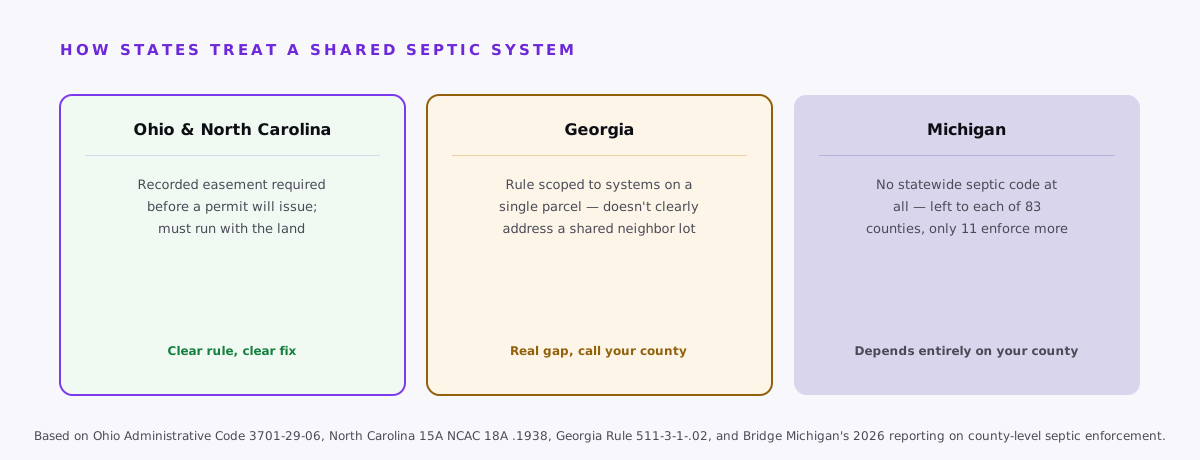
Where the system crosses onto, or serves, a parcel other than the one it sits on, several states require a permanent recorded easement before a permit will even issue — and at least one of the states Restar buys in doesn't clearly address the scenario in its own regulatory text at all:
If your house was built decades ago and the original easement was never recorded, or it lapsed, that's a real title problem, not a technicality — a title company generally won't insure over an unrecorded, undocumented right to use a system that isn't entirely on your own land.
Fannie Mae's own Selling Guide states it directly: "Private well or septic facilities must be located on the subject site, unless the subject property has the right to access off-site private facilities and there is an adequate, legally binding agreement for access and maintenance." (Fannie Mae Selling Guide, B4-1.3-04) No recorded agreement, no conventional loan on the house — regardless of whether the tank and drain field are working.
FHA and USDA publish nearly identical language for shared wells specifically — a binding, recorded agreement covering maintenance, cost-sharing, and access, running to successors in title. Neither agency's publicly available text spells out an equally specific clause for shared septic the way it does for shared wells, but Fannie Mae's rule groups "well or septic" under the same off-site-facility requirement, and in practice a shared system without paperwork raises the identical concern for any underwriter: who has the legal right to keep using it.
If the system needs to be worked on and your co-owner won't pay their share, your recourse under a recorded agreement is ordinary contract enforcement — a written demand, then a civil suit for contribution if that fails. Courts that have reviewed these disputes have generally upheld a validly recorded shared-system easement against a neighbor trying to get out of it.
In one such case, a Washington court kept a 2001 recorded easement in force after one owner sued to disconnect following a blockage, finding the other owner hadn't shown the shared use was unreasonable. That case isn't binding anywhere Restar buys, but it's a fair illustration of how courts treat a validly recorded agreement: as something a neighbor can't just walk away from once it's on the deed.
This is educational information, not legal advice. Septic easement law, recording requirements, and what counts as an "adequate" shared-maintenance agreement vary by state and by your specific documents — confirm your situation with a real estate attorney and your county environmental health office before assuming either way.
Worked on a $230,000 house that shares its septic system with a neighboring lot, with no recorded easement or maintenance agreement on file:
| Route | Gross price | Resolution cost | Commission | Net to seller | Timeline |
|---|---|---|---|---|---|
| Draft and record a shared-maintenance easement with the neighbor's cooperation, then list | $230,000 | Attorney-drafted recorded agreement, roughly −$2,000 (varies widely by complexity) | ~6% (−$13,800) | ~$214,200 | 60-100+ days: agreement negotiation and recording, then a normal listing |
| Disconnect and install a standalone system on your own parcel, then list | $230,000 | New standalone system install, roughly −$8,000 (general install-cost range; no figure exists specific to converting from a shared system) | ~6% (−$13,800) | ~$208,200 | 90-150 days: permitting, installation, then listing |
| Sell as-is to a cash buyer, sharing arrangement unresolved | $205,000 (as-is price reflecting the unresolved title issue) | $0 | $0 | ~$205,000 | 2-3 weeks |
Getting the easement recorded with your neighbor's cooperation nearly always nets the most — it's a paperwork fix, not a construction project, if the neighbor will sign. Installing a whole new standalone system costs more than most sellers expect for a system that already works, and it only makes sense if the neighbor relationship has broken down entirely. A cash sale doesn't make the title issue disappear, but it removes the requirement that it be resolved before anyone will close.
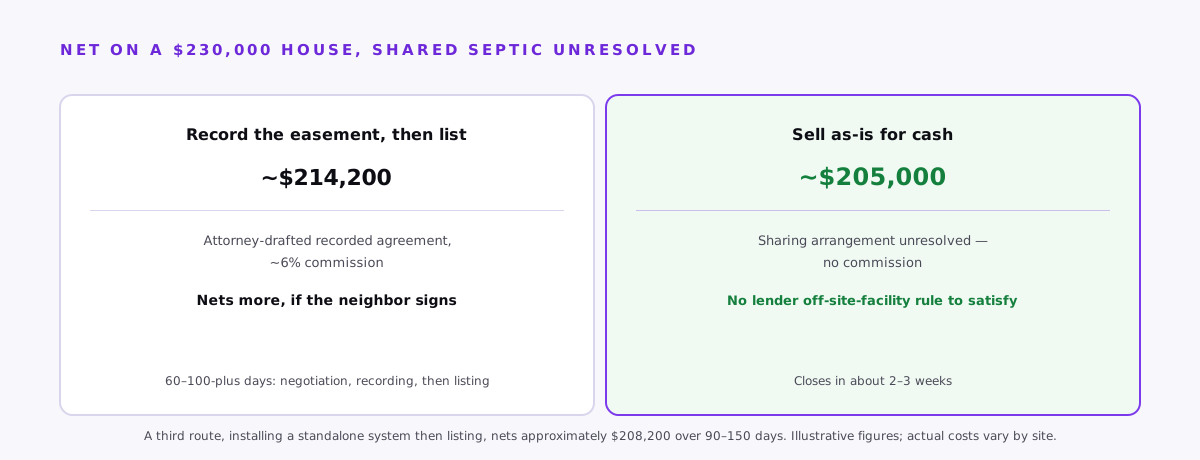
If your neighbor will sign a recorded easement, getting the paperwork resolved and listing usually nets more — we'd tell you that directly.
Where a cash sale earns its place is when the neighbor relationship has broken down or you can't wait out a title company's requirements. Send the address and we'll send a written offer within 24 hours. No cost, no obligation.
All guides · Selling a house with a failed septic system · Selling a house with a shared well agreement · Cash offer vs listing net proceeds
Step 1 of 5
No obligation, no fees, no repairs. We respond the same day.
You’ll talk to Trevor McAmis, Owner & Acquisitions Lead
(313) 710-6129
Takes about two minutes. Or call (313) 710-6129 — we answer.