Every market page publishes the numbers behind its offer. See the math
Home › Guides › Selling a House With a Failed Septic System
Guide
Selling a House With a Failed Septic System
Selling a house with a failed septic system is not primarily a repair problem. It is a financing problem. A failed system quietly removes almost every mortgage-backed buyer from your pool, which is why these houses sit, and why the discount sellers get offered is usually much larger than the cost of the repair. Understanding that mechanism is what tells you whether to fix it or sell it, and on the worked example below, fixing it wins by $12,460.
Takes about two minutes. Or call
(313) 710-6129 — we answer.
Educational only. This explains how these situations generally work. It is not legal, tax or financial advice, and the rules differ by state — talk to an attorney or CPA about your own situation before you act on any of it.
Selling a house with a failed septic system: the short answer
You can sell it, but not to most financed buyers. FHA, VA and conventional lenders all require a functioning, sanitary method of sewage disposal, so a failed system shrinks your market to cash buyers and renovation-loan borrowers. That is why as-is offers fall further than the repair costs.
This is educational information, not legal, engineering or health-code advice about your property. Septic rules are set at the state, county and sometimes township level and change often. Confirm anything that matters with your local health department and a licensed installer before you act.
Why the financing gate is the whole story
More than one in five households in the United States depend on a septic or other decentralized system, according to the EPA. So this is not an exotic situation — but it collides badly with how houses get bought.
Nearly every mortgage program requires the property to have safe, sanitary sewage disposal. HUD's Single Family Housing Policy Handbook 4000.1 requires the mortgagee to confirm each living unit has “sanitary facilities and a safe method of sewage disposal,” and where a property is on an onsite system, the appraiser must examine it for signs of failure or surface evidence of malfunction. Conventional financing lands in the same place from a different direction: a defect affecting the safety, soundness or sanitation of a property drives its condition rating down, and Fannie Mae requires deficiencies affecting safety, soundness or structural integrity to be repaired before the loan can be sold.
The practical consequence is simple and brutal. Sewage surfacing in the yard, or a health department order on file, and the appraiser notes it, the underwriter conditions the loan on repair, and the buyer either walks or asks you to fix it before closing. Your buyer pool collapses to people paying cash or using a renovation loan — a much smaller and more price-sensitive group.
That is the mechanism behind the discount, and it is worth being precise about its size. The National Association of Realtors' 2025 Profile of Home Buyers and Sellers found that 74% of buyers financed their purchase, with all-cash buyers at a record 26%. A failed system removes that three-quarters from your pool in one stroke, leaving you to negotiate with the quarter who pay cash — and they know perfectly well that they are the only ones left. That is why selling a house with a failed septic system is really a financing problem wearing a plumbing problem's clothes, and why the fix is worth more than it costs.
Find out whether it has actually failed, and get it in writing
“The septic is failing” covers a wide range of conditions, and the difference between them is thousands of dollars. Before you make any decision, get a licensed inspector to tell you which one you have.
A full tank — not a failure at all. Pumping typically runs a few hundred dollars, and a system that backs up because it has not been pumped in a decade may be entirely serviceable afterwards.
A baffle, lid, or distribution box problem — component-level, usually low four figures.
A saturated or failed drainfield — the expensive one. Effluent is no longer percolating, and the field has to be replaced, which means soil testing, a permit, and often a new location on the lot.
A site that will not perc — the worst case. If the soils will not accept a conventional field, you are into an engineered mound or an aerobic treatment unit, and the cost can multiply.
Get the inspection report, any health department correspondence, and at least two written quotes from licensed installers. You cannot negotiate with a buyer, or evaluate a cash offer, using a number somebody guessed at.
Check whether your county forces an inspection at sale
There is no national point-of-sale septic rule, and this trips up sellers constantly. Requirements are set locally and vary between neighboring counties.
Michigan is the clearest illustration, and it matters because it is one of our largest markets. The state has no statewide point-of-sale septic requirement; what exists instead is a patchwork of Time of Sale or Transfer ordinances adopted by individual counties and health departments, as Michigan State University Extension describes. Two houses forty minutes apart can face completely different obligations at closing. Other states and counties impose their own versions, and some have added them recently.
Call your county health department before you list. Ask three questions: is an inspection required at transfer, who is required to pay for and schedule it, and what happens if the system fails that inspection. In counties with a time-of-sale ordinance, a failed system is not a negotiable defect — you may be legally unable to transfer the property until it is corrected, which removes the as-is route entirely.
Three routes on one house, worked to a number
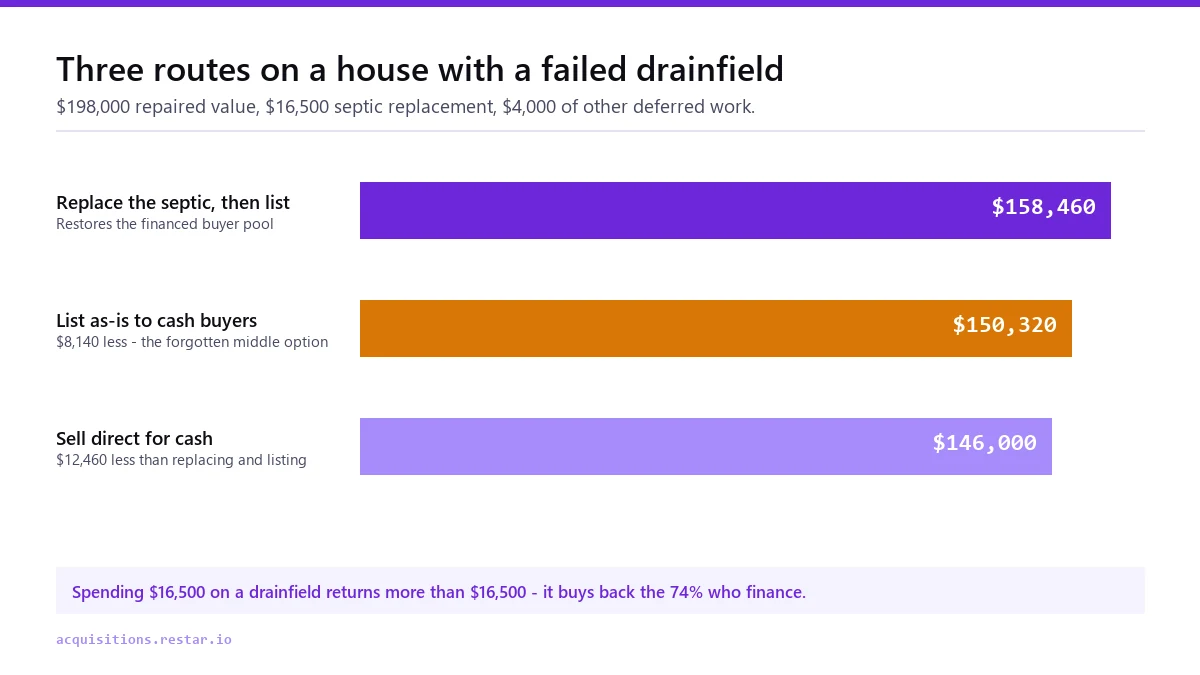
Here is a realistic case. A three-bedroom ranch on just over an acre, worth $198,000 repaired and functioning, with a saturated drainfield. Two licensed quotes come back at $16,500 for a new tank and field, plus about $4,000 of other deferred maintenance the house needs to show well.
Three routes on one house with a failed drainfieldRestar Acquisitions · worked example from this page
A worked illustration on one hypothetical property. Not a quote, not a prediction about your house, and not a fixed formula we apply.
Route 1 wins by $12,460 over our own offer, and by $8,140 over listing it as-is. On this house, the honest recommendation is to replace the septic and list it with an agent. Spending $16,500 to restore access to the financed buyer pool returns considerably more than $16,500, because what you are buying is not a drainfield — it is the three-quarters of buyers who need a mortgage.
Notice route 2, though. Listing as-is nets less than replacing, but it also nets more than a direct cash sale, because you keep the difference between an investor's retail-facing price and their acquisition price, minus the commission. The as-is listing is the forgotten middle option and it is frequently the second-best answer.
The four conditions that flip the answer
Route 1 wins on paper. It stops winning under any of these, and all four are common:
You cannot fund $16,500 up front. The math assumes you can pay the installer before you get paid at closing. If you cannot, route 1 is not available to you at any price, and comparing against it is academic.
The soils will not take a conventional field. If the perc test forces an engineered mound or an aerobic unit, the quote can double or worse. Re-run the table with the real number before deciding — at a $34,000 replacement cost, route 1 falls behind both alternatives.
You cannot get permitted or installed in time. Northern counties do not issue or install in frozen ground, and permit queues in spring can run weeks. Add four months of holding costs to route 1 and its lead shrinks fast.
You are on a deadline that will not wait. A foreclosure sale date, a probate deadline, or a relocation with a start date changes what certainty is worth. Our offer arithmetic guide shows exactly what that certainty costs.
Disclose it either way
Whatever route you take, selling a house with a failed septic system means disclosing the condition of that system in writing. Most states require sellers to disclose known material defects, and a failed septic is about as material as defects get — it is a health and sanitation issue, not a cosmetic one.
Trying to sell a failing system quietly is a bad plan on the merits as well as the ethics. Effluent surfacing in a yard is visible, health department records are public, and a buyer who discovers after closing what you knew before it has a straightforward claim. Hand over the inspection report and the quotes. A documented problem with a known price is something buyers can work with; a discovered one ends deals and starts lawsuits.
If the house has other damage beyond the septic, our damaged-house page covers how those stack, and should I repair before selling runs the same three-route comparison on general condition rather than a single system.
Alternatives to consider
Replace it and list — the highest-net route on the worked example above, and the default whenever you can fund the work and wait for the permit.
Repair rather than replace — get the inspector to distinguish a component failure from a field failure first. Sellers replace systems that needed a distribution box.
Connect to public sewer — if a main runs past the property, a tap-in is sometimes cheaper than a new field and permanently removes the issue.
List as-is with full disclosure — the forgotten middle route, and the second-best answer on the example above.
Offer a repair escrow — some lenders permit holding funds back at closing to complete the work, which can keep a financed buyer in the deal. Ask the buyer's lender early; not all programs allow it.
Sell as-is for cash — worth it specifically when you cannot fund the repair, cannot get permitted in time, or the site will not support a conventional replacement.
Common questions
Can you sell a house with a failed septic system?
Yes, but generally only to cash buyers or borrowers using a renovation loan. FHA, VA and conventional lenders all require a functioning, sanitary method of sewage disposal, so a failed system removes most financed buyers from your pool until it is corrected.
How much does it cost to replace a septic system?
It depends far more on your soils than on your house. A conventional tank-and-drainfield replacement commonly runs in the mid five figures, while a site that will not perc can require an engineered mound or aerobic unit at multiples of that. Get two written quotes from licensed installers before making any decision.
Do I have to disclose a failed septic system to buyers?
In most states you must disclose known material defects, and a failed septic system is a health and sanitation defect rather than a cosmetic one. Beyond the legal requirement, health department records are public and surfacing effluent is visible, so concealment tends to fail and to create liability after closing.
Is a septic inspection required when I sell my house?
There is no national requirement. Some counties and health departments impose time-of-sale or point-of-sale inspection ordinances while neighboring ones do not, and Michigan is a well-known patchwork with no statewide rule. Call your county health department before listing, because a local ordinance can make transfer impossible until the system passes.
Should I replace the septic system or just sell as-is?
Run the numbers on your own house rather than assuming. In the worked example on this page, replacing a $16,500 system and listing netted $12,460 more than a direct cash sale, because restoring financing restores the buyer pool. That reverses if you cannot fund the work up front, cannot get permitted in time, or the site requires an engineered system.
Will a buyer's lender allow money to be held back to fix the septic after closing?
Sometimes. Certain loan programs permit a repair escrow so funds are held at closing and released when the work is completed, which can keep a financed buyer in the transaction. Availability depends on the loan program and the lender, so ask the buyer's lender early rather than assuming it is possible.
Want a number to compare against the repair quote?
If you want to know what a cash sale looks like before you commit $16,000 to a drainfield, send us the property and whatever the inspector or health department gave you. We will tell you within 24 hours what we would pay and when we could close.
Send us the property here. If the arithmetic says replace it and list it — which on the worked example below it does — we will tell you that instead.
Every offer on this site is underwritten by a person, not a form. If the
numbers do not work for you, say so and I will tell you what would.
Also from Restar
Want the data behind all of this?
Restar Acquisitions is the acquisitions arm of Restar — a housing-market analytics
platform tracking 180+ metrics across every U.S. market, with composite scores and 12-month
price forecasts. The numbers on this page come from the same work.