A zoning variance is permission from your local government to deviate from a zoning rule — to legalize a setback encroachment, add an ADU, or subdivide a lot, for example. A pending application means that request hasn't been decided yet. Selling a house with a pending zoning variance doesn't erase the application, but what happens to it next varies by municipality.
Step 1 of 5
Tell us where the application stands and whether a hearing date is set. We'll give you a straight answer, including when waiting for the decision actually pays off.
You’ll talk to Trevor McAmis, Owner & Acquisitions Lead
(313) 710-6129
Takes about two minutes. Or call (313) 710-6129 — we answer.
Educational only. This explains how these situations generally work. It is not legal, tax or financial advice, and the rules differ by state — talk to an attorney or CPA about your own situation before you act on any of it.
A variance is case-by-case relief from a specific zoning standard — setback, height, lot coverage, use — granted by a local zoning board of appeals (sometimes called a board of zoning adjustment) after a hearing. The American Planning Association's own guidance on zoning ordinance variances describes the review as weighing whether strict enforcement of the ordinance would create unnecessary hardship, and separates “use variances” (approving a land use the zoning doesn't normally allow) from “area variances” (dimensional relief, like a setback or height exception). (American Planning Association)
This guide is specifically about a variance application that's still pending — filed, maybe scheduled for a hearing, but not yet approved or denied. That's a different situation than a property with an existing, already-legal nonconforming use that predates current zoning rules, which we cover separately in our guide to selling a house with a nonconforming use. It's also different from an open or expired building permit, which is a paperwork problem on completed work rather than a request still awaiting a decision — see our guide to selling a house with an open or expired permit if that's closer to your situation.
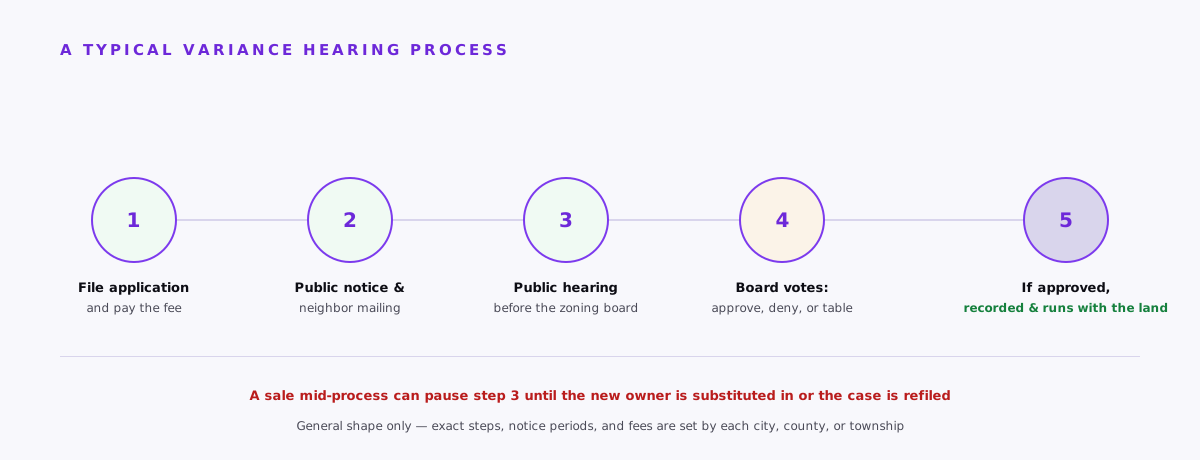
The short answer: in most jurisdictions, a pending zoning variance request attaches to the parcel, not to a specific person — but the “applicant of record” on file is usually whoever filed it, and that distinction matters the moment ownership changes mid-process. Local procedures diverge from there in ways that are genuinely municipality-specific, so treat the following as the general shape, not a rulebook:
None of this is standardized nationally. Application forms we reviewed from local governments make the applicant-of-record distinction explicit in their own paperwork (Charlotte County, Florida variance application), and state-level guidance for applicants describes the notice-and-hearing mechanics a board follows once a case is filed (New York Department of State, Guidelines for Applicants to the Zoning Board of Appeals). Neither document tells you what your specific city will do with your specific pending case — only your local zoning or planning department can. Call them before you list, not after.
A pending variance introduces exactly the kind of uncertainty mortgage underwriting doesn't like: the legal status of some part of the property — a setback, an addition, a second unit — is unresolved. In practice that shows up in two places:
The appraisal. An appraiser generally has to value the property as it legally exists today, not as it might exist if the variance is approved. If the variance would legalize an ADU or an added bedroom, an appraiser typically can't credit that square footage or unit until the zoning status is actually resolved and reflected in permits on file — which is the same bottleneck we cover in more depth in our guide to selling a house with an unpermitted second unit or ADU. A buyer's lender is appraising the house you have, not the house you're hoping to have.
The underwriting. Lenders generally want to see that a property's improvements and uses already comply with zoning, or have a clear, finished paper trail showing they do. A pending, unresolved variance is a flag many underwriters will want explained or resolved before closing, and some will decline to fund until the hearing is over one way or the other — particularly if the variance covers something structural rather than cosmetic. That can leave a financed buyer, and their purchase contract, waiting on a hearing date neither of you control.
This is educational information, not legal advice. Variance procedures, notice requirements, applicant-substitution rules, and fees are set entirely by each city, county, or township — confirm your specific application's status and options with your local zoning or planning department, and talk to a real estate attorney before deciding how to handle your sale around it.
Once you know your local procedure, deciding what to do with a pending zoning variance usually comes down to one of two paths, and either can work depending on your buyer and your timeline:
Withdraw and sell as-is. You tell the zoning department you're withdrawing the request, the hearing (if one was scheduled) is canceled, and the property sells on its current, legal condition — no pending encumbrance for a buyer's lender to flag. You give up any chance the variance would have added value, but you remove the uncertainty entirely.
Let the buyer assume the pending application. Where your jurisdiction allows a substitution of applicant, a buyer willing to take on the hearing — and the risk that it's denied — can step into your spot. This mostly shows up with cash or investor buyers who don't need lender sign-off before closing and are comfortable owning the outcome of a hearing they didn't start. A financed retail buyer is a much harder fit for this path, since their lender is unlikely to fund around an open question of that kind.
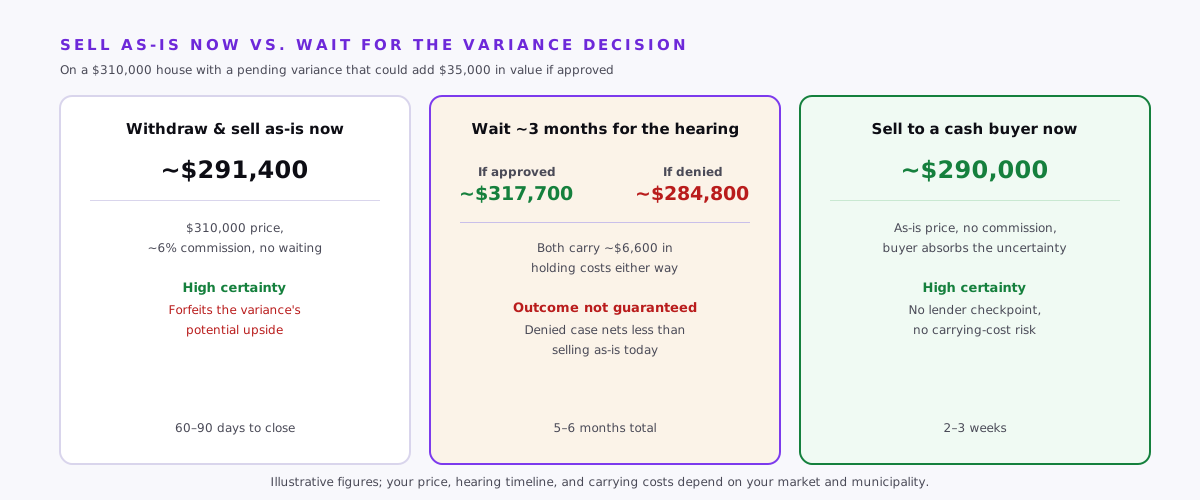
Here's where the math actually has to get specific, because the upside is real and so is the cost of waiting for it. Take a $310,000 house where the pending variance would legalize an added bedroom or small ADU conversion — call it a realistic $35,000 appraised-value bump if approved, to $345,000. A hearing cycle in most jurisdictions, from filing to a board decision, commonly runs somewhere in the range of two to four months, sometimes longer if a case gets continued. Call carrying costs — mortgage, insurance, property tax, utilities — a combined $2,200 a month while you wait.
| Route | Price | Extra cost while waiting | Net (after ~6% commission, where applicable) | Time | Certainty | Risk |
|---|---|---|---|---|---|---|
| Withdraw and sell as-is now | $310,000 | $0 | ~$291,400 | 60-90 days to close | High | Forfeits the variance's potential upside entirely |
| Wait for the hearing, then sell — approved | $345,000 | ~$6,600 (3 months) | ~$317,700 | 5-6 months total | Not guaranteed | Denial risk; carrying cost is sunk either way |
| Wait for the hearing, then sell — denied | $310,000 | ~$6,600 (3 months) | ~$284,800 | 5-6 months total | Not guaranteed | Worse off than selling as-is now |
| Sell to a cash buyer now, as-is | ~$290,000 | $0 | ~$290,000 | 2-3 weeks | High | Lower price reflects as-is condition and the uncertainty the buyer absorbs |
The shape of it: waiting pays off only if the variance is actually approved, and even then the gain over selling as-is now is a few percent after carrying costs eat into it. If it's denied, you've paid two or three months of holding costs for nothing and you're still selling the same house you could have sold today. A cash sale sits closest to the “sell as-is now” row on price, trades a little more of the spread for speed and zero carrying-cost exposure, and sidesteps the lender-financing friction a pending variance tends to create for a traditional buyer.
If your hearing is close and the carrying cost is manageable, waiting for a decision can net more if it's approved — we'd tell you that directly.
Where a cash sale earns its place is skipping the uncertainty entirely: no lender checkpoint waiting on a hearing outcome, no carrying costs while a board schedules and reschedules. Send the address and we'll send a written offer within 24 hours. No cost, no obligation.
All guides · Selling a house with a nonconforming use · Selling a house with an unpermitted second unit or ADU · Sell my house fast
Step 1 of 5
No obligation, no fees, no repairs. We respond the same day.
You’ll talk to Trevor McAmis, Owner & Acquisitions Lead
(313) 710-6129
Takes about two minutes. Or call (313) 710-6129 — we answer.