A legally nonconforming property — a duplex or triplex that was fine when it was built, in a zone that's since changed around it — doesn't lose its grandfathered status just because you sell. But three things can end it, and the honest obstacle for most sellers isn't zoning at all. It's financing. Here's what actually ends a nonconforming use, what doesn't, and why the realistic buyer pool skews toward cash.

Step 1 of 5
Tell us about the property. We don't need Fannie Mae-eligible financing to close, so the zoning status that narrows your retail buyer pool isn't a problem for us.
You’ll talk to Trevor McAmis, Owner & Acquisitions Lead
(313) 710-6129
Takes about two minutes. Or call (313) 710-6129 — we answer.
Educational only. This explains how these situations generally work. It is not legal, tax or financial advice, and the rules differ by state — talk to an attorney or CPA about your own situation before you act on any of it.
Selling itself doesn't end a legal nonconforming use — the right generally runs with the land, not the owner. But three things can kill it: letting the use sit vacant too long, major damage or destruction past a local threshold (often 50%), or a city's amortization deadline. Financing is the practical bottleneck: lenders impose real conditions, and some buyers simply can't get a loan.
A legal nonconforming use — sometimes called “grandfathered” — is a use or structure that was lawfully built or established before a zoning change made it no longer allowed, but is permitted to keep operating anyway. The classic example on a rental property: a duplex or triplex built decades ago in an area that's since been rezoned single-family-only. The structure stays legal to keep renting as-is; it's rebuilding, expanding, or changing it that runs into trouble.
This is a different problem than the ones covered in our guides on unpermitted work or an unpermitted second unit or ADU. Those are paperwork and code problems — something was built without the permit it needed. A nonconforming use is the opposite: the use was entirely legal when established; the zoning map changed around it. Connecticut's own legislative research office defines it cleanly: a nonconforming use “legally exists at the time a zoning restriction prohibiting or limiting it is adopted” (Connecticut OLR Report 2016-R-0141).
Abandonment or discontinuance. Minnesota's zoning statute is explicit: a nonconforming use is lost if discontinued “for a period of more than one year” (Minn. Stat. § 462.357, subd. 1e). Many cities use similar windows — six months to a year is common. Here's the nuance that matters for a seller: some states require real intent to abandon, not just the passage of time. Connecticut's rule is that “passage of time alone does not constitute abandonment” — an owner has to have voluntarily stopped the use and shown intent not to resume it (Connecticut OLR Report 2016-R-0141). Other states, including Minnesota, make it a straight time clock with no intent inquiry at all. That difference can matter a great deal if your property sits vacant during a slow sale process.
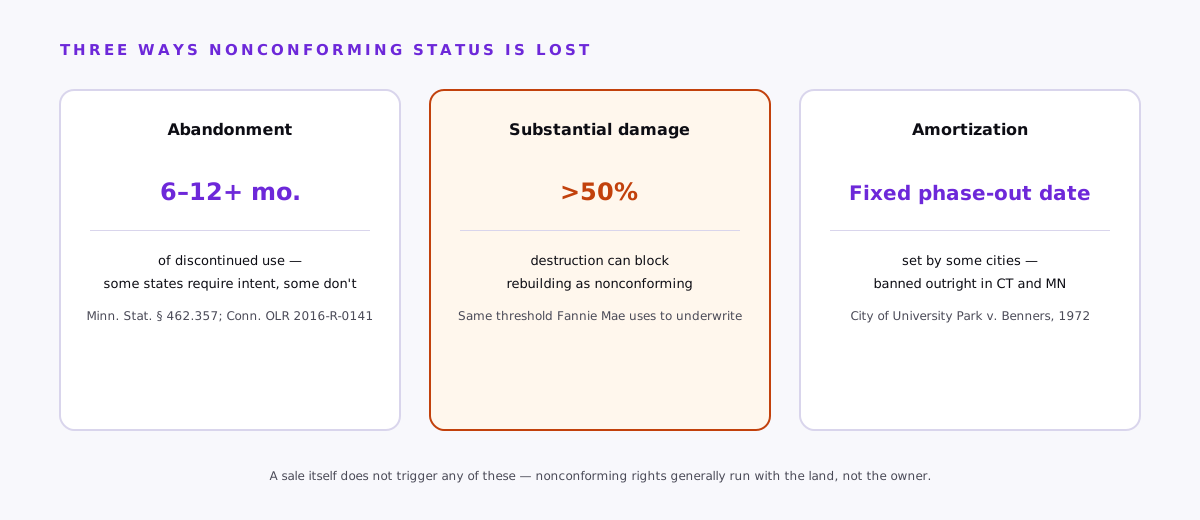
Substantial damage or destruction. Minnesota's statute sets a 50%-of-assessed-value threshold: if a nonconforming structure is destroyed beyond that, the right to rebuild as nonconforming is lost unless a building permit is applied for within 180 days (Minn. Stat. § 462.357, subd. 1e). A 2004 amendment to that same statute tightened things further by barring expansion of a nonconforming use, while leaving in place the requirement that a rebuild permit be sought within 180 days. Most cities that address this use some version of a 50% rule, though the exact percentage and rebuild deadline vary by jurisdiction. This threshold isn't just academic — it's the same number mortgage investors use to decide whether a property is financeable at all.
Amortization. Some cities set a hard date by which a nonconforming use must stop entirely, treating it like a depreciating asset with a fixed payoff date. This isn't universal — Connecticut and Minnesota both prohibit it outright for most uses (Connecticut OLR Report 2016-R-0141) — but where it's allowed, courts have generally required the phase-out period to be “reasonable,” meaning long enough for the owner to recoup their investment in the structure, measured as of when the zoning changed (City of University Park v. Benners, 485 S.W.2d 773, Tex. 1972).
No — and this is the one piece of good news in this topic. Nonconforming rights generally “run with the land,” meaning they transfer automatically to a new owner, not something a seller has to hand off or a buyer has to re-apply for (Connecticut OLR Report 2016-R-0141; Florida Bar Journal, “The Status of Nonconforming Use Law in Florida”). A buyer doesn't lose the grandfathered status just because ownership changed hands.
The real risk is timing, not the sale itself. If the property sits vacant through a long marketing period, a local zoning board could treat that vacancy as evidence the use was abandoned — especially in a jurisdiction that doesn't require proof of intent. And if a prior owner already abandoned the use before selling, a buyer doesn't get to revive it; abandonment that happened before the sale carries forward (Connecticut OLR Report 2016-R-0141). The practical lesson: if you're selling a nonconforming multi-unit property, keeping it occupied and the use actively running through closing is the safer path, and it's worth a conversation with a zoning attorney if a sale is going to take months.
Fannie Mae's Selling Guide requires an appraiser to classify every property's zoning as legal conforming, legal nonconforming, illegal, or no zoning — and for a legal nonconforming property, “the appraisal analysis [must reflect] any adverse effect that the nonconforming use has on the value and marketability of the property” (Fannie Mae Selling Guide, B4-1.3-04). That's a real underwriting condition, not boilerplate: appraisers often struggle to find comparable sales with matching nonconforming status, which can complicate the valuation on its own.
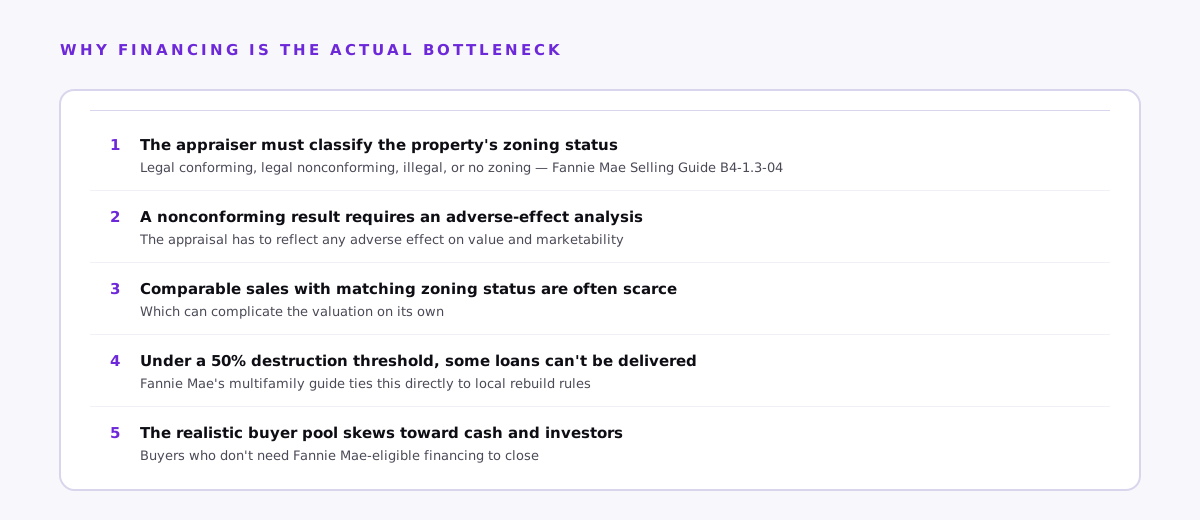
The sharper edge is what happens if the structure is ever destroyed. Fannie Mae's multifamily guide requires lenders to confirm the local destruction threshold at which a jurisdiction would prohibit rebuilding to the pre-loss condition — and if that threshold is under 50%, the loan generally can't be delivered to Fannie Mae at all. In plain terms: if your city would only let a damaged nonconforming duplex be rebuilt as nonconforming after less than 50% destruction, some lenders simply won't finance it, full stop. Standard homeowners and landlord insurance makes this worse in a fire or storm: it pays to restore what was lost, not to cover the economic loss of a unit that current zoning won't let you rebuild. “Ordinance or Law” coverage exists specifically to narrow that gap, but it's an add-on, not standard.
| Financed retail buyer | Cash buyer | |
|---|---|---|
| Appraisal condition on nonconforming status | Required — may add delay or a lower valuation | No appraisal contingency |
| Rebuild-risk underwriting (50% rule) | Can outright block the loan in some cases | Not applicable |
| Comparable sales available | Often limited — matching-zoning comps are scarce | Not a financing requirement |
| Realistic buyer pool | Narrower — fewer lenders will touch it | Investors and cash buyers who don't need agency financing |
None of this means a nonconforming duplex or triplex sells for nothing — tired landlords sell income-producing nonconforming properties regularly. It means the buyer pool skews toward cash and investor buyers who don't need Fannie Mae-eligible financing, which is the same dynamic that shows up on properties with code violations or unpermitted work: a smaller pool, a longer retail timeline if you insist on a financed buyer, and a faster, more certain close if you go to cash instead. The honest tradeoff is the same one on every guide on this site — a retail sale to the right buyer can net more, if that buyer and their lender actually show up; a cash sale nets less but removes the financing uncertainty entirely.
This is educational information, not legal advice — a zoning or real estate attorney can tell you how your specific municipality's ordinance treats nonconforming use, abandonment, and rebuild rights.
If your nonconforming-use property is running into appraisal conditions or a shrinking financed-buyer pool, a cash sale sidesteps all of it — no appraisal contingency, no lender rebuild-risk underwriting.
Send us the property here and we'll give you a straight number.
All guides · Tired landlord · Selling a house with an unpermitted ADU · Sell my house fast
Step 1 of 5
No obligation, no fees, no repairs. We respond the same day.
You’ll talk to Trevor McAmis, Owner & Acquisitions Lead
(313) 710-6129
Takes about two minutes. Or call (313) 710-6129 — we answer.
