If you're a landlord with a rented basement unit, an in-law suite, or a detached cottage in the backyard that was never permitted as a separate dwelling, you're sitting on something riskier than a typical unpermitted renovation. Here's why that's true, what it actually does to your sale, and what your real options are.
Step 1 of 5
Tell us about the property. We'll give you a written cash offer within 24 hours that doesn't depend on the unit being legalized first.
You’ll talk to Trevor McAmis, Owner & Acquisitions Lead
(313) 710-6129
Takes about two minutes. Or call (313) 710-6129 — we answer.
Educational only. This explains how these situations generally work. It is not legal, tax or financial advice, and the rules differ by state — talk to an attorney or CPA about your own situation before you act on any of it.
An unpermitted second unit — a basement apartment, converted garage, or detached ADU that was never legally established — is a zoning and life-safety issue, not just a missing-permit issue, and most lenders won't count its rental income or value toward the sale. Legalizing it, disclosing and discounting, or de-converting it back to single-family are your three real paths; a cash sale sidesteps the financing problem entirely, at a lower price than a legalized, financeable listing would likely bring.
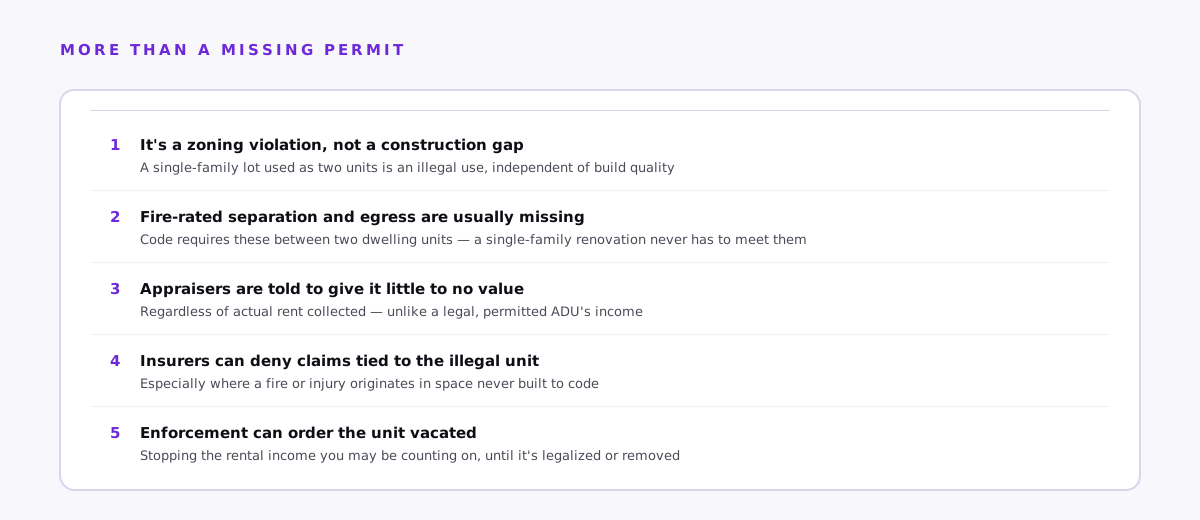
A missing permit for, say, a finished basement rec room is a construction-quality question. An unpermitted second unit is something else: it's an illegal use of a lot zoned for a single household, and the unit itself typically lacks the life-safety construction that code requires once a house legally becomes a two-family dwelling.
Fannie Mae's own underwriting guidance treats this as a zoning-compliance problem distinct from ordinary construction defects — if an accessory dwelling unit exists “in an area where zoning prohibits ADUs,” the property can only be eligible for financing if the appraiser can demonstrate the use is typical and accepted in that specific market, and the lender separately confirms the illegal use “will not jeopardize any future property insurance claim.” See Fannie Mae Selling Guide B4-1.3-05.
The construction side matters too. Once a house legally has two dwelling units, building codes generally require a minimum fire-rated wall and floor assembly separating them, plus an independent means of egress for each unit — requirements a single-family renovation never has to meet. An unpermitted second unit usually wasn't built to any of that, which is the real safety risk underneath the paperwork problem.
As of October 2025, Fannie Mae began allowing rental income from a legal ADU to count toward a borrower's qualifying income, capped at 30% of total qualifying income. Freddie Mac has a parallel allowance. Both require the ADU to be legally permitted and zoning-compliant — neither extends to an unpermitted unit, which is the meaningful limit sellers need to understand before assuming this recent change helps their sale.
For an unpermitted unit, the practical reality reported across appraisal and lending industry sources is much harsher: appraisers are generally instructed to give illegal space only insignificant or incidental value, and many lenders decline to count any value or income from it at all, regardless of what it's actually renting for. That's a direct hit to what a financed buyer's lender will actually lend against — which is a large part of why unpermitted units tend to depress what a conventional retail sale can realistically close at.
Two risks sit on top of the financing problem, and both are worth taking seriously before you list: the possibility that an insurer denies a future claim tied to the illegal unit, and the possibility that your local building department actively enforces against it and forces the income to stop while enforcement is pending.
Insurance. Fannie Mae's own rule — requiring lenders to confirm an illegal unit “will not jeopardize any future property insurance claim” — is effectively an acknowledgment that insurers can and do deny claims tied to illegal unit use, particularly when a fire or injury originates in space that was never built to code. If something goes wrong in that unit while you still own the house, you could be left without coverage for it.
Enforcement. Jurisdictions that actively enforce against illegal conversions can order the unit vacated and require either a full legalization (licensed design and construction, permits, a new certificate of occupancy) or removal of the illegal work altogether, with tenants required to leave before any removal work begins. New York City's own building department describes this enforcement path directly on its site. The specific daily penalty figures vary by source and jurisdiction and aren't consistent enough to quote a single number here — what's consistent is that the unit's income can simply stop while enforcement is pending, which is its own real financial exposure for a landlord relying on that rent.
Disclosure matters regardless of which state you're in: a known unpermitted unit is the kind of material fact standard seller disclosure forms ask about, and an as-is sale does not erase your duty to disclose something you actually know. Talk to a real estate attorney about your specific state's requirements.
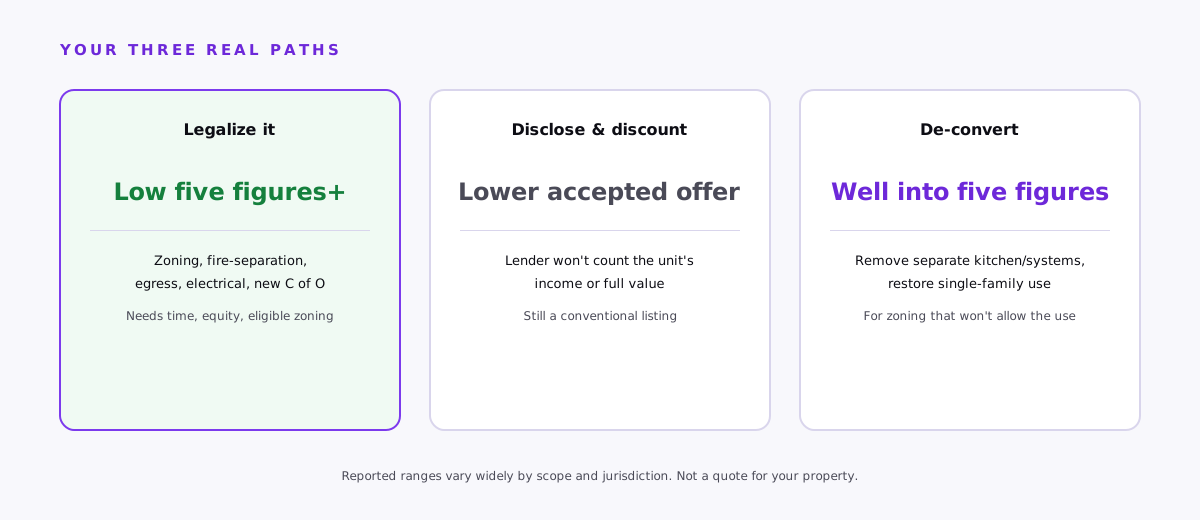
| Path | What it involves | Rough cost range | Who it fits |
|---|---|---|---|
| Legalize it | Bring the unit to current zoning, fire-separation, egress, and electrical code; obtain permits and a new certificate of occupancy | Commonly reported in the low five figures for straightforward cases, rising sharply if structural or full-system work is needed | Landlords with time, equity, and a jurisdiction that allows the use at all |
| Disclose and discount | List as-is, disclose the unpermitted unit, negotiate against the financing limits a buyer's lender will apply | Reflected in a lower accepted offer rather than a specific fee | Sellers who want to list conventionally but don't want to manage legalization themselves |
| De-convert to single-family | Remove the separate kitchen/systems that make it a legal second unit, restoring single-family use | Reported ranges for a full duplex-to-single-family conversion run well into five figures nationally | Sellers in jurisdictions unwilling to legalize the use, or where legalization costs exceed the unit's value |
The honest tradeoff, as always: a cash sale avoids the appraisal and lender friction entirely, which is real and valuable if you need speed or certainty. It is not the path to the highest sale price. A legalized unit, sold conventionally with its rental income counted by a lender, will generally net more than a cash sale of the same property with the unit still unpermitted — if you have the time, capital, and a jurisdiction that allows it.
Some jurisdictions have created real amnesty or streamlined-legalization pathways for existing unpermitted second units, separate from the general permit process. California is the clearest example: a 2024 state law limits how local agencies can deny permits for pre-2020 unpermitted ADUs, and cities like Berkeley have layered their own reduced-fee amnesty programs on top.
See San Mateo County's summary of the state ADU amnesty law and Berkeley's amnesty program for unpermitted dwelling units, which publishes its specific fees directly.
This is a California-specific development as of this writing, not a nationwide trend — if you're outside California, call your local building or planning department directly and ask whether anything similar exists for your situation rather than assuming either that nothing does or that California's program applies to you.
If the unit is currently rented, see selling a rental property with tenants for how an active lease factors into your sale timeline. And if speed and certainty matter more than maximizing price here, we can make a written offer within 24 hours, unpermitted unit and all.
This article is for general educational purposes only and is not legal, financial, or tax advice. Zoning rules, building codes, and legalization programs vary enormously by state and locality and change over time. Talk to a real estate attorney and your local building department about your specific property before making a decision.
A cash sale doesn't need an appraiser to value the unit or a lender to underwrite its income, so the zoning and financing problem never comes up.
Send us the address and we'll give you a straight number, unpermitted unit and all.
All guides · Selling a house with unpermitted work · Tired landlord situations · Selling a rental property with tenants
Step 1 of 5
No obligation, no fees, no repairs. We respond the same day.
You’ll talk to Trevor McAmis, Owner & Acquisitions Lead
(313) 710-6129
Takes about two minutes. Or call (313) 710-6129 — we answer.
