A TEFRA lien lets a state Medicaid agency record a claim against a nursing-home resident's house while they are still alive, not after death. It works like a mortgage, not a transfer of ownership — the house can still be sold, but the lien, capped at what Medicaid actually spent, has to be paid off at closing. It is a different mechanism from Medicaid estate recovery and the look-back period, and only about half of states use it at all.

Step 1 of 5
Tell us about the lien and the timeline you're working with. We'll give you a straight answer, including when listing with an agent nets more.
You’ll talk to Trevor McAmis, Owner & Acquisitions Lead
(313) 710-6129
Takes about two minutes. Or call (313) 710-6129 — we answer.
Educational only. This explains how these situations generally work. It is not legal, tax or financial advice, and the rules differ by state — talk to an attorney or CPA about your own situation before you act on any of it.
If you're searching this because a letter showed up about a lien on your parent's house while they're still alive in a nursing home, the first thing to know is that this is a different legal mechanism from the two things people usually confuse it with.
A TEFRA lien — named for the Tax Equity and Fiscal Responsibility Act of 1982 — is authorized under 42 U.S.C. §1396p(a). It lets a state place a lien on the real property of a Medicaid recipient who is a permanent nursing-home resident, is spending nearly all their income on care as a condition of coverage, and — after the state gives notice and an opportunity for a hearing — has been determined unlikely to ever return home.
That is not the same as:
A TEFRA lien is neither of those. It attaches while the Medicaid recipient is alive, it only ever reaches the house (not other assets), and — critically — the home stops being exempt from a lien the moment a protected relative isn't living in it. The federal statute specifically bars a lien if a spouse, a child under 21 (or a blind or disabled child of any age), or a sibling with an equity interest who lived there for at least a year before the recipient's admission is lawfully residing in the home. The lien also dissolves automatically if the resident is discharged and comes home.
This is also a state-by-state decision, not a federal mandate. The regulation implementing it, 42 CFR §433.36(c), uses the word "if a State chooses" — and CMS's own State Medicaid Manual says plainly that TEFRA liens were never mandated. A nationwide review by the Medicaid and CHIP Payment and Access Commission (MACPAC) found TEFRA liens were, as of 2020, authorized in 26 of the 51 state Medicaid plans (50 states plus D.C.) it reviewed — MACPAC, Report to Congress, March 2021, Ch. 3. Roughly half the country doesn't use this tool at all. That same MACPAC research found states collected roughly $733 million nationally in fiscal year 2019 through Medicaid estate recovery and lien-triggered sales combined — a figure that isn't broken out by TEFRA liens specifically, so don't treat it as a per-lien or per-state number.
Where Restar's 12 operating states actually stand
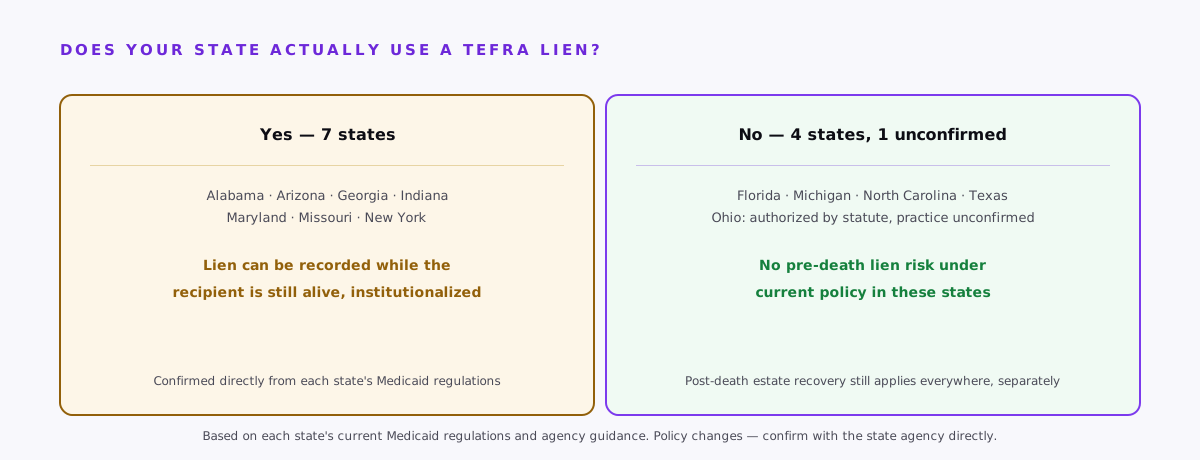
We checked each state's own Medicaid regulations and agency guidance directly rather than repeat what circulates on elder-law blogs, because at least one aggregator site we found had a specific state wrong.
| State | Uses TEFRA liens on living recipients? | Source |
|---|---|---|
| Alabama | Yes | Ala. Admin. Code r. 560-X-33-.06; Alabama Medicaid lien FAQ |
| Arizona | Yes | Ariz. Admin. Code R9-28-802, R9-28-806 |
| Florida | No — by policy | Fla. Medicaid State Plan Attachment 4.17-A: "current policy is not to file liens against homestead property" |
| Georgia | Yes | Ga. Comp. R. & Regs. r. 111-3-8-.07 |
| Indiana | Yes | Ind. Code 12-15-8.5-1 through -12 |
| Maryland | Yes | COMAR 10.09.24.15 |
| Michigan | No — barred by statute | MCL §400.112g(9): the department "shall not place or record a lien" under TEFRA |
| Missouri | Yes | 13 CSR 70-4.110; DSS Income Maintenance Manual §0880.010.00 |
| New York | Yes | 18 NYCRR §360-7.11 |
| North Carolina | No | NC Medicaid Manual MA-2285: "estate recovery does not include placing a lien on the property" |
| Ohio | Authorized by statute; current practice not publicly confirmed | Ohio Rev. Code §5162.211 |
| Texas | No | Texas HHSC MERP FAQs: "MERP does not place liens on assets before or after the death of a Medicaid recipient" |
This table reflects each state's statute or agency guidance as of this writing. Medicaid policy changes; confirm your state's current practice with an elder-law attorney or the state Medicaid agency before acting on it.
You can still sell the house. A TEFRA lien behaves like a mortgage recorded against the property, not a transfer of title. Alabama's own Medicaid agency FAQ states this directly: the agency "does not... become the owner of the property," and a family "can sell the property and pay off the lien... prior to the Medicaid recipient's death."
What changes is what happens at the closing table. Just as with a mortgage or a judgment lien, title can't transfer clean until the lienholder — here, the state Medicaid agency — is paid off or releases the lien. For the exact mechanics of how multiple liens get paid out of sale proceeds, see our guide to selling a house with a lien on it.
The payoff is capped, not the full sale price. The state can't collect more than it actually spent on the recipient's care. Alabama's FAQ frames it as "the lesser of... Medicaid expenses or the tax appraised value." Whatever equity remains above that figure belongs to the seller or the family, not the state.
Selling can create a separate problem: Medicaid eligibility. This is the part families miss, because they're focused on the lien and not on what happens to the cash. Per the federal Medicaid and CHIP Payment and Access Commission's own 2021 report to Congress, citing CMS: "If the property is sold during the beneficiary's lifetime, any equity would be considered to be part of a beneficiary's assets for eligibility purposes and could make them ineligible for Medicaid until those assets are spent down." A primary residence is excluded from Medicaid's asset test without limit — but only while it stays a residence. The moment it's sold, the cash from it counts, and Medicaid's federal baseline resource limit is just $2,000 for an individual (20 CFR §416.1205(c)) — some states run different limits under their own rules, so check with the state agency directly. Selling the house to pay off a TEFRA lien without a plan for the remaining proceeds can accidentally end someone's Medicaid coverage.
This is exactly the kind of decision that needs an elder-law attorney, not a general real estate guide. We're not going to tell you whether paying off the lien counts as an allowable way to spend down excess assets — no federal or state source we found states that explicitly, and it shouldn't be guessed at in a situation this consequential.
This article is educational information, not legal or financial advice. Talk to an elder-law attorney about your specific lien, state, and Medicaid eligibility situation before selling.
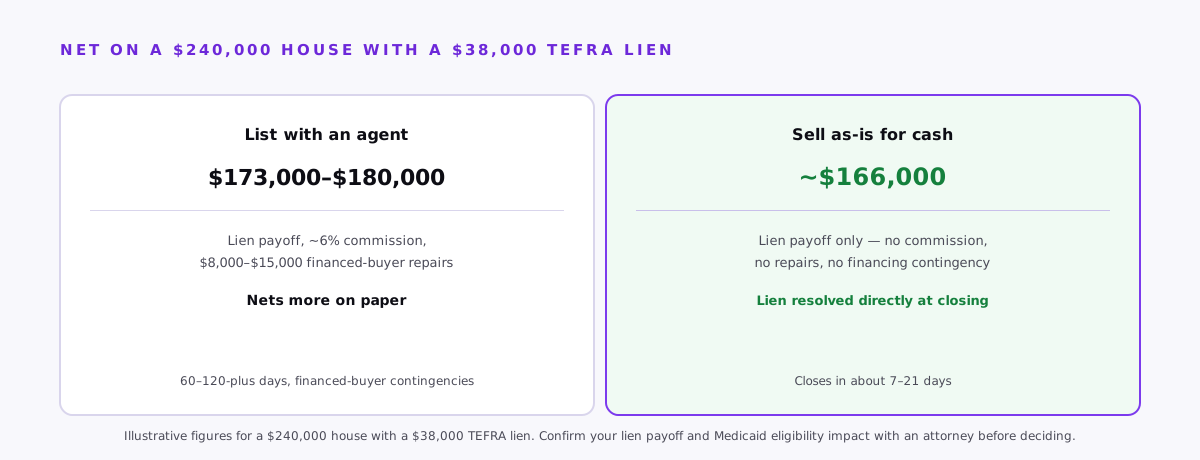
A family facing a TEFRA lien is usually also facing a parent's ongoing care costs, so time has a real dollar value here. Three realistic routes, worked on a $240,000 house with a $38,000 TEFRA lien recorded against it:
| Route | Gross price | Lien payoff | Commission/fees | Repairs typically needed | Net before Medicaid spend-down planning | Timeline |
|---|---|---|---|---|---|---|
| List with an agent, retail buyer | $240,000 | $38,000 | ~6% ($14,400) | $8,000–$15,000 average for financed-buyer repair requests | ~$173,000–$180,000 | 60–120+ days to close, financed-buyer contingencies |
| Sell as-is to a cash buyer | $204,000 (as-is discount reflects no repairs, no financing risk) | $38,000 | $0 | $0 (buyer takes as-is) | ~$166,000 | 7–21 days |
| Do nothing now, keep paying for care out of other funds | $0 realized | Lien continues accruing against the home | — | — | — | Indefinite; lien still has to be resolved eventually |
The retail-listing route nets more on paper — but it assumes the house can actually get financed-buyer approval while a recorded lien and, often, deferred maintenance from an elderly owner's home sit on title, and it assumes 60-120 days the family may not have if care costs are mounting. A cash sale nets less in exchange for speed and certainty: no repair negotiation, no financing contingency that can collapse mid-escrow, and a lien payoff handled directly at a closing that can happen in under three weeks. Neither is the "right" answer independent of the family's actual cash-flow and care situation — which is also why the eligibility question above has to be answered by an attorney before any of this math gets locked in.
If the family has time and other funds covering care costs, listing with an agent after the lien is resolved usually nets more — we'd tell you that directly.
Where a cash sale earns its place is when care costs are mounting and the family needs the lien resolved and the house closed fast, without a financed buyer's contingencies. Send the address and we'll send a written offer within 24 hours. No cost, no obligation.
All guides · Medicaid estate recovery · Selling a house with a lien on it · Cash offer vs listing net proceeds
Step 1 of 5
No obligation, no fees, no repairs. We respond the same day.
You’ll talk to Trevor McAmis, Owner & Acquisitions Lead
(313) 710-6129
Takes about two minutes. Or call (313) 710-6129 — we answer.
