Every market page publishes the numbers behind its offer. See the math
Home › Guides › Medicaid Estate Recovery: Selling the House After a Death
Guide
Medicaid Estate Recovery: Selling the House After a Death
A parent goes into a nursing home. The caseworker says the house is exempt, so the family stops worrying about it. Then the parent dies, and a letter arrives from the state asking to be repaid for years of care. Nothing went wrong and nobody was misled. The house was genuinely exempt, for eligibility. Medicaid estate recovery is a separate rule that applies after death, and it catches families completely off guard because the two rules sound like they should be the same rule. This page explains what the state can actually take, who is protected from it, and what happens to the claim when you sell.
Takes about two minutes. Or call
(313) 710-6129 — we answer.
Educational only. This explains how these situations generally work. It is not legal, tax or financial advice, and the rules differ by state — talk to an attorney or CPA about your own situation before you act on any of it.
Medicaid estate recovery: the short answer
Medicaid estate recovery is a state's claim to be repaid, out of a deceased enrollee's estate, for long-term care it funded after age 55. The house is usually the only asset large enough to satisfy it. Selling does not erase the claim — it gets paid from the proceeds at closing.
This is educational information about how estate recovery generally works. It is not legal or tax advice. Recovery rules, deadlines, definitions of “estate” and hardship standards vary substantially from state to state, and the difference between two states can be tens of thousands of dollars. Talk to an elder law or probate attorney about the specific estate before you sign anything.
Why the house was exempt then and is not protected now
This is the whole confusion, and it is worth being precise about it, because families spend a lot of energy being angry at a caseworker who told them the truth.
Eligibility asks whether someone owns too much to qualify for Medicaid. A primary residence is generally excluded from that count, within an equity limit, so an applicant is not forced to sell their home to get care. That exclusion did its job: the care was approved and nobody had to sell a house to get it.
Recovery is a different question asked at a different time: after the enrollee has died, can the state be reimbursed from what they left behind? The answer, for the categories of care described below, is that federal law requires the state to try. The home being exempt for eligibility says nothing about whether it is reachable afterwards.
So the family was not lied to. Two rules, two purposes, two moments in time. The trap is that nobody sits the family down in year one and explains that the second rule exists.
What the state is required to recover, and what it may recover
The framework is federal, in 42 U.S.C. § 1396p, and the Centers for Medicare & Medicaid Services summarizes it plainly on the Medicaid estate recovery page. There are two tiers, and knowing which tier applies changes the size of the claim enormously.
Mandatory. For someone aged 55 or older, states are required to seek recovery for nursing facility services, home and community-based services, and related hospital and prescription drug services. This is the long-term-care bill, and it is the one that runs into six figures.
Optional. States may also recover for all other Medicaid services provided to that person — ordinary doctor visits, hospital stays unrelated to long-term care — with an exception for Medicare cost-sharing paid on behalf of Medicare Savings Program beneficiaries. Some states take this option and some do not.
Two practical consequences follow. First, if the person was under 55 when the services were provided, the mandatory tier does not apply to that care at all. Second, the claim is capped at what Medicaid actually paid — which is the state's negotiated rate, not the facility's private-pay sticker price. Ask for an itemized accounting rather than accepting the first figure in the letter. The number in a recovery notice is a claim, and claims are sometimes wrong.
One more piece that surprises people: money remaining in certain trusts after the enrollee's death may be used to reimburse Medicaid. A trust is not automatically a wall. If the house sits in one, the terms matter — see our guide on selling a house held in a trust, and take the trust instrument to the attorney.
When the state cannot recover, or has to wait
These protections are federal, so they exist in every state, and they are the first thing to check before anyone panics about a letter.
A surviving spouse. States may not recover from the estate of an enrollee survived by a spouse. In most states this defers recovery rather than canceling it — the claim can revive against the spouse's estate later, depending on the state. Do not assume the file is closed.
A surviving child under 21. Same bar.
A surviving blind or disabled child, of any age. Same bar, and the “any age” is doing real work — a disabled adult child in their fifties triggers it.
There is also a separate set of protections around liens placed during the person's lifetime. A state may put a lien on real property while an enrollee is permanently institutionalized, but not while any of the following live in the home: the spouse, a child under 21, a blind or disabled child of any age, or a sibling who has an equity interest in the home and lived there for a qualifying period. And if the enrollee is discharged and returns home, the state must remove that lien.
That sibling protection is the least known item on the list, and it turns up more often than you would expect — a brother or sister who moved in to provide care and holds a share of the house. If that describes your situation, raise it with an attorney before you do anything else.
The undue hardship waiver is not a formality
Federal law requires every state to establish a procedure for waiving estate recovery where recovery would cause undue hardship. States write their own standards, and they are genuinely different from one another, but the recurring themes are: the property is the sole income-producing asset of the survivors, such as a working farm or small business; the heir has lived in the home for a substantial period and would be made homeless; or recovery would leave survivors dependent on public assistance.
Two hard practical points. Waivers usually have a short deadline — often measured in weeks from the date of the recovery notice, not months. And the estate has to apply; nobody grants one automatically because the situation looks sympathetic. If the letter is sitting unopened on a counter, open it today and find the deadline. A missed hardship deadline is one of the few genuinely unrecoverable mistakes in this whole area.
Partial waivers and negotiated reductions also exist in many states, and some will compromise a claim rather than force a distressed sale. That is a conversation an elder law attorney has regularly and you have never had. It is generally worth the fee.
What recovery actually leaves: three routes on one house
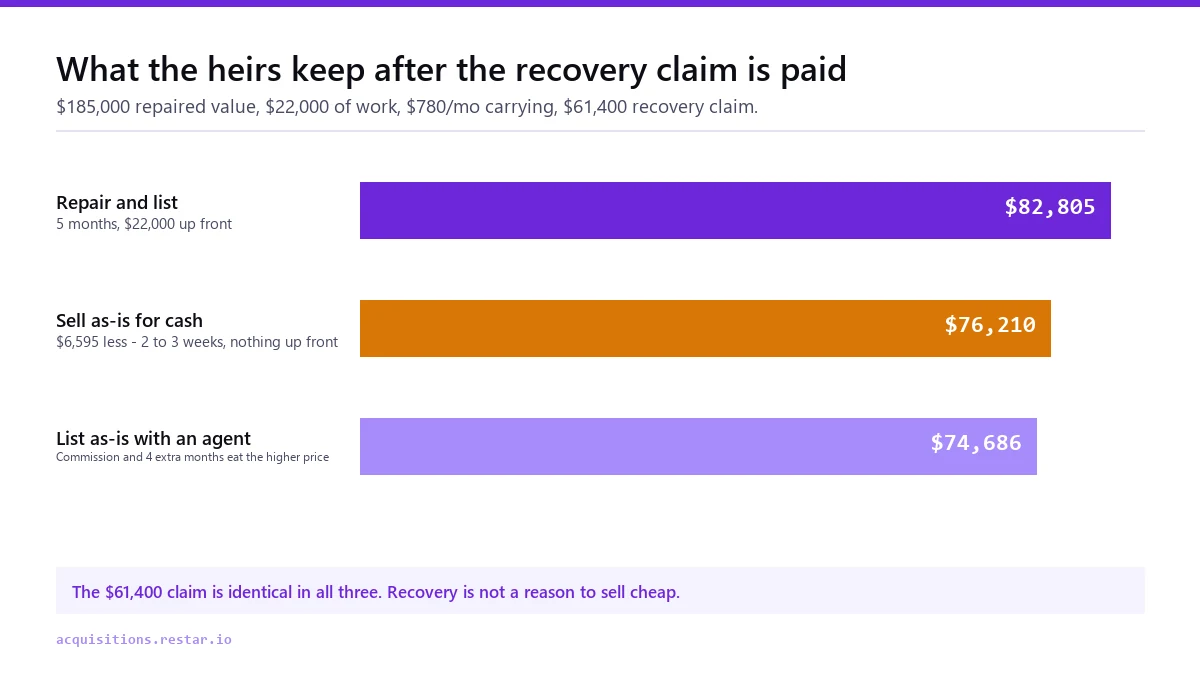
Here is the part families most need and almost never see written down. Assume a house with a repaired value of $185,000, no mortgage, needing about $22,000 of work — roof, one bathroom, flooring, paint. Carrying costs are $780 a month in taxes, insurance, utilities and yard care. The recovery notice states the program paid $61,400.
What the heirs keep after the recovery claim is paidRestar Acquisitions · worked example from this page
Route
Repair and list
Sell as-is for cash
List as-is with an agent
Sale price
$185,000
$138,000
$152,000
Repairs
−$22,000
—
—
Agent commission
−$10,175
—
−$8,360
Seller closing costs
−$2,220
covered
−$1,824
Holding costs
−$3,900
−$390
−$2,730
Buyer concessions
−$2,500
—
−$3,000
Estate proceeds
$144,205
$137,610
$136,086
Recovery claim
−$61,400
−$61,400
−$61,400
To the heirs
$82,805
$76,210
$74,686
An illustration on one hypothetical house, not a quote and not a prediction. Your figures will differ.
Read the bottom row honestly. Repairing and listing keeps the most — $6,595 more than a cash sale. That is the true cost of speed here, and if the estate has $22,000 available and five months of patience, that is the route with the better number. We are not going to pretend otherwise.
But notice the third column. Listing the house as-is through an agent — the option families reach for when they cannot fund repairs — comes out slightly behind a cash sale in this example, because commission, concessions and four extra months of carrying costs eat the higher price. The choice is rarely “cash versus the market.” It is usually “can this estate fund and supervise a renovation, or not.”
And note what does not change: the $61,400 claim is identical in all three columns. Recovery is not a reason to accept a low price. It comes off the top either way, so the only thing you control is how large the pile is before it does.
How the claim gets paid when you sell
Mechanically, settling a Medicaid estate recovery claim is less alarming than it sounds. In most states the sequence looks like this.
The estate opens, or a small-estate procedure is used. Many states require notice to the Medicaid agency or its recovery contractor when an estate is opened. Missing that notice can extend the window in which the state can act.
The claim is presented in writing. It should state the amount and the period of service. Ask for the itemization.
Title search finds it. If the state recorded a lien, it shows up in the search and must be cleared before a title company will insure the sale. If it did not record a lien, the claim still has to be dealt with as an estate debt — distributing sale proceeds to heirs while a valid claim is outstanding is how a personal representative ends up personally liable.
It is paid at closing, from the proceeds, and released. Exactly like a mortgage payoff. The closer requests a payoff figure and a release, and the number comes off the settlement statement. Our guide to selling a house with a lien on it covers the general mechanics.
The practical planning point is timing. Payoff figures and releases from a state agency or its contractor are frequently the slowest item in the file — weeks, not days. Request the payoff the moment the house goes under contract, not the week of closing, or you will watch a clean deal miss its date over a piece of paper.
If the sale will not cover the claim, say so early. Some states will accept the net proceeds in satisfaction rather than force a probate fight over a shortfall, but that is a negotiation to start before you are at a closing table.
What this means for your decision
For most families, the honest answer is the unglamorous one: get the hardship question answered first, then list the house with an agent. Medicaid estate recovery does not put you on a clock the way a foreclosure sale date does. If the estate can fund repairs and wait a few months, the open market pays more than a direct buyer will — ours included — and the extra proceeds go to the heirs, not to the state, because the claim is fixed.
A cash sale earns its place on a narrower set of facts: the estate has no liquidity to fund repairs or carry the house, the property is vacant and deteriorating while probate grinds on, the heirs are scattered and nobody can supervise contractors, or there is a hardship application that needs a defined figure and a firm date rather than an open-ended listing. Those are real situations and there is nothing wrong with choosing speed in them. Just choose it with the table above in front of you.
What we would push back on, hard, is the fear-driven version of this decision — selling quickly and cheaply because a letter from the state felt frightening. The claim is a fixed number. Panic costs the heirs money and buys them nothing.
Alternatives to consider
Apply for the undue hardship waiver — first, and on the deadline in the letter. It is the only route that can reduce the claim itself rather than the cost of paying it.
Ask for an itemized accounting and check it — against dates of service and coverage periods. Claims contain errors, and reviewing one costs nothing.
Negotiate a compromise — many states will settle a claim, particularly where forcing a sale would produce less than a cooperative one.
List it with an agent — the highest-net route whenever the estate can fund repairs and carry the property.
List it as-is — slower and commissioned, but it reaches retail buyers without a renovation budget.
An heir buys the house from the estate — the claim is satisfied from the purchase price and the house stays in the family. Needs an independent valuation to be fair to the other heirs.
Rent it out — only if the estate can stay open long enough and someone will actually manage it. See holding costs of a vacant house for what waiting really costs.
Sell as-is for cash — right when the estate has neither the money nor the time to do anything else.
Common questions
Can Medicaid take my parent's house after they die?
The state can make a claim against the estate for what it paid for long-term care after age 55, and the house is usually the only asset big enough to satisfy it. It is a claim to be repaid rather than a seizure, so the house is normally sold and the claim paid from the proceeds. Recovery is barred where there is a surviving spouse, a child under 21, or a blind or disabled child of any age.
The caseworker said the house was exempt. Why is there a claim now?
Because those are two different rules. The home exclusion applies to eligibility, so nobody has to sell their house to qualify for care. Estate recovery is a separate question asked after death about whether the state can be reimbursed from what was left behind. Being exempt for eligibility does not protect the house from recovery afterwards.
Does selling the house get rid of a Medicaid estate recovery claim?
No. Selling converts the house into money the claim can be paid from. In practice the payoff comes off the settlement statement at closing, like a mortgage, and the state releases its claim or lien. Distributing proceeds to heirs while a valid claim is outstanding can leave the personal representative personally liable.
How much can the state recover?
No more than Medicaid actually paid on that person's behalf for the recoverable categories of care, and no more than the estate contains. That is the state's paid rate, which is generally lower than a facility's private-pay rate. Ask for an itemized accounting rather than accepting the figure in the notice at face value.
What is the undue hardship waiver and who qualifies?
Every state must have a procedure for waiving recovery where it would cause undue hardship. Standards vary, but common grounds include the property being the survivors' sole income-producing asset, an heir having lived in the home and facing homelessness, or recovery leaving survivors on public assistance. Deadlines are short and often measured in weeks from the notice, and the estate has to apply.
Do I have to sell the house quickly because of the claim?
Usually not. Unlike a foreclosure sale date, a recovery claim is a fixed amount that does not grow with time in most states, so rushing rarely helps and generally costs the heirs money. The exceptions are a short hardship-application deadline, a vacant property that is deteriorating, or an estate with no cash to carry the house.
If a recovery claim is sitting against a house you have inherited, the useful thing early on is a number you can plan against — whether or not you sell to us. We will put ours in writing with the reasoning behind it, so the estate has something concrete to weigh against a listing.
Send us the property here. Get a broker price opinion too. Two numbers beat one, and the estate is better off for having both.
Every offer on this site is underwritten by a person, not a form. If the
numbers do not work for you, say so and I will tell you what would.
Also from Restar
Want the data behind all of this?
Restar Acquisitions is the acquisitions arm of Restar — a housing-market analytics
platform tracking 180+ metrics across every U.S. market, with composite scores and 12-month
price forecasts. The numbers on this page come from the same work.