Every market page publishes the numbers behind its offer. See the math
Home › Guides › Selling a House With a Life Estate: Who Signs, Who Gets Paid
Guide
Selling a House With a Life Estate: Who Signs, Who Gets Paid
Selling a house with a life estate goes wrong the same way almost every time: nobody realizes until the closing table that no single person owns the whole thing. A life estate deed is one of the most common pieces of do-it-yourself estate planning in America, and one of the least understood by the people who end up living with it. Mom deeded the house to the kids years ago and kept the right to live there for life. Now it has to be sold. This page explains exactly who has to sign, how the money divides between the life tenant and the remaindermen, and the tax consequence of selling during the life tenant's lifetime that catches almost every family by surprise.
Takes about two minutes. Or call
(313) 710-6129 — we answer.
Educational only. This explains how these situations generally work. It is not legal, tax or financial advice, and the rules differ by state — talk to an attorney or CPA about your own situation before you act on any of it.
Selling a house with a life estate: the short answer
Selling a house with a life estate normally requires every owner to sign: the life tenant and every remainderman. The life tenant alone cannot convey clear title. Proceeds are then split between them using an actuarial factor based on the life tenant's age.
General information, not legal or tax advice. Life estates are creatures of state property law and the rules differ meaningfully between states. Talk to a real estate attorney and a CPA about your own situation before you sign anything.
What a life estate actually is
A life estate splits ownership of a property along the axis of time rather than space. The life tenant holds the right to possess, use and take the income from the property for as long as they live. The remainderman — or more often, several remaindermen — holds the remainder interest, which is the right to own the property outright the moment the life tenant dies.
Both of these are real, present ownership interests. That is the part people miss. The remaindermen do not inherit the house later in the way a will beneficiary does; they own something today. Their interest is on the deed, it can be attached by their creditors, and it has to be dealt with in a divorce. Equally, the life tenant is not a tenant in the renting sense. They cannot be evicted, they generally owe the property taxes, insurance and ordinary upkeep, and under the old doctrine of waste they cannot let the place fall down or strip value out of it to the detriment of the people who come after.
Families usually create these deeds for one of three reasons: to avoid probate on the house, to start a clock running for Medicaid planning, or simply because a form was cheap and a lawyer seemed expensive. All three work reasonably well right up until somebody needs to sell.
Who has to sign
This is the question that stalls these sales, and the answer is unwelcome but simple. Selling a house with a life estate is not one signature, it is all of them. To convey full, clear, insurable title before the life tenant dies, everyone on the deed signs: the life tenant and every single remainderman. Not a majority of them. All of them.
The reason is title insurance rather than law in the abstract. A title company is being asked to insure that the buyer gets the whole property. If one remainderman has not signed, that person still owns a slice of the future, and no underwriter will insure around it. Our guide to title insurance cost covers what the underwriter is actually agreeing to.
Two things a life tenant can do alone are worth naming, because they get suggested and they rarely help:
Sell the life estate interest by itself. Legally possible in most states. Practically almost worthless — you are offering a stranger the right to occupy a house for exactly as long as an unrelated person happens to keep living, after which they own nothing. There is no real market for this.
Rent the property out. A life tenant is generally entitled to the income during their life. This matters, because it is sometimes a genuine alternative to selling — see the alternatives at the bottom of this page.
And one thing remaindermen cannot do alone: force the life tenant out or sell the house over their objection. The life estate is a possessory right. Buying out the life tenant is a negotiation, not a remedy.
The lady bird deed exception
There is an important variant that reverses the signing rule, and if you have one you need to know it before you start rounding up signatures.
An enhanced life estate deed — widely called a lady bird deed — keeps a retained power in the life tenant to sell, mortgage or give the property away during their lifetime without the remaindermen's consent. If the deed contains that reserved power, the life tenant can sign a deed on their own and the remainder interest is simply extinguished. The remaindermen receive nothing and have no say.
These deeds are recognized in only a handful of states. Florida, Texas and Michigan are three of them, and all three are markets we buy in, so we see this regularly. Ohio, Indiana, Georgia, Maryland, New York, North Carolina, Alabama and Arizona generally do not offer this instrument, though several have their own transfer-on-death deed that does a related job. Do not assume from a neighboring state.
How to tell which one you have: pull the recorded deed and read the granting language. A plain life estate reserves a life estate and stops. An enhanced one reserves the life estate and a power to sell, convey, mortgage or otherwise dispose of the property during the grantor's lifetime without the joinder of the remaindermen. That clause is the whole difference. If the wording is ambiguous, that is a question for an attorney and not for a cash buyer, ourselves included.
How the sale proceeds divide
Once the house sells, the net proceeds have to be split between the life tenant and the remaindermen, because both gave up something. The split is not fifty-fifty and it is not negotiable-by-vibes. It is actuarial.
The convention, and the method the IRS uses, is to value the life estate as a function of two inputs: the life tenant's age and the interest rate in force for the month of the sale — the rate published under section 7520. Those two numbers produce a life estate factor between 0 and 1. The remainder factor is whatever is left over. An older life tenant produces a smaller life estate factor, because the expected occupancy is shorter.
Here is the arithmetic on a house that nets $216,045, with a life tenant of 78 and an illustrative factor of 0.35:
Factor
Share of net proceeds
Life tenant
0.35
$75,616
Remaindermen (three, equally)
0.65
$140,429 — $46,810 each
Total net
1.00
$216,045
The 0.35 is an illustration so the mechanics are visible, not a quoted figure. Your real factor comes from the IRS table for the life tenant's actual age and the rate for the month you close. Ask the closing attorney or your CPA to pull it — it takes them about two minutes and it is the number the split should run on.
The family can agree to divide it differently, and often does — frequently the children direct their entire share to the parent, because the parent needs the money to fund care and the children were never counting on it. That is a perfectly ordinary outcome. But it should be a deliberate decision made with the actuarial number in front of everybody, not an accident of who happened to be at the closing table. And be aware that a materially uneven split can have gift tax consequences worth asking a CPA about before, not after.
The tax trap: no step-up on a lifetime sale
This is the most expensive thing on this page, and it is the reason a family should price the tax before deciding to sell rather than wait.
When a life tenant dies holding a retained life estate, the whole property is generally pulled back into their taxable estate, and the remaindermen take it with a stepped-up basis — their cost basis resets to the value at the date of death. Sell it the following week and the taxable gain is close to nothing. That is the single biggest tax advantage a life estate deed carries, and it is why these deeds get recommended in the first place.
Sell during the life tenant's lifetime and none of that happens. There is no death, so there is no step-up. Each owner takes their proportionate share of the original cost basis and pays tax on their share of the gain. The life tenant may be able to shelter their portion with the primary-residence exclusion if they have lived there and meet the tests in IRS Publication 523. The remaindermen almost certainly cannot, because they do not live in the house.
Run it on the same sale. If the parent originally paid $78,000 for the house, the remaindermen's 0.65 share of that basis is $50,700. Their share of the proceeds is $140,429. That is a taxable gain of $89,729, and at an illustrative 15% federal long-term rate it is roughly $13,459 in federal tax — about $4,486 each, before any state tax.
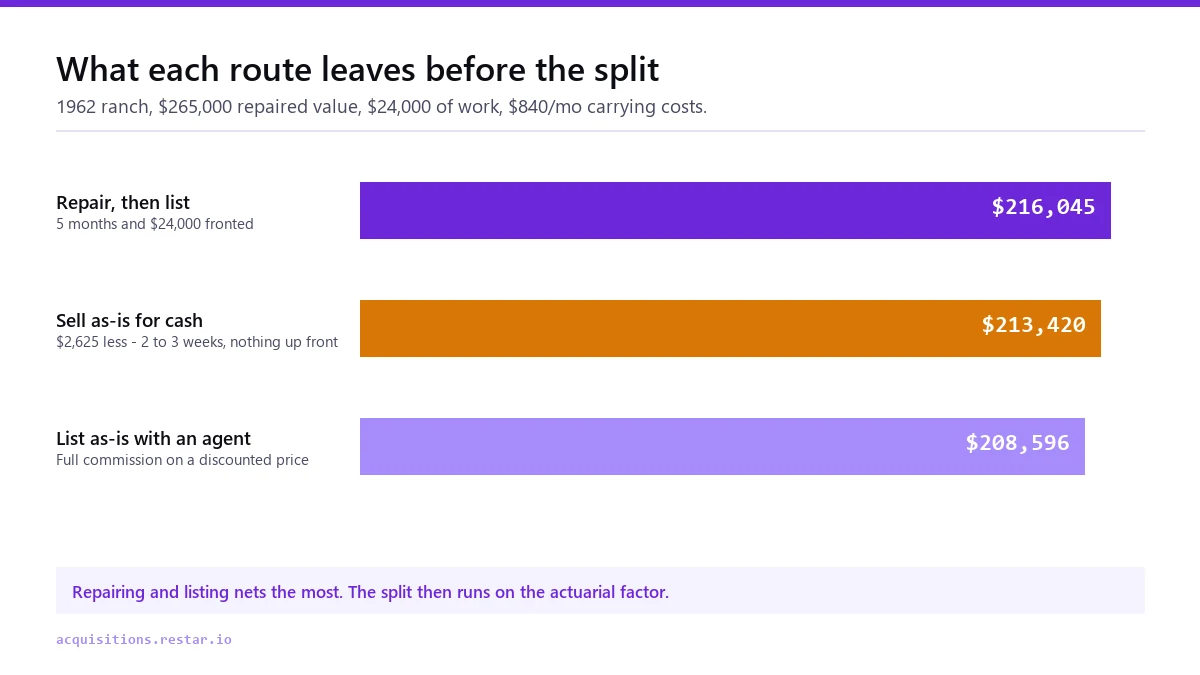
What each route leaves before the splitRestar Acquisitions · worked example from this page
Rates and outcomes vary with income, state and holding period, and the rules on retained life estates are genuinely technical. This is an illustration of the mechanism, not a computation of your bill. A CPA should run your actual numbers.
So the practical upshot of selling a house with a life estate during the life tenant's lifetime is not “never sell early.” It is that waiting can be worth real money, and that money should be weighed against the cost of waiting — the carrying costs, the deterioration of an empty house, and whether the life tenant needs the proceeds now to pay for care. Sometimes a $13,000 tax bill is the cheapest way to fund a year of assisted living. Just make it a decision rather than a surprise.
What the house is actually worth in each route
Selling a house with a life estate does not change the sale arithmetic itself, which obeys the same rules as any other. Here is a 1962 ranch worth $265,000 repaired, carrying about $840 a month in taxes, insurance, utilities and upkeep, and needing $24,000 of work:
Repairing and listing nets the most — $2,625 more than a cash sale. We would rather say that plainly than pretend otherwise. If the family has $24,000 to front, five months to wait, and someone with the time to manage contractors on a house nobody lives in, that is the route with the highest number at the end.
What the table also shows is that the gap is smaller than most people expect, and that listing as-is is the weakest of the three here — it pays a full commission on a discounted price and still absorbs four months of carrying costs. The cash route's advantage is not the price. It is that it requires no money up front from a family that may not have any, no coordination between three siblings in three states, and no empty house sitting through a winter.
There is also a wrinkle specific to life estates: a house occupied by an elderly life tenant is often in worse condition than the family believes. Deferred maintenance accumulates quietly. If the $24,000 estimate turns out to be $40,000 once the work starts, route one stops being the winner. Our guide on whether to repair before selling covers how to price that risk, and cash offer vs listing net proceeds works the comparison in more detail.
If a remainderman will not sign
It happens constantly, and usually for ordinary human reasons rather than malice: one sibling thinks the price is too low, one is not speaking to another, one cannot be found, one is going through a divorce and their attorney has told them to sign nothing.
Buy their interest out. The cleanest fix. Price it off the actuarial share so the number is defensible rather than a guess. Get it papered by an attorney.
Find out what the objection actually is. Very often it is not the price but the process — a sibling who found out about the sale from someone else. A second written offer, or an appraisal everyone can see, resolves more of these than anything else.
Mediation. Far cheaper than litigation and it preserves the possibility of a family Christmas.
Partition. A court action to force a sale of co-owned property. Available in many states as against co-remaindermen, but slow, expensive, public, and it will not disturb the life tenant's possessory right. Treat it as the last resort it is. Our guide on when heirs cannot agree to sell goes through the mechanics.
Wait. Genuinely an option, and given the step-up analysis above, sometimes the financially correct one.
One thing to avoid: do not sign a purchase contract that you cannot perform. If three of four remaindermen sign a contract and the fourth refuses, you have not sold a house — you have created a broken contract and, quite possibly, an earnest money dispute. Confirm every signature is available before anyone signs anything. Any buyer worth dealing with will want the same confirmation.
Medicaid, and why the timing matters
A great many life estate deeds exist for Medicaid reasons, and selling the house can undo the planning that the deed was created to do.
The broad shape, which varies by state: transferring the remainder interest starts a look-back clock, and once the house is in a life estate, the property may be treated differently from a countable asset for eligibility purposes. Selling converts the house into cash, and cash is countable. A life tenant on Medicaid, or applying, can go from eligible to ineligible on the day the sale closes, and the proceeds share they receive may have to be spent down before benefits resume.
There is also the recovery side. States are required to seek recovery from the estates of certain Medicaid recipients after death, and states differ sharply in whether a life estate that has already terminated is within reach. Our guide to Medicaid estate recovery and selling the house covers that in detail.
If Medicaid is anywhere in this picture, an elder law attorney is not optional and is not expensive relative to what is at stake. We would say that even if it cost us the deal, because the alternative is a family that sells a house and loses a benefit worth several times the proceeds. Get the advice first, then decide about selling.
Alternatives to consider
Wait for the step-up. If the life tenant is comfortable, the house is maintained and nobody needs cash, waiting can be worth more than any price difference between routes.
Rent it out. A life tenant is generally entitled to the income. If the life tenant has moved to care and the house is sound, renting can fund that care without triggering the sale analysis at all. Our guide on renting versus selling runs those numbers.
List it with an agent. Highest net on this page if the house can be repaired and shown, and the right answer for most life estate houses that are in decent shape.
Buy out one interest. Children buy the life estate, or the parent buys the remainder. Either collapses the split into one owner who can then sell normally.
Check for a lady bird deed. If you have one, most of this page's difficulty disappears. Read the deed before you organize anything.
Terminate the life estate by agreement. In most states everyone can simply join in a new deed. Same signatures, but done once and calmly rather than under a closing deadline.
Common questions
Can a life tenant sell the house without the remaindermen?
Not with an ordinary life estate. Selling a house with a life estate needs every owner on the deed, and a life tenant can sell only their own life interest, which has almost no market, and a title company will not insure a full transfer without every remainderman signing. The exception is an enhanced life estate or lady bird deed, recognized in Florida, Texas, Michigan and a few other states, which reserves the power to sell without the remaindermen's consent.
How are the proceeds split between the life tenant and the remaindermen?
By an actuarial factor based on the life tenant's age and the section 7520 interest rate for the month of sale. An older life tenant gets a smaller share because the expected occupancy is shorter. The closing attorney or a CPA can pull the current factor from the IRS table. Families can agree to divide it differently, but the actuarial number should be visible to everyone first.
Do you get a step-up in basis if you sell a life estate house before death?
No. The step-up happens at death, when a retained life estate property is generally included in the life tenant's estate. Sell during the life tenant's lifetime and each owner uses their share of the original cost basis instead. The remaindermen usually cannot use the primary-residence exclusion either, because they do not live there, so their share of the gain is typically taxable.
What happens to Medicaid if we sell the house?
Selling converts a house into cash, and cash is a countable asset for eligibility. A life tenant who is on Medicaid or applying can lose eligibility on the day the sale closes and may have to spend down their share of the proceeds. State rules on estate recovery also vary considerably. Speak to an elder law attorney before selling, not after.
Can one remainderman block the sale?
With an ordinary life estate, yes. Clear title needs every signature, so one holdout stops a normal sale. The usual routes forward are buying out that interest at its actuarial value, mediation, or a partition action in states that allow it against co-remaindermen. Partition is slow, public and expensive, so treat it as a last resort.
How do I tell whether I have a lady bird deed?
Pull the recorded deed from the county and read the granting language. A plain life estate reserves a life estate and stops there. An enhanced life estate deed additionally reserves a power to sell, convey or mortgage the property during the grantor's lifetime without the remaindermen joining. That reserved power is the entire difference, and if the wording is unclear it is a question for an attorney.
Do the remaindermen have to pay the property taxes?
Usually not. The life tenant generally carries the ordinary costs of possession, which typically means property taxes, insurance and routine maintenance, while the remaindermen are not responsible for those during the life tenancy. Major structural repairs are less clear cut and the allocation varies by state, which is a common source of family disputes worth settling in writing early.
Most life estate sales stall because nobody has a real number to argue about. A written as-is offer gives the family something concrete to weigh against repairing and listing, and against simply waiting.
We buy in our own name and we will tell you when listing is the better route — on the example on this page, it was. Send us the property here, and please talk to an attorney about the deed before anyone signs.
Every offer on this site is underwritten by a person, not a form. If the
numbers do not work for you, say so and I will tell you what would.
Also from Restar
Want the data behind all of this?
Restar Acquisitions is the acquisitions arm of Restar — a housing-market analytics
platform tracking 180+ metrics across every U.S. market, with composite scores and 12-month
price forecasts. The numbers on this page come from the same work.