Selling a house with a failing retaining wall — cracking, bulging, leaning, or already partially collapsed — means disclosing a material defect in most states, and the wall typically needs a permit and an engineer's stamp to fix if it's over about 4 feet tall. It's usually excluded from homeowners insurance as earth movement. None of that has to be resolved before a cash sale can close.

Step 1 of 5
Tell us about the wall and whether an engineer has looked at it. We'll give you a straight answer, including when rebuilding it and listing nets more.
You’ll talk to Trevor McAmis, Owner & Acquisitions Lead
(313) 710-6129
Takes about two minutes. Or call (313) 710-6129 — we answer.
Educational only. This explains how these situations generally work. It is not legal, tax or financial advice, and the rules differ by state — talk to an attorney or CPA about your own situation before you act on any of it.
A retaining wall holds back soil or a slope; your house's foundation holds up the house. They're separate structures, though a failing retaining wall can eventually undermine a foundation if the soil it was holding back shifts or erodes toward it. If your actual issue is cracking or settling in the house itself, see our guide on selling a house with foundation problems instead — this guide is specifically about a wall built to hold back earth: gravity block, segmental/modular block, poured concrete, or timber.
Repair and replacement costs vary a lot depending on whether the wall needs a localized fix or a full rebuild, and these figures all come from contractor-estimate aggregators (HomeAdvisor, Fixr), not government data:
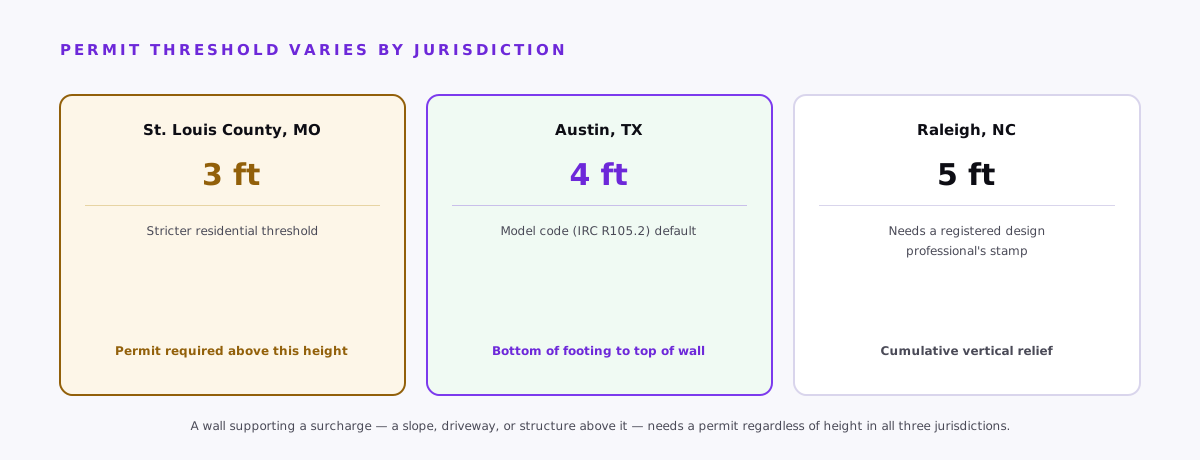
The model building code (IRC Section R105.2) exempts a retaining wall under 4 feet tall, measured from the bottom of the footing to the top, from needing a permit — unless the wall supports a surcharge (a slope, driveway, structure, or parked vehicles above it), in which case the exemption doesn't apply regardless of height. Austin, Texas adopts that identical 4-foot/surcharge-exception rule locally. (HomeAdvisor)
But jurisdictions genuinely differ. Raleigh, North Carolina's threshold is cumulative vertical relief over 5 feet, not 4, and requires a design stamped by a North Carolina-registered design professional. Some Missouri jurisdictions, including St. Louis County, set a stricter 3-foot threshold for residential walls. The practical rule: check your local building department before assuming any specific number, and know that a wall supporting a surcharge can require a permit and engineering regardless of its height.
Standard homeowners policies carry an earth movement exclusion that eliminates coverage for loss from "earthquake... landslide, mudslide or mudflow, subsidence or sinkhole, and any other earth movement including earth sinking, rising or shifting," regardless of cause — a provision found in most property insurance policies, even broad "all-risk" ones. (IRMI, earth movement exclusion)
Retaining walls are typically covered under a policy's "Other Structures" section, and can be paid for if the wall collapses from a sudden, named covered peril — a falling tree, lightning, wind. What's almost never covered is the more common failure mode: gradual soil pressure, poor drainage, or long-neglected hydrostatic pressure building up behind the wall until it bulges or gives way. That's earth movement, and it's excluded. If your wall is failing from ordinary age and water pressure rather than a single storm event, budget for the repair yourself rather than expecting your insurer to step in.
Where a retaining wall holds up soil that would otherwise shift onto or away from a neighboring lot, the common-law doctrine of lateral and subjacent support can make a landowner who removes that support strictly liable for resulting damage to a neighbor's property, regardless of negligence, in many jurisdictions. Who actually carries the maintenance obligation when a wall sits on or near a property line is fact-specific — it depends on the survey, who built it, and what any recorded covenant says — so this is a question for a local real estate attorney, not a rule to assume one way or the other.
Retaining wall failures are not a hypothetical risk. A North Carolina jury awarded $101 million in May 2026 in a wrongful-death and injury case after a commercial retaining wall — rebuilt without engineering plans or permits, and backfilled before the concrete had properly cured — collapsed and killed a mason in 2021. A 40-foot wall in Ossining, New York collapsed in 2018 after heavy rain and destroyed the rear of a commercial building. Both are commercial examples, not residential disclosure cases, but they're a real illustration that a failing retaining wall is not a cosmetic problem.
This is educational information, not legal or engineering advice. Whether your specific wall needs a permit, an engineer's stamp, or creates liability exposure to a neighbor depends on your local code and your property's actual survey — confirm with your building department and a real estate attorney before you do anything.
Only two of the states Restar buys in have confirmed, name-it-directly disclosure line items for retaining walls on their standard seller disclosure forms: Texas's TREC Seller's Disclosure Notice lists "Retaining walls and/or fill (compacted soil)" as its own checkbox, separate from fences and drainage. (TREC Seller's Disclosure Notice) Georgia's standard form asks directly whether there are "any problems with driveways, walkways, patios, or retaining walls." Ohio's statutory disclosure form (Ohio Rev. Code §5302.30) and North Carolina's don't name retaining walls specifically — they fold the question into a broader structural-components or material-defect category instead. Don't assume "my state's form doesn't say 'retaining wall'" means you're off the hook: a known failing wall is a material defect that affects value, and nearly every state's general disclosure duty reaches it whether or not the form uses that exact phrase.
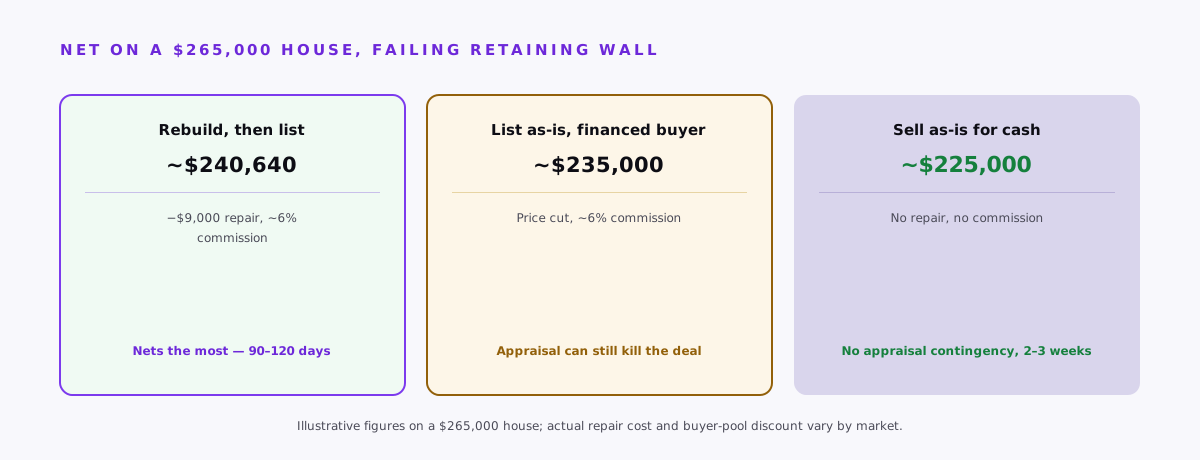
Worked on a $265,000 house with a retaining wall that's visibly leaning and partially separated from its footing, confirmed by a contractor to need full replacement with an engineer's stamp (the wall is over 4 feet and supports a sloped backyard):
| Route | Gross price | Repair cost | Commission | Net to seller | Timeline |
|---|---|---|---|---|---|
| Rebuild the wall with an engineer's stamp, then list | $265,000 | −$9,000 (replacement near the top of the typical range, plus engineering) | ~6% (−$15,360) | ~$240,640 | 90-120 days: permit, engineering, construction, then a normal listing |
| List as-is with a price concession, financed buyer | $250,000 (price reflects the known defect) | $0 upfront | ~6% (−$15,000) | ~$235,000 | 60-90+ days, with real risk: an appraiser or FHA/VA inspector can flag the wall as a safety issue requiring repair before closing, which can delay or kill the deal |
| Sell as-is to a cash buyer | $225,000 | $0 | $0 | ~$225,000 | 2-3 weeks, no appraisal contingency |
Rebuilding the wall before listing nets the most here if you can front the repair cost and wait out the construction timeline. Listing as-is with a price cut looks attractive on paper but carries real closing risk with a financed buyer, since a failing retaining wall is exactly the kind of safety issue an appraiser can flag as a repair condition — which can reopen negotiations or kill the deal weeks into escrow. A cash sale is worth the lower number specifically when you can't front $9,000 and 90+ days, or when you'd rather not gamble on a financed buyer's appraisal going smoothly.
If you can front the repair cost and the engineering timeline, rebuilding before you list usually nets more — we'd tell you that directly.
Where a cash sale earns its place is when you can't front the repair cost, or you'd rather not risk a financed buyer's appraisal flagging the wall mid-escrow. Send the address and we'll send a written offer within 24 hours. No cost, no obligation.
All guides · Selling a house with foundation problems · Cost of a property survey before selling a house · How cash home buyers calculate offers
Step 1 of 5
No obligation, no fees, no repairs. We respond the same day.
You’ll talk to Trevor McAmis, Owner & Acquisitions Lead
(313) 710-6129
Takes about two minutes. Or call (313) 710-6129 — we answer.