Yes — you can sell a house with foundation problems. A hairline crack rarely stops a sale, but visible settlement, a sloping floor, or a structural engineer's report can scare off financed buyers and slow a retail sale down. A cash buyer can often move forward without requiring the repair to happen first; a retail buyer usually nets more once the fix is done, but that route costs time and money up front. Foundation problems have a way of showing up at the worst possible moment — a door that's stopped closing right, a crack that's widened since last spring, a buyer's inspector on his knees in the crawlspace with a flashlight. Most of the time it isn't catastrophic. Sometimes it is. Either way, once a foundation issue is on paper — in an inspection report, an appraisal note, or your own disclosure — it changes how a sale plays out, and it's worth understanding exactly how before you're negotiating under pressure. This guide covers what actually causes foundation problems, realistic repair costs, what you're required to disclose, how the issue surfaces in a financed sale, and the honest math on repairing-then-listing versus selling as-is.

Step 1 of 5
Send the address and we'll tell you honestly whether repairing it first and listing retail would net you more.
You’ll talk to Trevor McAmis, Owner & Acquisitions Lead
(313) 710-6129
Takes about two minutes. Or call (313) 710-6129 — we answer.
Educational only. This explains how these situations generally work. It is not legal, tax or financial advice, and the rules differ by state — talk to an attorney or CPA about your own situation before you act on any of it.
Most foundation damage in the U.S. traces back to soil movement, not bad concrete. Expansive clay soil swells when it absorbs water and shrinks as it dries, pushing and pulling unevenly on a foundation until something cracks or settles. Poor drainage, leaking pipes, tree roots, and frost heave make it worse. Settling alone isn't automatically a red flag — what matters is whether it's ongoing.
State geological surveys treat expansive soil as one of the most common — and most expensive — hazards a house can sit on. Colorado's state geological survey calls it the state's most damaging geologic hazard, causing more dollar damage annually than floods, earthquakes, and tornadoes combined (Colorado Geological Survey: Expansive Soil and Rock). Virginia's Department of Energy geology division notes the same dynamic plays out nationally, worsened by drought-then-saturation cycles, water rerouted by poor drainage or leaking pipes and downspouts, and moisture drawn out by large trees planted too close to the house (Virginia Energy: Expansive Soils).
A few other causes show up regularly alongside expansive soil: frost heave in colder climates, where freeze-thaw cycles shift soil under a shallow footing; long-term plumbing leaks that saturate soil under a slab; and, less commonly, a foundation that was simply under-built for its soil conditions in the first place. Nearly every house settles some in its first years — what matters is whether the movement is ongoing and how much has actually happened.
Foundation repair costs range from a few hundred dollars for a stable hairline crack to tens of thousands for structural underpinning, depending almost entirely on severity, region, and foundation type. The national average total project cost was roughly $11,950 in 2026. Treat every figure below as a general range, not a quote for your specific house.
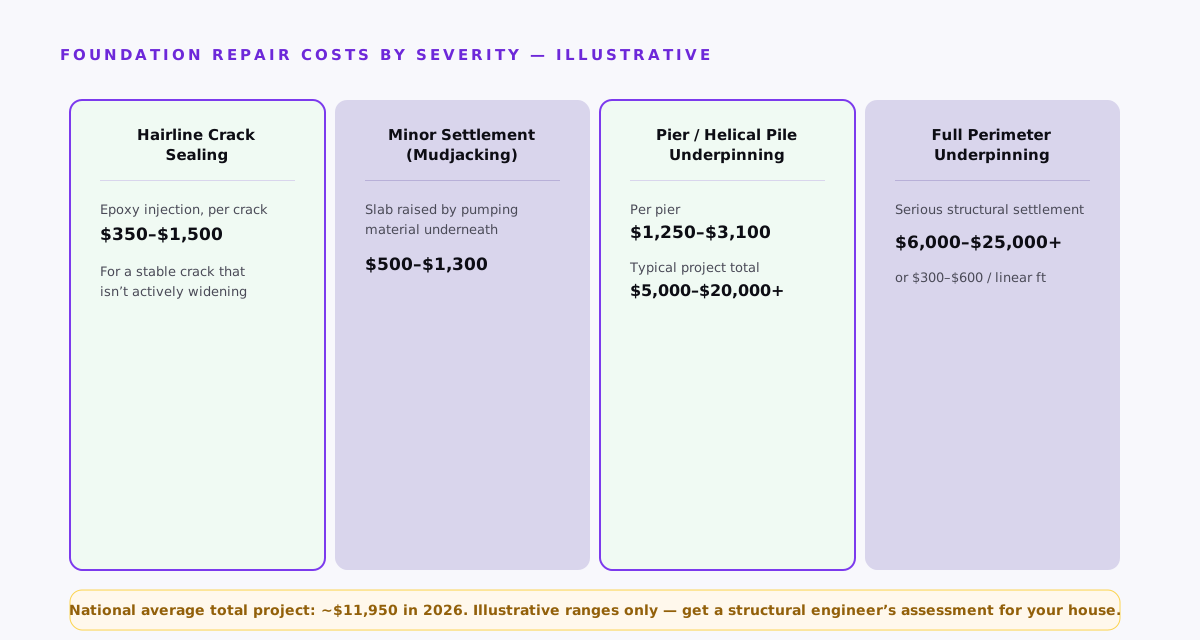
Hairline crack sealing or epoxy injection: roughly $350–$1,500 per crack, for a stable crack that isn't actively widening.
Minor settlement (mudjacking or slabjacking): roughly $500–$1,300, for a slab that's settled slightly and can be raised by pumping material underneath it.
Pier or helical pile underpinning: roughly $1,250–$3,100 per pier, with a typical project running $5,000–$20,000 or more depending on how many piers a structural engineer specifies.
Full perimeter underpinning: roughly $6,000–$25,000 or more, sometimes priced at $300–$600 per linear foot for serious, structural settlement.
HomeAdvisor and Angi (shared ownership, aggregated cost data) put the national average total foundation repair project at roughly $11,950 in 2026, up about 18% since a 2023 trough (HomeAdvisor: Foundation Repair Cost). These figures are national averages pulled from contractor and homeowner-reported data, not a quote for any specific property, soil type, or state.
One thing worth knowing before you call your insurance company: standard homeowners insurance generally does not cover foundation damage caused by soil settlement or earth movement, because insurers treat it as a gradual, preventable process rather than a sudden, accidental loss (NerdWallet: Does Homeowners Insurance Cover Foundation Repair?). A foundation crack caused by a sudden covered event — a burst pipe, a fire, a falling tree — is a different story and is more likely to be covered; ask your insurer directly about your specific policy and cause of damage.
Real estate law generally starts from "buyer beware," but that protection has a well-established limit: a seller who knows about a material defect and has a legal duty to disclose it isn't protected by hiding it. Cornell Law School's Legal Information Institute puts it plainly: "a seller who withholds material information when they have a duty to disclose is not protected by caveat emptor" (Cornell LII: Caveat Emptor).
A known, active foundation problem — visible cracking, a sloping floor, a prior repair, an engineer's report you've already received — is squarely the kind of thing most states' disclosure rules are built to catch. Exactly what you have to disclose, in what form, and under what penalty for getting it wrong varies meaningfully by state — some states require a specific written seller disclosure form with a line item for foundation or structural issues, others rely more on general fraud and concealment law. Confirm the specific requirement for wherever your property sits with a real estate attorney or your listing agent before you sign anything, rather than guessing based on what a neighboring state requires.
A financed buyer's home inspection is usually where a foundation issue becomes official, even if you already knew about it. The Consumer Financial Protection Bureau specifically flags a cracked foundation as the kind of serious inspection finding that can change a buyer's decision to move forward: "If there are serious flaws, such as a cracked foundation, you may decide that you don't want to buy this home after all" (CFPB: Schedule a Home Inspection). From there, a buyer will often bring in a structural engineer for a second opinion, and both FHA and VA loan programs require the foundation to be structurally sound as a baseline condition of loan eligibility — a serious, undocumented foundation issue can stall or kill financing on those loan types specifically, not just spook a cautious buyer.
Once an issue is documented, a lender will typically want it either repaired before closing or priced into a renegotiated offer, and the appraiser's valuation of the house will usually reflect the defect either way. That combination — inspection finding, lender requirement, lower appraisal — is what turns a foundation crack into a stalled closing rather than a quick negotiation.
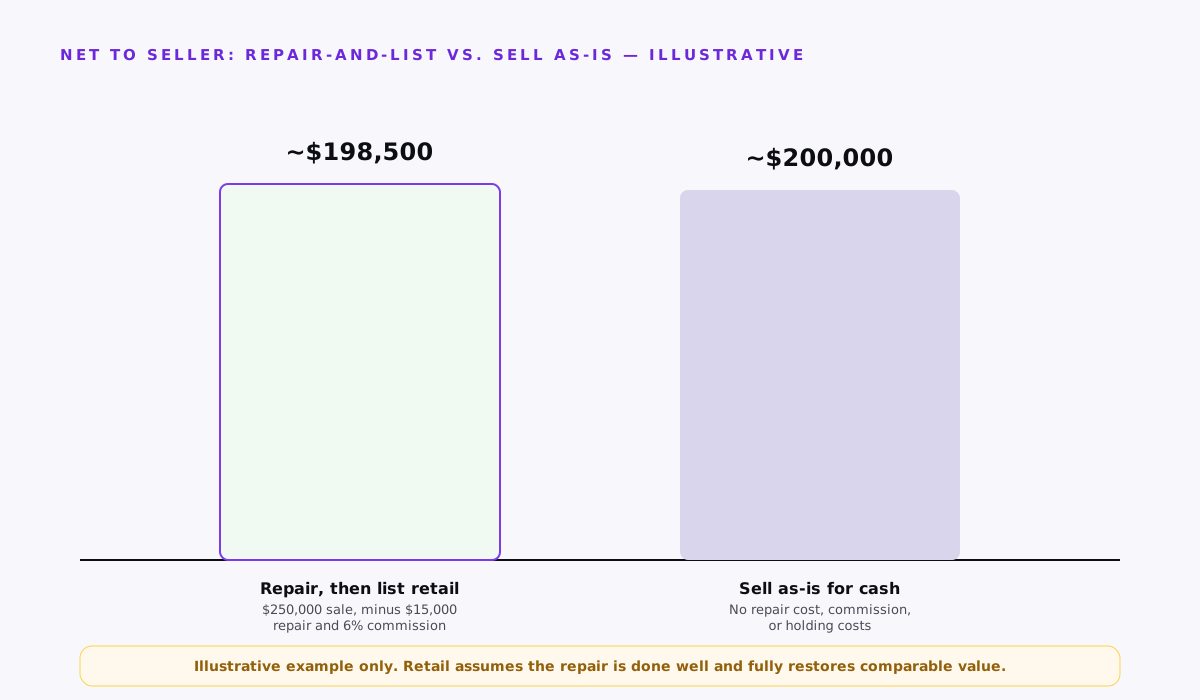
These numbers are illustrative only, built around a hypothetical $250,000 house with a documented $15,000 foundation repair, not a quote for your property.
| Repair, Then List Retail | Sell As-Is for Cash | |
|---|---|---|
| Repair cost before sale | ~$15,000, paid up front | $0 — buyer takes on the repair |
| Typical commission | ~6% of sale price | None |
| Time before you have cash in hand | Weeks of repair work, then a typical retail listing timeline | Days to a few weeks |
| Financing risk | Buyer's lender can still re-inspect and re-negotiate | Cash sale, no lender inspection contingency |
A fully repaired, retail-listed house with clean disclosures generally nets more than an as-is cash sale once you account for the repair cost and commission — but only if you have the cash to front the repair, the time to wait out a listing, and confidence the repair fully resolves the issue rather than surfacing again at the buyer's own inspection. A cash sale skips the repair cost, the commission, and the financing risk, but it typically prices in the unresolved defect and nets less than a fully repaired retail sale would. Run your own numbers with real contractor quotes before deciding; our cash offer vs. listing net proceeds guide walks through that comparison in more depth, and our should I repair before selling guide covers the repair-or-don't decision more broadly.
Selling as-is to a cash buyer isn't the only path once a foundation issue is on the table.
Get a structural engineer's assessment first. Before assuming the worst, a licensed structural engineer can tell you whether you're looking at cosmetic settling or an active structural problem — that distinction changes every other decision on this list.
Repair it, then list retail. If the numbers work and you have the time, a documented repair with a warranty from a reputable foundation contractor can put a house back on equal footing with an unaffected comparable.
Disclose it and price it in on a retail listing. Some buyers — particularly investors or handy buyers — will take on a known, disclosed foundation issue at a discounted price without requiring you to fix it first.
Sell as-is to a cash buyer. If you don't have the cash, the time, or the appetite to manage a foundation repair, an as-is sale lets a buyer take on the issue directly, typically at a lower price than a repaired retail sale.
Restar Acquisitions buys houses directly, as-is, for cash, in 45 markets across Alabama, Arizona, Florida, Georgia, Indiana, Maryland, Michigan, Missouri, New York, North Carolina, Ohio, and Texas. If your property is in one of those markets, we can typically give a written offer within 24 hours, and a known foundation issue — even an active one — doesn't automatically take you out of consideration, because we're not relying on a lender's structural soundness requirements the way a financed buyer would be.
We are not real estate agents, brokers, or structural engineers, and we do not represent you as a seller — we're a direct buyer, and our interests in a transaction are our own, not yours. As the comparison above shows, a repaired house sold retail usually nets more than an as-is cash sale, if you have the time and cash to get there. If that's the better fit for your situation, we'll say so.
This article is for general educational purposes only and is not legal, tax, financial, or structural engineering advice. Foundation issues vary enormously in cause and severity, and disclosure requirements vary by state. Talk to a licensed structural engineer about the condition of your house and a real estate attorney about your disclosure obligations before making a decision.
We'll give you a written offer within 24 hours and can work with a known foundation issue that would typically stall a financed retail sale — and if repairing it first and listing nets you more, we'll say so.
All guides · Should I repair before selling? · Cash offer vs listing net proceeds · Cost of lender-required repairs
Step 1 of 5
No obligation, no fees, no repairs. We respond the same day.
You’ll talk to Trevor McAmis, Owner & Acquisitions Lead
(313) 710-6129
Takes about two minutes. Or call (313) 710-6129 — we answer.
