<b>A drainage easement doesn't stop you from selling, but anything built inside it — a shed, a pool, a fence, fill dirt — can become the buyer's problem or yours before closing.</b> A drainage or stormwater easement is a recorded right, usually held by a city, county, or HOA, that lets water flow across a specific part of your land and restricts what you can build there to protect that flow. It's a different thing from a boundary dispute or a shared driveway, and the maintenance rules attached to it depend heavily on exactly which city or county you're in. Selling a house with a drainage easement means knowing what's actually recorded, whether anything on your property violates it, and who's responsible for keeping it clear. This guide covers what these easements actually restrict, who enforces them, what it costs to fix a violation, and the honest math on cash versus listing.
Step 1 of 5
Tell us what's on the land and we'll tell you honestly whether it's a problem and what a cash offer looks like.
You’ll talk to Trevor McAmis, Owner & Acquisitions Lead
(313) 710-6129
Takes about two minutes. Or call (313) 710-6129 — we answer.
Educational only. This explains how these situations generally work. It is not legal, tax or financial advice, and the rules differ by state — talk to an attorney or CPA about your own situation before you act on any of it.
A drainage easement is a recorded right allowing water to flow across a specific part of a privately-owned lot — through a natural swale, a man-made ditch, or an underground pipe — while the landowner keeps full title to the ground itself.
The City of Raleigh describes it plainly: drainage easements "allow for surface flow of water and/or protect underground and above ground stormwater infrastructure," and most residential ones are privately maintained by the property owner or an HOA rather than the city. This is a different category from a boundary-line dispute (which is about where the property line actually sits) or a shared-driveway easement (which is about access, not water) — a drainage easement is specifically about protecting a flow path, and it comes with its own set of building restrictions. The federal framework behind most of this is the EPA's National Pollutant Discharge Elimination System, which regulates stormwater discharges from municipal systems and leaves most day-to-day permitting to the states.
Those restrictions are consistent across the jurisdictions that publish them: no permanent structures — sheds, pools, patios, retaining walls, additions — inside the easement area, and limits on fencing, fill dirt, and landscaping that would obstruct the flow. Raleigh's rules specifically prohibit fences and retaining walls in a drainage easement except under narrow conditions (a fence crossing perpendicular, or set back 5 feet when running parallel). Florida's water management districts go further for conservation-adjacent drainage areas, prohibiting construction, vegetation removal beyond invasive species, and adding or removing fill or soil, because the restriction is protecting flood control and drainage function, not just the pipe itself.
This is the part sellers most often get wrong, because the answer to "who's responsible for keeping this clear" genuinely depends on the specific city or county, not on a national rule.
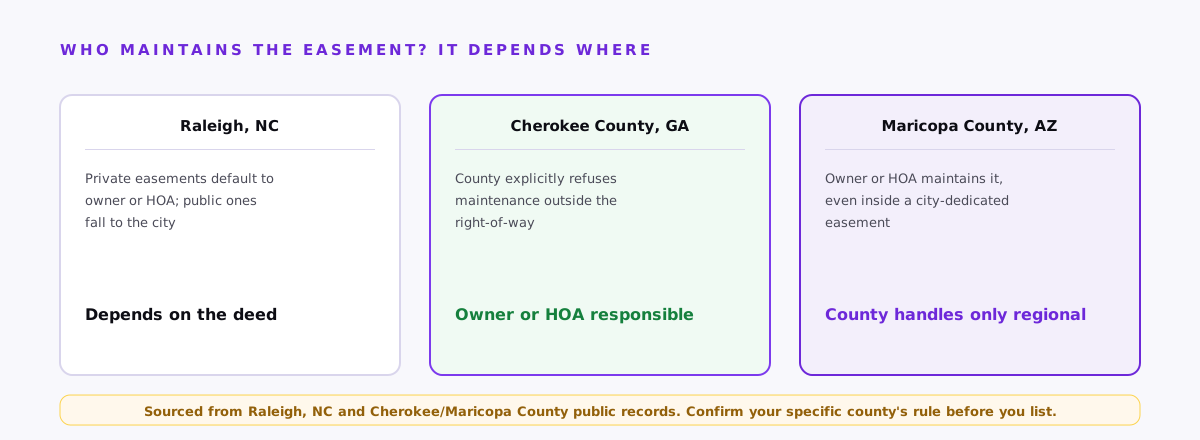
In Raleigh, private easements are maintained by the owner or HOA unless the documents say otherwise; public ones fall to the city. In Georgia, it's set county by county — Cherokee County explicitly puts maintenance of any drainage easement outside the public right-of-way on the property owner or HOA; DeKalb County only maintains a facility the county has formally "accepted"; Cobb County puts open easements on the owner; Oconee County splits it, with the owner handling the easement itself and the HOA handling any subdivision detention pond. In Maricopa County, Arizona, maintenance of drainage facilities generally falls to the homeowner or HOA even when the facility sits inside an easement dedicated to the city, with the county's Flood Control District stepping in only for larger regional systems.
A few state-specific quirks are worth knowing if you're in one of our markets. Ohio has a distinct "petition ditch" process (Ohio Revised Code Chapter 6131) used heavily in semi-rural areas to establish a public drain, and a separate chapter, ORC 6137.12, sets up a dedicated drainage improvement maintenance fund and caps the permanent maintenance easement at 25 feet from the top of the bank. Indiana gives its County Surveyor statutory authority over regulated drains, with a right of entry up to 75 feet from the drain's centerline or the top of each bank under Indiana Code 36-9-27-33 — though the drainage board can reduce that to as little as 25 feet from the top of the bank on some open ditches. Michigan recognizes "prescriptive" drainage easements: under MCL 600.5801(4), if water from an upstream property has flowed across a lower property openly and continuously for 15 years without objection, an easement can exist by law even though it was never formally recorded, a doctrine the Michigan Court of Appeals applied specifically to a flowage easement in Terlecki v. Stewart (2008) — which means a seller can have a real, legally binding easement that doesn't show up in the county's recorded documents at all.
A recorded drainage easement surfaces in a standard title search, and most state seller-disclosure forms ask about known easements by name, so disclosing it isn't optional even if a buyer never asks directly.
The real risk isn't the easement itself — it's whatever has been built inside it. A shed, an in-ground pool, or filled-in low ground that encroaches on a drainage easement has no grandfather protection just because it's been there a while; a title company, survey, or a buyer's lender flagging it during underwriting can force removal or regrading as a condition of closing, and that conversation goes much better before a contract is signed than after.
If you don't already have a current survey, that's the document that stakes the easement on the ground and shows exactly what's inside it versus outside it. A standard residential boundary survey runs $1,200 to $5,500 for most homes, with simple lots as low as $475 and complex parcels running considerably more; turnaround is typically five to ten days, with rush options available for a premium. If you suspect something on your property might be sitting inside a recorded easement, getting that confirmed before you list is cheaper than finding out from a buyer's attorney, and it's worth reviewing against our seller closing costs guide so you know what else is already coming out of your proceeds.
If a structure or alteration does turn out to be inside the easement, remediation costs vary a lot by what has to come out. A contractor-sourced estimate for swale repair work puts minor erosion fixes at $200 to $500, major erosion control at $1,000 to $3,000, and a full swale redesign or reshaping at $1,500 to $4,000, with drainage pipe installation running $1,000 to $2,500. If the violation is a structure rather than erosion — a pool built where it shouldn't have been, for example — demolition and removal costs run separately and can be substantially higher; get a specific quote for whatever is actually in the easement rather than estimating from a general range.
Most of these numbers come from regional contractor pricing rather than a single national consumer-cost database, so treat them as a planning range and get a local quote before you budget around a specific figure. The point that matters for a sale: an easement violation is a fixable problem with a knowable cost, not an open-ended one, and resolving it before you list removes a line item a buyer's financing can get stuck on.
Here's an illustrative example on a $295,000 home where a shed sits partly inside a rear drainage easement, flagged during a buyer's survey:
| Retail listing | Cash sale | |
|---|---|---|
| List / offer price | $295,000 | $266,000 |
| Shed removal + regrading (required before financed closing) | −$2,800 | $0 (sold as-is) |
| Agent commission (~5.5%) | −$16,225 | $0 |
| Seller closing costs | −$3,200 | −$1,200 |
| Carrying costs while the fix and financing resolve (6–10 weeks) | −$1,800 | $0 |
| Net to seller | ~$270,975, in 6–10+ weeks, if financing clears after the fix | ~$264,800, in 1–2 weeks, with certainty |
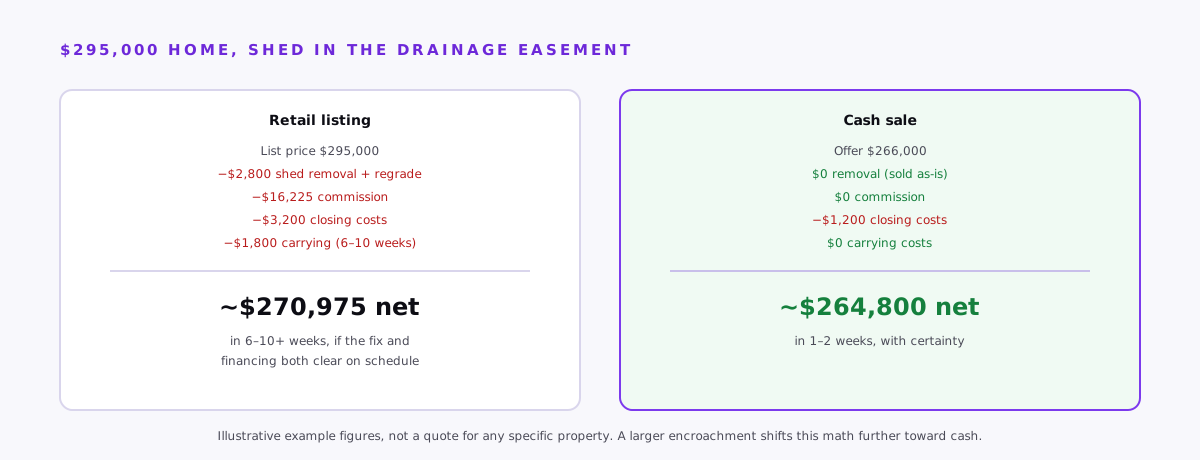
Retail nets more in this example, but it depends on the fix actually happening on schedule and a financed buyer's loan clearing afterward — two things outside your control once you're committed to that path. If the violation is more involved than a shed, if you can't front the remediation cost before closing, or if you just need certainty over a few extra thousand dollars, cash removes both the repair and the financing risk from the equation. See our property survey cost guide for more on confirming what's actually on your land before you price either path.
Restar Acquisitions buys houses as-is for cash in 12 states, and we check recorded easements and what's actually built on the land before we give you a number — including anything that might be sitting inside a drainage easement. We give a written offer within 24 hours, no repairs or commissions, and you pick the closing date. We're a direct buyer, not your real estate agent, and we don't represent you in the transaction.
Alternatives worth checking before you decide:
This article is for general education only and isn't legal advice. Drainage and stormwater easement rules, maintenance obligations, and remediation requirements vary by city, county, and state, and change over time. Confirm your property's specific easement terms with your local stormwater or public works department, your title company, or a real estate attorney before you list or sell.
We check recorded easements and anything built inside them before we give you a number, not after a buyer's survey flags it mid-contract. You'll get a written offer within 24 hours, no repairs or commissions, and you pick the closing date.
All guides · Selling a house with a boundary line dispute · Cost of a property survey before selling a house · Seller closing costs
Step 1 of 5
No obligation, no fees, no repairs. We respond the same day.
You’ll talk to Trevor McAmis, Owner & Acquisitions Lead
(313) 710-6129
Takes about two minutes. Or call (313) 710-6129 — we answer.