Yes — you can sell a house with a boundary line dispute or an encroachment, but expect extra steps. A survey will likely surface it, title insurance may add an exception, and a financed buyer's lender can stall or walk. A cash buyer can often work around an unresolved boundary problem that would otherwise derail a retail sale. A boundary problem has a way of staying invisible until you actually try to sell. You've lived next to the same fence, driveway, or hedge line for years without giving it a second thought — then a buyer's lender orders a survey, and suddenly there's a stranger's garage six inches over your line, or your own shed turns out to be sitting on the neighbor's lot. It can feel like your property just became someone else's problem to untangle, on a deadline you didn't choose. This guide walks through what actually separates a boundary dispute from an encroachment from an adverse possession risk, how the issue tends to surface once you're under contract, why title insurance treats it the way it does, and the real paths to resolving it — a boundary line agreement, a new survey, a quiet title action, or selling as-is to a buyer who can work around it while you sort out the rest.
Step 1 of 5
Send the address and we'll tell you honestly whether resolving it first and listing retail would net you more.
You’ll talk to Trevor McAmis, Owner & Acquisitions Lead
(313) 710-6129
Takes about two minutes. Or call (313) 710-6129 — we answer.
Educational only. This explains how these situations generally work. It is not legal, tax or financial advice, and the rules differ by state — talk to an attorney or CPA about your own situation before you act on any of it.
A boundary dispute, an encroachment, and adverse possession are three related but distinct problems, and the fix depends on which one you actually have. A boundary dispute is disagreement about where the legal line runs, on paper. An encroachment is something physically built across that line. Adverse possession is the risk that someone else could eventually gain legal ownership of land they've occupied long enough without your permission. These terms get used almost interchangeably by homeowners, but title companies, surveyors, and attorneys treat them as separate issues with separate remedies.
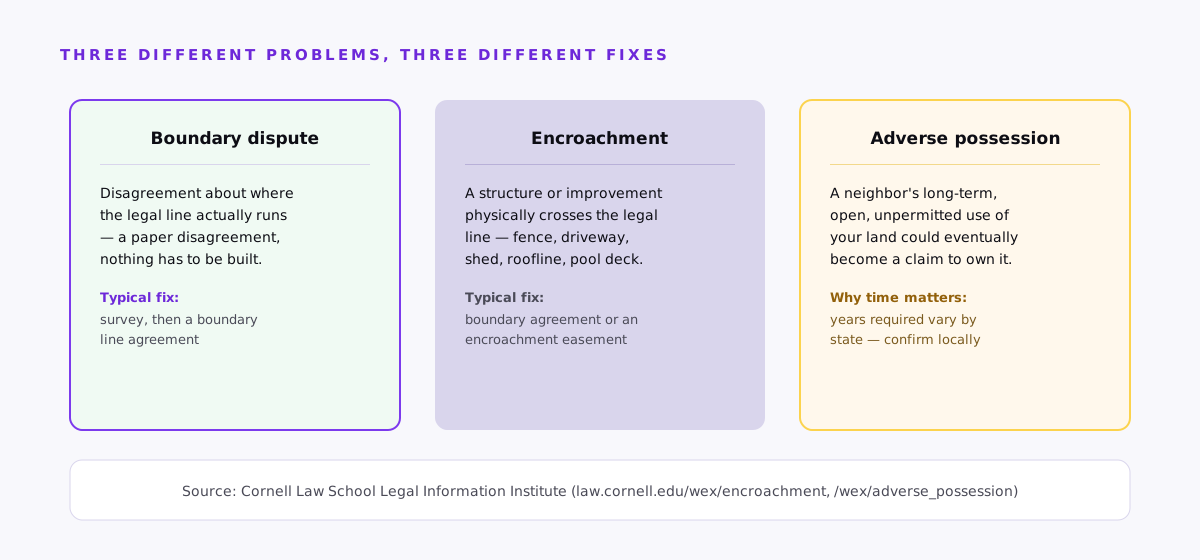
A boundary dispute is disagreement about where the legal property line actually runs — often because two surveys don't agree, or because nobody has ever had a formal survey done and everyone's been going by an old fence or a hedge line for decades. Nothing has to be built on the wrong side for a boundary dispute to exist; it can be purely a disagreement about where the line is on paper.
An encroachment is more concrete: a structure or improvement — a fence, a driveway, a shed, an overhanging roofline, a pool deck, even landscaping — physically crosses the legal line onto the neighboring lot, whether or not anyone currently disputes where that line is. Cornell Law School's Legal Information Institute defines an encroachment as “an unauthorized intrusion onto a neighboring property through the creation or extension of a physical structure (including flora) above or below the surface of land” (Cornell LII: Encroachment). Encroachments often start small and get discovered only when a survey is pulled for a sale.
Adverse possession is a separate and more serious risk: a doctrine under which someone who has openly, continuously, and without permission occupied a piece of land they don't own may eventually be able to claim legal title to it. Cornell LII describes adverse possession as a doctrine “under which a trespasser, in physical possession of land owned by someone else[,] may acquire valid title to the property,” noting that the number of years required varies by state — a typical statute requires roughly 7 years under color of title or 20 years without it, though the threshold differs by jurisdiction; Cornell specifically notes New York requires around 10 years (Cornell LII: Adverse Possession). New York is one of Restar's operating states, which is a useful reminder that these timelines are genuinely state-specific and worth confirming locally rather than assumed.
Most sellers find out about a boundary problem the same way: it was invisible until someone else went looking for it. A financed buyer's lender typically orders a new or updated survey before closing, and the title company runs a title search alongside it. Between the two, a fence, driveway, shed, or addition that crosses the legal line — or a legal description that doesn't match the neighbor's — usually gets caught before the sale can close, often for the first time in the property's history.
If your buyer is financing the purchase, their lender will typically require a new survey (or an updated one) before closing, and the title company will run a title search alongside it. A survey doesn't just confirm square footage — it plots the legal boundary lines against what's actually built on the ground. If a fence, driveway, shed, or addition crosses the line, or if your legal description doesn't match your neighbor's, the surveyor's report flags it, and the title company typically responds by adding a title exception: language in the title commitment that carves the boundary issue out of what the policy covers.
Sometimes it surfaces earlier — during a pre-listing inspection, when a neighbor raises it directly, or because a previous owner mentioned it and it never got resolved. However it comes up, the timing matters: a boundary issue discovered mid-contract, with a closing date already set, is a much tighter spot to resolve from than one you get ahead of before listing.
Title insurance exists to guarantee that you're conveying clean, marketable title — ownership free of undisclosed claims, gaps, or competing interests. A genuine, unresolved boundary dispute or encroachment is exactly the kind of cloud that undermines that guarantee, because it raises the possibility that part of what you're selling isn't fully yours to sell, or that you're buying a future lawsuit along with the house.
In practice, a title insurer usually won't issue a clean policy over a known boundary problem without doing one of a few things: adding a specific exception that excludes the boundary issue from coverage, requiring it be resolved before closing, or — in some cases — offering an endorsement that provides limited coverage for it once a current survey confirms the extent of the problem. A retail buyer's lender will generally want the exception removed or the issue resolved outright, since an unmarketable title is also a collateral problem for the loan. That's the mechanical reason a boundary dispute can stall a financed sale even when everyone involved is acting in good faith.
There are a handful of established ways to actually resolve a boundary problem, rather than just disclose around it: a licensed survey to establish exactly where the line runs and what crosses it, a boundary line agreement recorded with the county when neighbors cooperate, an encroachment easement for minor overlaps nobody wants to physically undo, and a quiet title action — a lawsuit asking a court to settle ownership — when neighbors won't cooperate at all. Each produces a different level of resolution, at a different cost and timeline.
A licensed survey is usually the starting point for everything else — you can't fix a boundary line you haven't precisely located. A current, licensed survey establishes exactly where the legal line runs and exactly what, if anything, crosses it.
A boundary line agreement (sometimes paired with a quitclaim deed for the disputed strip) is the fastest resolution when neighbors are willing to cooperate: both owners agree in writing to a specific line — often based on the new survey, and often close to where a longstanding fence already sits — and record that agreement with the county. Once recorded, it becomes part of the public chain of title, and the ambiguity that worried the title company generally goes away. Some states, including North Carolina, have a formal statutory process for exactly this kind of dispute: North Carolina's General Statutes provide a “special proceeding” in superior court where an owner whose boundary line is in dispute can have the court establish it, including ordering a county surveyor to run and mark the line (North Carolina General Statutes, Chapter 38 — Boundaries). Other states handle the same basic idea — a court-supervised process to fix a disputed line — through different statutes and case law, so it's worth asking a local real estate attorney what your state calls it and how it works.
An encroachment easement is a middle path when the encroachment is minor and nobody wants to move a wall or tear out a driveway: instead of relocating the structure, the encroaching owner and the affected owner formally agree — again, recorded — to allow the encroachment to remain, typically for as long as the structure exists.
A quiet title action is the option when neighbors won't cooperate, can't be located, or actively dispute the line. It's a lawsuit asking a court to determine ownership and resolve competing claims once and for all. Cornell LII describes it plainly: “a quiet title action is a special legal proceeding to determine ownership of real property” (Cornell LII: Quiet Title Action). It's more expensive and slower than a negotiated agreement, but it produces a court judgment that definitively clears the cloud on title — see our guide on the cost of a quiet title action for what that process typically involves and runs.
If a neighbor has been using a strip of your land as their own — parking on it, fencing it in, mowing it, building on it — for long enough, and without your permission, they may eventually be able to claim legal ownership of it under your state's adverse possession law. The exact number of years required, and the specific conditions (open and notorious use, continuous possession, sometimes payment of property taxes on the disputed strip), vary meaningfully by state.
This is why time matters in a very literal sense: the longer an encroachment or disputed boundary sits unaddressed, the closer a neighbor's use of that strip may get to satisfying your state's statutory period, and the harder — and more expensive — it typically becomes to resolve. It's also why a title company or attorney will want to know how long a given encroachment has existed, not just that it exists. This is genuinely one of the more state-specific, fact-specific corners of real estate law, and confirming where you stand takes a local real estate attorney, not a guess based on how the fence looks.
These are general ranges for illustration only, not a quote for any specific property or state. The right path depends heavily on how cooperative your neighbor is and how much equity is at stake.
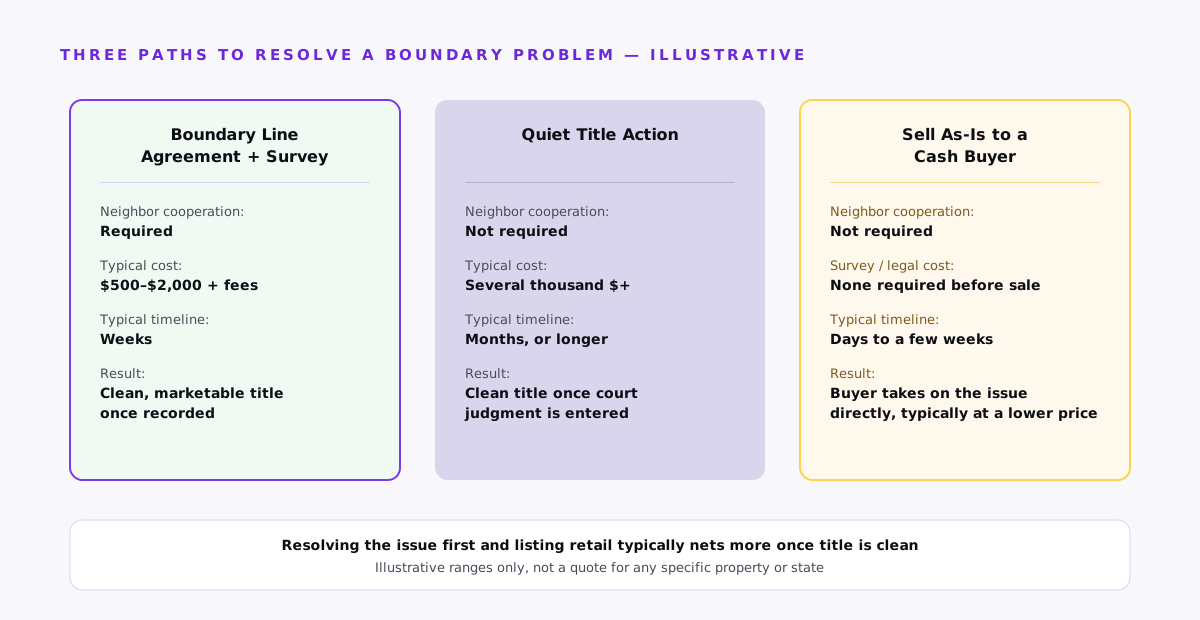
| Boundary Line Agreement + Survey | Quiet Title Action | Sell As-Is to a Cash Buyer | |
|---|---|---|---|
| Requires neighbor's cooperation | Yes | No (that's the point) | No |
| Typical cost | Roughly $500–$2,000 for a survey, plus recording fees | Often several thousand dollars or more in legal and court costs | No survey or legal work required before you sell |
| Typical timeline | Weeks, if the neighbor agrees quickly | Months, sometimes longer if contested | Days to a few weeks |
| Outcome for title | Clean, marketable title once recorded | Clean, marketable title once judgment is entered | Buyer takes on the issue directly; you're not warranting clean title the way a retail sale requires |
A boundary line agreement or a quiet title action, done before you list, generally lets you sell on the retail market and typically nets more than an as-is cash sale once the issue is resolved — a fully marketable, agent-listed house usually commands a higher price than an as-is sale, even after accounting for the time and cost of resolving the boundary problem first. Selling as-is to a cash buyer skips the survey, the negotiation with the neighbor, and the wait for a court date, but it typically nets less than a retail sale would once title is clean — that tradeoff holds even when the cash sale is specifically what lets you sidestep an unresolved boundary problem that a financed buyer's lender wouldn't accept. Run your own numbers before deciding; our cash offer vs. listing net proceeds breakdown walks through how that comparison typically works.
Selling as-is isn't the only option, and for a lot of sellers it isn't the first one to try.
Resolve it with the neighbor first, then list retail. If your neighbor is reasonable and the fix is straightforward, a boundary line agreement plus a fresh survey can clear the issue in weeks, after which you can list with an agent and typically net more than an as-is sale.
Get a survey and pursue quiet title before selling. If the neighbor won't cooperate or can't be reached, a quiet title action takes longer and costs more, but it produces a court judgment that permanently resolves the question — worth it if you have time before you need to sell.
Try mediation. Many boundary disputes are as much about hurt feelings and old history as they are about inches of land; a neutral mediator can sometimes get to a written agreement faster and cheaper than either side expects, without going to court.
Sell as-is to a cash buyer who can navigate it. If you need to move on a timeline that doesn't allow for a survey-and-negotiation process or a court case, an as-is sale lets a buyer take on the boundary issue directly — typically at a lower price than a fully resolved retail sale, in exchange for speed and certainty.
Restar Acquisitions buys houses directly, as-is, for cash, in 45 markets across Alabama, Arizona, Florida, Georgia, Indiana, Maryland, Michigan, Missouri, New York, North Carolina, Ohio, and Texas. If your property is in one of those markets, we can typically give a written offer within 24 hours of seeing it, require no repairs, and charge no commissions — you also pick the closing date. A boundary dispute or encroachment that would stall a financed retail sale usually doesn't stop us from making an offer, because we're not relying on a lender's clean-title requirements the way a traditional buyer would be.
We are not real estate agents or brokers, and we do not represent you as a seller — we're a direct buyer, and our interests in a transaction are our own, not yours. As the comparison above shows, a cash sale usually nets less than a boundary issue resolved and then listed retail, when you have the time and the neighbor is willing to cooperate. If that path works better for your situation — or if you don't need to sell at all — we'll say so. A fast sale isn't the right fit for everyone, and an unresolved property line is worth taking seriously either way.
This article is for general educational purposes only and is not legal, tax, or financial advice. Boundary line law, adverse possession statutes, and quiet title procedures vary significantly by state. Talk to a real estate attorney or licensed surveyor about your specific situation before making a decision.
We'll give you a written offer within 24 hours and can work around an unresolved boundary dispute or encroachment that would typically stall a financed retail sale — and if resolving it first and listing nets you more, we'll say so.
All guides · Cost of a quiet title action · Title insurance cost explained · Cash offer vs listing net proceeds
Step 1 of 5
No obligation, no fees, no repairs. We respond the same day.
You’ll talk to Trevor McAmis, Owner & Acquisitions Lead
(313) 710-6129
Takes about two minutes. Or call (313) 710-6129 — we answer.
