<b>A conservation easement doesn't block a sale, but it permanently limits what any future owner can do with the land, and that restriction never expires when the title changes hands.</b> If a land trust or government agency holds a conservation easement on your property, your buyer inherits the exact same restrictions you've been living under, which narrows the pool of people willing to buy and can make a lender nervous about financing it. Selling a house with a conservation easement means confirming what's actually restricted, disclosing it clearly, and being honest with yourself about who your realistic buyer is. This guide covers what a conservation easement actually is under federal tax law, how it affects a sale in practice, what it costs if the easement has been violated, and the real math on cash versus a retail listing.
Step 1 of 5
Tell us about the property and we'll tell you what the easement actually restricts and what a cash offer looks like.
You’ll talk to Trevor McAmis, Owner & Acquisitions Lead
(313) 710-6129
Takes about two minutes. Or call (313) 710-6129 — we answer.
Educational only. This explains how these situations generally work. It is not legal, tax or financial advice, and the rules differ by state — talk to an attorney or CPA about your own situation before you act on any of it.
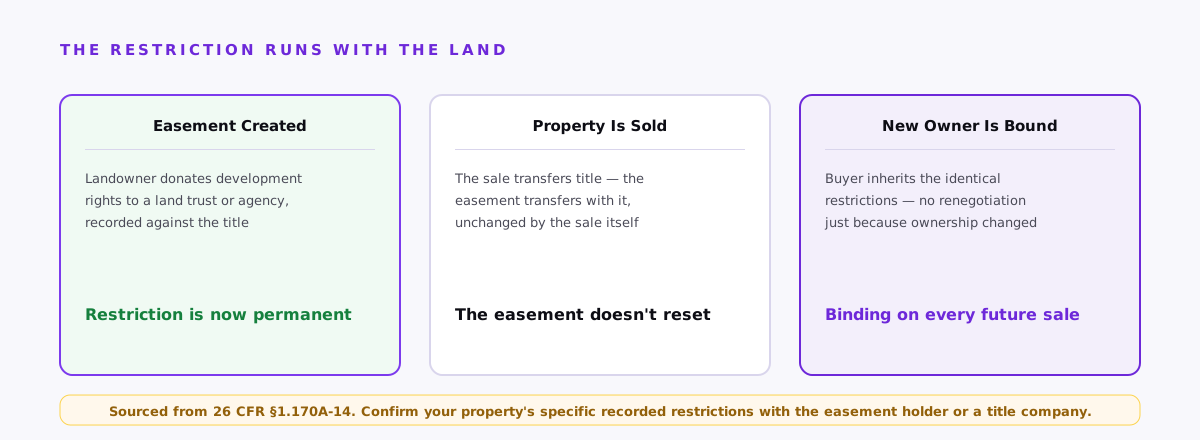
A conservation easement is a restriction on how real property can be used, granted in perpetuity to a qualifying land trust or government agency, and recorded against the title so it binds every future owner the same way it bound the person who created it.
The federal rule governing this — 26 CFR §1.170A-14, the regulation under Internal Revenue Code §170(h) — requires that the restriction be "legally enforceable (for example, by recordation in the land records)" and that the holding organization have the right to enforce it, including the right to require restoration if it's violated, plus a right to enter and inspect.
Most conservation easements get created when a landowner donates the development rights to a land trust (see, for example, the Texas Land Trust Council's explanation of how this works in one of our footprint states) or a government agency in exchange for a federal income tax deduction, which is exactly why perpetuity is non-negotiable: the regulation states a contribution isn't treated as exclusively for conservation purposes "unless the conservation purpose is protected in perpetuity." The restriction has to serve one of four purposes the IRS recognizes — public outdoor recreation or education, habitat protection, open-space or scenic preservation, or historic preservation — and it typically bars things like subdivision, commercial or residential development beyond what's already there, and significant alteration of the land's natural or agricultural character.
Owning land under a conservation easement is not the same as owning land under an agricultural-use tax covenant like Georgia's CUVA, which we cover separately in our agricultural exemption rollback tax guide. A CUVA covenant is a 10-year agreement with a county or state tax authority that lowers your property tax bill and can be renewed or allowed to lapse. A conservation easement is permanent, typically held by a private land trust or conservation-focused agency rather than a tax authority, and usually involves a one-time payment or tax deduction to the original donor rather than an ongoing tax break. The two mechanisms can theoretically exist on the same parcel, but they are legally and functionally separate, and conflating them when you talk to a buyer, a title company, or a tax professional is a good way to get bad advice.
A conservation easement does not prevent a sale. Land under one can be bought and sold like any other private property — the easement simply travels with the title, the same way a recorded utility easement or a deed restriction would. What changes is the shape of the deal.
Disclosure. If you know your property carries a conservation easement, you need to disclose it clearly, and most state seller-disclosure forms ask about recorded easements by name. A recorded easement will also surface in a standard title search, so a buyer's title company is going to find it even if it never came up in conversation — the only question is whether they find out before or after they've fallen in love with the property and started making plans for it that the easement won't allow.
Financing. Lenders tend to treat conservation easements as a complicating factor rather than a disqualifying one. An appraiser has to value land with permanent development restrictions differently than unrestricted land, which can slow underwriting, and a lender wants to be confident that if they ever had to foreclose, the restricted property would still cover the loan. Some buyers report appraisal gaps or reduced loan amounts specifically tied to the restriction. None of this makes the property unlendable, but it adds friction that a cash buyer simply doesn't run into.
Buyer pool. The restriction narrows who wants the property — a buyer hoping to subdivide, build a second structure, or substantially develop the land is going to walk away once they understand what's actually recorded against the title. At the same time, it attracts a real, if smaller, pool of buyers who specifically want conserved, undeveloped, or agricultural land: ranchers, farmers, hunters, and conservation-minded buyers who see the restriction as a feature rather than a defect. A future owner also can't renegotiate the easement's terms with the holder just because they'd prefer different rules — the restriction they're buying is the restriction that exists.
A conservation easement's holder — the land trust or agency — has an ongoing obligation to monitor the property, typically with an annual site visit, and the legal right to compel restoration if the restrictions have been violated: an unauthorized structure, land clearing beyond what's allowed, or a use the easement doesn't permit.
A detailed cost study of land trust stewardship found that minor violations average about $1,241 in staff time and site visits to resolve, with roughly a 12% annual probability of one occurring on any given easement. Major violations are a different scale entirely: a 1999 survey of 147 land trusts by the Land Trust Alliance found average legal fees around $35,000 for a contested major violation, with a typical range of $5,000 to $100,000, and full litigation running $70,000 to $100,000 or more before any appeal — that same 1999 survey found 53% of violations were resolved within two years of discovery, though some dragged on for five years or more. Legal costs were recovered from the violating party in only about half of the cases surveyed, which is exactly why most easement agreements make the landowner responsible for both restoration costs and the holder's legal fees if a violation goes to enforcement.
What this means for a seller: if you've built something on the restricted portion of your land, cleared trees you weren't supposed to, or otherwise pushed past what the easement allows, that's a liability that follows the property through a title search just like the easement itself does. A buyer's attorney or title company reviewing the recorded restriction alongside the actual condition of the land can catch a mismatch, and fixing it before you sell is almost always cheaper than having it surface during someone else's closing.
The most reliable way to confirm whether your property carries a conservation easement is the same way any recorded restriction gets confirmed: pull your deed and any attached documents from the county recorder or register of deeds, or ask your title company to run a title search. Because the regulation requires the restriction to be "legally enforceable... by recordation," a genuine conservation easement has to be on file with the county, which means it's discoverable even if nobody mentioned it to you when you bought the property. If you do confirm a donated easement, the IRS's instructions for Form 8283 cover how the original charitable contribution was reported, which can help you understand what the donor agreed to.
There used to be a national public database for this — the National Conservation Easement Database compiled land-trust and government easement records into a searchable map. As of January 2025, that database is no longer being actively updated, and it directs researchers toward county records and state agencies for current information. In practice, the county recorder and your title company remain the dependable sources; a national database that isn't being maintained is a starting point at best, not something to rely on.
Here's an illustrative example on a $380,000 property on 8 acres with a conservation easement covering most of the acreage, where the restriction has meaningfully narrowed the realistic buyer pool and a lender has flagged the appraisal as a complication.
| Retail listing | Cash sale | |
|---|---|---|
| List / offer price | $380,000 | $342,000 |
| Extended marketing time for a narrower buyer pool (5–8+ months) | −$7,200 carrying costs | $0 |
| Agent commission (~5.5%) | −$20,900 | $0 |
| Seller closing costs | −$4,100 | −$1,500 |
| Financing risk (appraisal gap or buyer's loan falling through) | Real risk of a late-stage fall-through | Not a factor |
| Net to seller | ~$347,800, in 5–8+ months, if financing holds | ~$340,500, in 1–2 weeks, with certainty |
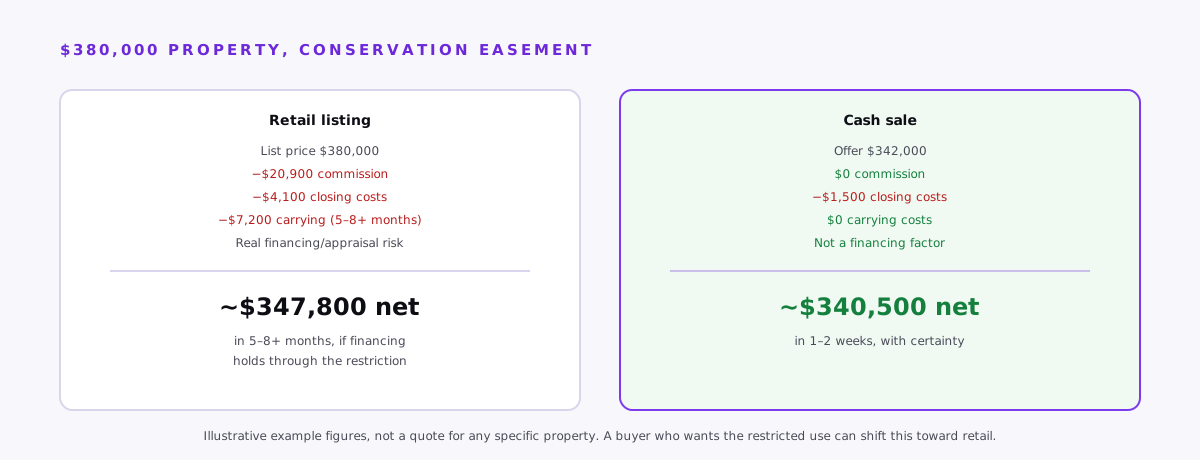
This example lands with retail netting modestly more, and that's the honest, non-cherry-picked result: a conservation easement mainly costs you time and financing certainty, not necessarily total dollars, because the buyer who actually wants restricted land tends to pay closer to its true value for that use rather than discounting it the way a typical retail buyer discounts a distressed property. If you need to close in weeks rather than months, or you're not confident a financed buyer's lender will clear the appraisal, the math shifts toward cash. Run your own numbers against our property tax reassessment guide for what else factors into net proceeds on a sale.
Restar Acquisitions buys houses as-is for cash in 12 states, and we check recorded easements and title restrictions before we give you a number, not after. We give a written offer within 24 hours, no repairs or commissions, and you pick the closing date. We're a direct buyer, not your real estate agent, and we don't represent you in the transaction.
Alternatives worth checking before you decide:
This article is for general education only and isn't legal or tax advice. Conservation easement terms, enforcement practices, and disclosure requirements vary by state, by holder, and by the specific easement document. Confirm your property's actual recorded restrictions with the easement holder, a title company, or a real estate attorney before you list or sell.
We check recorded easements before we give you a number, not after a financed buyer's lender gets nervous six weeks into a deal. You'll get a written offer within 24 hours, no repairs or commissions, and you pick the closing date.
All guides · Selling a house with an agricultural exemption rollback tax · Property tax reassessment when you sell a house · How much is my land worth
Step 1 of 5
No obligation, no fees, no repairs. We respond the same day.
You’ll talk to Trevor McAmis, Owner & Acquisitions Lead
(313) 710-6129
Takes about two minutes. Or call (313) 710-6129 — we answer.