<b>Selling the house doesn't automatically trigger a rollback or breach tax — changing the land's use does, and whose use changes it depends on your buyer.</b> If your land is assessed at its farm or conservation value instead of full market value, Texas and Georgia (among the states Restar Acquisitions buys in) each have a mechanism that claws back part of what you saved in property taxes if the land stops qualifying. Selling a house with agricultural exemption rollback tax exposure hanging over the parcel isn't a reason to panic, though — the size of that clawback and when it applies are specific and calculable, not a vague penalty, but a number your county appraisal district or tax assessor can run for you before you sign anything. This guide covers how Texas's 1-d-1 open-space valuation and Georgia's Conservation Use Valuation Assessment (CUVA) actually work at the point of sale, what triggers the tax, and the real arithmetic on both sides.

Step 1 of 5
Tell us about the property and we'll help you understand whether a sale actually triggers anything before you commit to one path.
You’ll talk to Trevor McAmis, Owner & Acquisitions Lead
(313) 710-6129
Takes about two minutes. Or call (313) 710-6129 — we answer.
Educational only. This explains how these situations generally work. It is not legal, tax or financial advice, and the rules differ by state — talk to an attorney or CPA about your own situation before you act on any of it.
Both programs work on the same basic idea: land actively used for farming, ranching, timber, or conservation is taxed on what it can produce, not on what it would sell for if subdivided — and the gap between those two numbers is often enormous. A 10-acre parcel with a market value of $600,000 near a growing Texas or Georgia suburb might carry a productivity or conservation-use value of $20,000–$40,000, cutting the annual property tax bill by 60–85% while the qualifying use continues.
Texas 1-d-1 open-space valuation (Texas Constitution Art. VIII, §1-d-1; Tax Code Chapter 23, Subchapter D) covers land in active agricultural use — crops, livestock, beekeeping, and similar qualifying uses, with county-specific minimum acreage and history-of-use requirements.
Georgia's Conservation Use Valuation Assessment (CUVA) (O.C.G.A. § 48-5-7.4, summarized by the Georgia Department of Revenue's Property Tax Division) covers bona fide agricultural use, commercial timber/forestry, or environmentally sensitive land, generally requiring at least 10 contiguous acres — some counties set a higher local minimum, so confirm yours with the county tax assessor — (state-designated environmentally sensitive land can qualify at any size), held under a signed 10-year covenant with the county. This works alongside the general property tax reassessment that happens at any sale, not instead of it.
In both states, a house sitting on qualifying land doesn't disqualify the parcel by itself — what matters is whether the land around it is still being put to the qualifying use, and whether that continues after the sale.
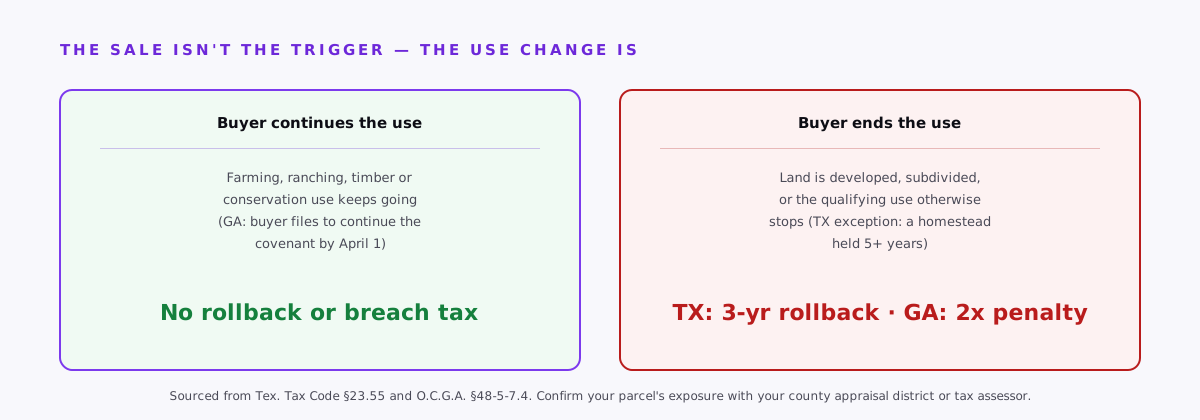
Selling the property is not, on its own, the trigger in either state — it's a change in how the land is used that triggers it, and that change can happen at the moment of sale or well after, depending on what the buyer does.
Texas rollback tax (Tax Code § 23.55). If 1-d-1 land changes from a qualifying agricultural use to a non-qualifying use, the appraisal district assesses a rollback tax equal to the difference between the tax actually paid under the agricultural valuation and the tax that would have been owed at full market value, for each of the three years before the change (cut down from five years by HB 1743, effective for changes after September 1, 2019). A separate 2021 law, HB 3833, removed the 5 percent annual interest charge that previously applied on top of the rollback tax itself for changes of use after that date. One narrow exception: if the new use is the buyer building and maintaining a homestead on the land, the rollback doesn't apply as long as the homestead is maintained for five years.
Georgia CUVA breach. The covenant runs with the land — selling the property does not, by itself, break it. A buyer who is a qualified owner (an individual, family-farm entity, or qualifying trust) can file to continue the existing covenant by April 1 of the year after the sale, picking up the remaining balance of the original 10-year term rather than starting a new one. The breach penalty — twice the difference between the tax paid under conservation-use assessment and what would have been owed at fair market value, for each completed or partially completed year of the covenant, plus interest from the date of breach — only applies if the covenant is actually broken: the new owner doesn't continue the qualifying use, doesn't requalify, or the land is converted to a non-qualifying use. Death of the covenant holder, condemnation, foreclosure, and some senior-citizen and medical-hardship situations are recognized exceptions to the penalty.
The practical upshot in both states: who you sell to changes the tax consequence. A buyer who keeps farming, ranching, or conserving the land (or, in Texas, builds and holds a homestead) can mean no rollback or breach tax at all. A buyer who subdivides, develops, or otherwise ends the qualifying use triggers it — and in Texas that tax is typically billed to whoever owns the land when the appraisal district catches the change, which can be the new owner, not you.
Texas example. Productivity value $18,000, true market value $520,000, combined local tax rate 2.1%. Tax actually paid at productivity value: about $378/year. Tax that would have been owed at market value: about $10,920/year. The three-year rollback difference: roughly $31,626, billed with interest from the date the appraisal district determines the change occurred.
Georgia example. A 40-acre parcel saving $2,800/year under CUVA versus fair market assessment, breached in year 6 of its 10-year covenant. Penalty: twice the accumulated differential for each completed year — roughly 6 × $2,800 × 2 = $33,600, plus interest accruing from the breach date, before any appeal.
Neither number is small, and neither is a flat percentage you can estimate from a listing price — both depend entirely on the gap between the special-use value and the market value, which your county appraisal district (Texas) or tax assessor's office (Georgia) can calculate for your specific parcel before you commit to any sale structure.
This is one of the few situations where the honest answer genuinely depends on your buyer, not just your path to sale. A retail buyer who intends to build a subdivision or a single large home and stop farming or conserving the land will trigger the rollback or breach tax — and a sharp buyer's agent will factor that into their offer, effectively asking you to discount the price to cover it, or structuring the contract so the tax lands on you at closing rather than them later.
Take a 15-acre Texas parcel: market value $540,000, productivity value $16,000, combined rate 2.0%, rollback exposure around $31,000 if the use changes.
| Sell to a developer (use changes) | Sell to a buyer continuing ag use | |
|---|---|---|
| Negotiated price | $540,000 | $480,000 |
| Rollback tax (3 years) | −$31,000 (often negotiated into price) | $0 — use continues |
| Agent commission (~5.5%) | −$29,700 | $0 (cash, no listing) |
| Closing costs | −$5,400 | −$1,600 |
| Carrying costs while marketing (4–6 months, typical for rural listings) | −$6,000 | $0 |
| Net to seller | ~$467,900, in 4–6+ months, rollback risk negotiated into price | ~$478,400, in 1–2 weeks, no rollback trigger |
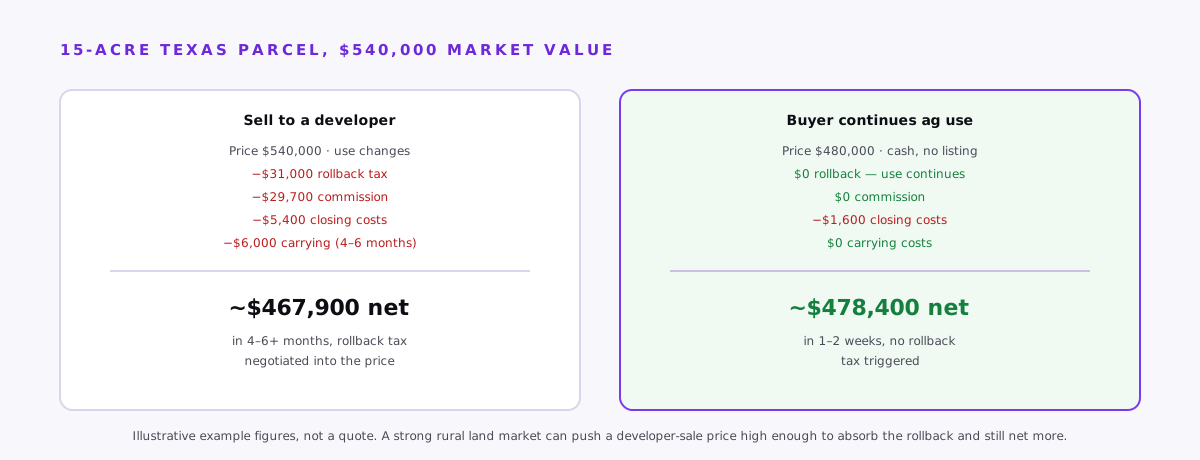
The retail-developer path isn't automatically worse — a strong rural land market can push the gross price high enough to absorb the rollback and still net more. The point isn't that one path wins by default; it's that the rollback or breach exposure has to be priced in explicitly, by you or by whoever's buying, rather than discovered after closing when the appraisal district or tax assessor catches the change.
Restar Acquisitions buys houses as-is for cash in 29 markets across 10 states, including rural and exurban parcels in Texas and Georgia where 1-d-1 and CUVA valuations are common, and we check the covenant or special-use status of the land before we give you a number. We give a written offer within 24 hours, no repairs or commissions, and you pick the closing date. We're a direct buyer, not your real estate agent, and we don't represent you in the transaction.
Alternatives worth checking before you decide:
This article is for general education only and isn't legal or tax advice. Rollback tax, CUVA, and special-use valuation rules vary by county and state and change over time. Confirm your parcel's specific exposure with your county appraisal district or tax assessor, and talk to a real estate attorney or CPA before structuring a sale.
We've bought houses on land under ag-use and conservation-use valuations before, and we check the covenant status before we give you a number — not after you've already signed something that triggers a tax you didn't expect.
All guides · Property tax reassessment when you sell a house · How much is my land worth · We buy houses in Georgia
Step 1 of 5
No obligation, no fees, no repairs. We respond the same day.
You’ll talk to Trevor McAmis, Owner & Acquisitions Lead
(313) 710-6129
Takes about two minutes. Or call (313) 710-6129 — we answer.