Every market page publishes the numbers behind its offer. See the math
Home › Guides › Property Tax Reassessment When You Sell a House
Guide
Property Tax Reassessment When You Sell a House
Property tax reassessment when you sell a house is the gap almost nobody explains until a buyer's lender flags it during underwriting. In most of the country your current tax bill is a reasonable preview of what the buyer will pay. In Michigan and Florida it usually is not, because both states cap how fast a long-held property's taxable value can climb while you own it — and both reset that cap the year after a sale. A house taxed on a number well below its market value can see the buyer's bill jump by thousands of dollars annually, and if nobody ran that math before closing, it shows up as a renegotiation demand in week three of escrow instead. Here is the actual arithmetic in both states, and what a seller should do with it.
Takes about two minutes. Or call
(313) 710-6129 — we answer.
Educational only. This explains how these situations generally work. It is not legal, tax or financial advice, and the rules differ by state — talk to an attorney or CPA about your own situation before you act on any of it.
Property tax reassessment when you sell a house: the short answer
Property tax reassessment when you sell a house in Michigan or Florida works differently than most places: a long-held property's taxable value is capped well below its sale value while you own it. The year after you sell, that cap resets and the new owner is taxed on a much higher number.
This is general educational information about how two specific state property tax systems work, not tax advice. Millage rates, exemptions and exact assessment dates vary by county and change year to year. Confirm the actual current numbers for your property with your county assessor, and talk to a CPA about how this affects your specific closing or purchase.
Why your current tax bill is not a preview of the buyer's bill
Most states assess property at close to its current market value every year, so a buyer can look at the seller's tax bill and get a reasonably honest read on what they will owe. Michigan and Florida both work differently on purpose — each caps the annual growth of the taxable number while you own the house, specifically so long-term owners are not taxed out of a home whose market value has risen faster than their income. The tradeoff is that the cap has to reset somewhere, and the mechanism both states chose is the sale itself.
That means the seller's own tax bill, printed right there on last year's statement, is frequently the least useful number in the transaction for predicting what the buyer will actually pay starting the year after closing.
Michigan: uncapping under Proposal A
Michigan's system runs on two separate numbers for the same property: State Equalized Value (SEV), which tracks roughly half of true market value, and Taxable Value, which is what the tax bill is actually calculated from and which can only rise each year by the rate of inflation or 5%, whichever is lower, for as long as ownership does not change.
MCL 211.27a(3) requires that in the calendar year following a transfer of ownership, the property's Taxable Value be uncapped and set equal to its SEV for that year — the assessor has no discretion to phase it in or refuse. The Michigan Department of Treasury's guidance on changes in ownership confirms the same rule and lists the transfer types that are exempt from triggering it, mainly certain transfers within a family or into a trust.
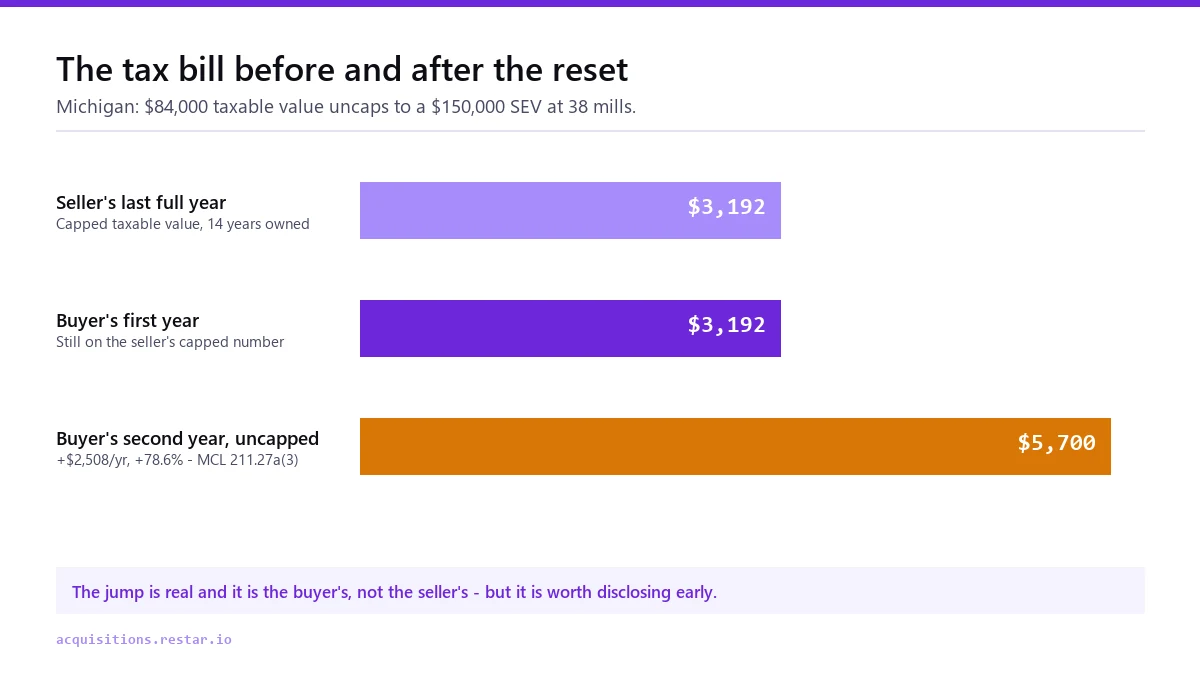
Here is what that looks like in dollars on a house owned 14 years, long enough for the gap between the two numbers to open up substantially. Assume a combined local millage rate of 38 mills, meaning $38 of tax per $1,000 of taxable value.
Seller's last full year
Buyer's first year
Buyer's second year (uncapped)
Taxable Value
$84,000
$84,000
$150,000 (= SEV)
Tax at 38 mills
$3,192
$3,192
$5,700
The buyer's first full year after closing is typically still calculated on the seller's capped Taxable Value, because the uncapping applies starting the assessment year following the transfer. The jump lands in the second year of ownership: from $3,192 to $5,700, an increase of $2,508, or 78.6%. A buyer who financed the purchase using the seller's $3,192 figure to judge affordability is running their monthly budget on a number that is about to be wrong by roughly $209 a month.
The tax bill before and after the resetRestar Acquisitions · worked example from this page
A worked illustration using round assumptions. Not a prediction about your house or your buyer's — your actual Taxable Value, SEV and local millage rate will differ, and your county assessor's office has the real numbers.
Florida: Save Our Homes and portability
Florida's version is called the Save Our Homes cap, and it works on the same principle applied to homesteaded property: the assessed value used for tax purposes can rise at most 3% a year or the change in the Consumer Price Index, whichever is lower, regardless of how fast the home's actual just value (market value) climbs.
On a house with a $340,000 just value but an assessed value of $190,000 after years under the cap, at a combined millage of roughly 19 mills:
Seller, capped
Buyer, reassessed at just value
Assessed value
$190,000
$340,000
Tax at 19 mills
$3,610
$6,460
That is a $2,850, or 79%, jump the year after the sale — and unlike Michigan, Florida applies the reassessment starting the January immediately after the transfer, so a buyer can hit the higher number in their very first full tax year rather than their second.
Portability runs the other direction and matters if you are the one selling and buying again in Florida. Under section 193.155(8), a homeowner can transfer up to $500,000 of their accumulated Save Our Homes benefit — the gap between just value and assessed value, $150,000 in the example above — to a new Florida homestead, as long as the new homestead is established within two years of leaving the old one. If you are relocating within the state, filing for portability is the single highest-value form most sellers forget to ask about.
What this actually means if you are selling
This is not a number that changes what you, the seller, owe. Michigan and Florida both calculate the seller's own final bill on the capped number all the way through the year of sale. The reset is entirely the buyer's future problem — but it becomes your problem too the moment it surprises them.
Buyers who finance the purchase often have their lender or agent run this exact calculation during underwriting, because a mortgage's debt-to-income math depends on projected carrying costs, and an escrow account sized on the seller's old tax bill will be underfunded once the uncapped number arrives. When that math surfaces late — after the offer, sometimes after the inspection period — it shows up as a request to renegotiate price or a credit, not as a polite question.
The honest fix is to raise it yourself, early, in the listing or in early buyer conversations. A seller who says plainly "the current tax bill reflects a capped value; expect it to reset to roughly $X after the year following the sale" is not creating a problem, they are getting ahead of one that a buyer's own due diligence will surface anyway.
This is also true regardless of who is buying, cash or financed. The reassessment mechanism does not care how the sale is funded — a cash buyer's future tax bill uncaps on exactly the same schedule as a financed buyer's. What differs for an investor is that they will typically run the post-uncapping number into their own underwriting on a rental purchase, which is part of why cash offers on long-held, heavily-capped properties sometimes come in lower than owners expect — the buyer is pricing a real future cost the seller's own bill does not show. Our guide to should I rent or sell my house covers how that same future tax number affects a landlord's own hold-versus-sell math.
Common questions
Will my property taxes go up when I sell my house?
Not yours — the seller's tax bill for the year of sale is calculated on the existing capped value in both Michigan and Florida. What changes is the buyer's bill: in Michigan the taxable value uncaps to the State Equalized Value the year following the transfer, and in Florida the Save Our Homes cap is removed and the property is reassessed at full just value the January after the sale.
What is Michigan's uncapping and when does it happen?
Under MCL 211.27a(3), a property's Taxable Value — normally capped from rising more than the rate of inflation or 5% a year, whichever is lower — is reset equal to its State Equalized Value in the calendar year following a transfer of ownership. On a house with an $84,000 Taxable Value and a $150,000 SEV, that is roughly a $2,508 annual tax increase at a 38-mill rate, landing in the buyer's second full year of ownership.
What is Florida's Save Our Homes cap and does it transfer to a buyer?
No. Save Our Homes caps a homesteaded property's assessed-value growth at 3% a year or the CPI change, whichever is lower, but under Fla. Stat. 193.155(3)(a) that cap is removed on any change of ownership and the property is reassessed at full just value the January after the sale. It does not transfer to the buyer — it stays with the seller, who can port up to $500,000 of it to a new Florida homestead within two years under the portability provision.
Does selling to a cash buyer avoid the tax reassessment?
No. The uncapping in Michigan and the Save Our Homes reset in Florida both trigger on any change of ownership, regardless of whether the buyer pays cash or finances the purchase. An investor buying with cash typically factors the post-reassessment tax bill into their offer on a long-held property, which is part of why an offer can come in lower than an owner who only looked at the current bill might expect.
How do I find my property's current capped value versus its market value?
Your county assessor's office publishes both figures — in Michigan look for State Equalized Value versus Taxable Value on your assessment notice or tax bill; in Florida look for just value versus assessed value. The gap between the two numbers, multiplied by your local millage rate, is a reasonable estimate of the tax increase a buyer will eventually see.
What is property tax portability in Florida and how do I claim it?
Portability lets a Florida homeowner transfer up to $500,000 of their accumulated Save Our Homes benefit — the difference between a home's just value and its capped assessed value — to a new Florida homestead, provided the new homestead is established within two years of leaving the old one. You apply through your county property appraiser's office, generally with the same paperwork that establishes the new homestead exemption.
Send us the address and we will tell you within 24 hours what we would pay as-is — and, if it matters to your buyer pool, roughly what the reassessment jump will look like the year after closing. Buyers who run this number themselves sometimes come back to renegotiate; sellers who already know it rarely get caught off guard.
Every offer on this site is underwritten by a person, not a form. If the
numbers do not work for you, say so and I will tell you what would.
Also from Restar
Want the data behind all of this?
Restar Acquisitions is the acquisitions arm of Restar — a housing-market analytics
platform tracking 180+ metrics across every U.S. market, with composite scores and 12-month
price forecasts. The numbers on this page come from the same work.