A mortgage co-signer — often a parent helping a child qualify for their first loan — is personally liable for the debt but typically has no ownership interest in the house at all. Selling the house and paying the loan off in full ends that liability, because there's no debt left to be liable for. The one place this gets genuinely risky is a short sale: paying only part of the balance does not automatically release a co-signer from the rest, and that gap needs a written lender waiver, not an assumption.

Step 1 of 5
Tell us about the property and what's owed. We'll give you a straight read on what it's worth and whether our number clears the payoff.
You’ll talk to Trevor McAmis, Owner & Acquisitions Lead
(313) 710-6129
Takes about two minutes. Or call (313) 710-6129 — we answer.
Educational only. This explains how these situations generally work. It is not legal, tax or financial advice, and the rules differ by state — talk to an attorney or CPA about your own situation before you act on any of it.
Fannie Mae's Selling Guide (B2-2-04) splits this into two categories that get confused constantly. A co-signer or guarantor signs the note and is liable for the debt, but is explicitly “not on title.” A non-occupant co-borrower is a different category — someone who may or may not be on title. The FTC's own consumer guidance puts the practical version plainly: “Cosigning a loan doesn't give you any title, ownership, or other rights to the property the loan is paying for.”
So a pure co-signer — debt liability, no title — is a different animal from the unmarried co-owner situation this site already covers, where the dispute is about who owns the house. Here, the co-signer owns nothing and can't block, delay, or have any legal say over a sale through a property claim, because a partition action — the legal remedy for a co-owner who won't agree to sell — is only available to someone with a recorded ownership interest. A pure co-signer has none.
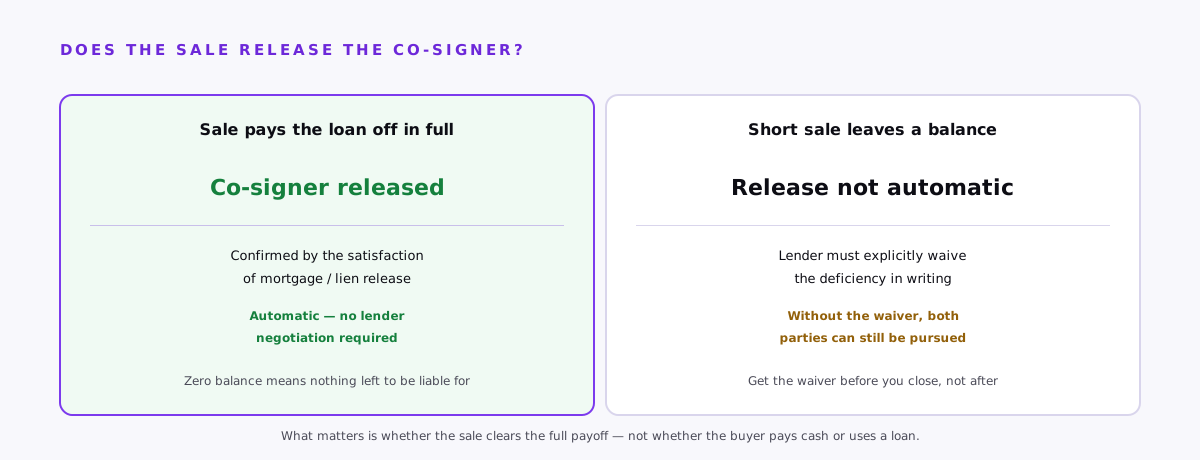
Yes, when the sale pays the loan off in full. A satisfaction of mortgage (the recorded document confirming the lien is gone) exists because once a loan balance hits zero, there's nothing left on the note for anyone — borrower or co-signer — to be liable for. That's basic to how a promissory note works, not a special rule written for co-signers.
The scenario where this goes wrong is a short sale — a sale where the proceeds don't cover the full payoff. Lenders and legal practitioners are consistent on this point: a borrower or co-signer can't assume that a lender simply agreeing to let a short sale happen means the leftover balance, the deficiency, is forgiven. Unless the short sale agreement explicitly states the lender is waiving the deficiency, both the primary borrower and the co-signer can still be pursued for what's left unpaid. The fix isn't complicated — get it in writing before you close — but skipping that step is exactly how a co-signer gets a collections call six months after everyone assumed the house sale ended their involvement.
The loan shows up on the co-signer's credit report the entire time it's open, and per Experian's own guidance, another lender can count those payments in the co-signer's debt-to-income ratio for the co-signer's own future loan applications — even though the co-signer isn't the one making the payments. When the loan pays off at closing, the servicer reports it closed and paid, and it's allowed to stay on the credit report as a closed, paid account for up to 10 years — that's normal, not a sign anything went wrong. Experian also notes it can take 30–60 days after closing for that update to actually post, so a co-signer who checks their report the week after closing and still sees an open balance hasn't necessarily hit a problem — they've hit normal reporting lag. Pulling the report again after that window, rather than assuming the worst immediately, is the right move.
A pure co-signer isn't a required signature on the deed — only people on title convey the property — so there's nothing for them to sign at the closing table itself. What they should get, directly from the seller or the closing agent, is confirmation the loan paid off in full:
If the sale was a short sale rather than a full payoff, the one document that actually matters is the written deficiency waiver in the short sale agreement itself — without it, closing is not the end of the story for either the borrower or the co-signer.
Michigan is one of the few states with a cosigner-specific statute on the books. Enacted in 1989, it requires a creditor to mail the cosigner written notice of the primary borrower's default and give them at least 30 days to pay or make arrangements before any adverse information reaches a credit bureau. The statute doesn't name mortgages specifically, so confirm applicability with a Michigan attorney rather than assuming it covers your situation — but it's a real example of why “ask your servicer” beats guessing at a one-size-fits-all rule.
Say the house is worth $230,000 retail and the mortgage payoff is $205,000. The co-signer's exposure comes down entirely to whether the accepted price clears that $205,000 — not whether the buyer pays cash or uses a loan.
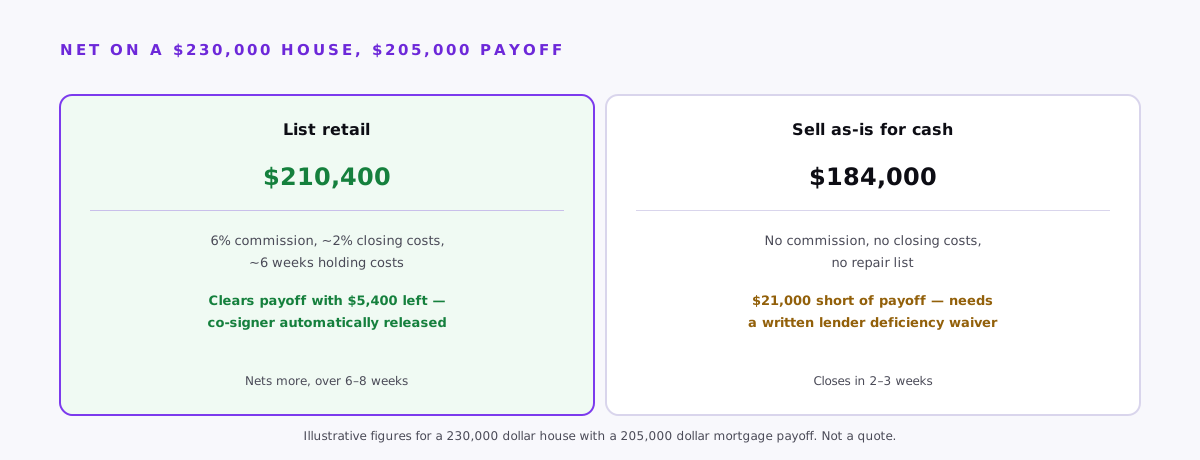
| List retail | Sell as-is for cash | |
|---|---|---|
| Starting value | $230,000 | $230,000 |
| Agent commission (6%) | −$13,800 | $0 |
| Seller closing costs (~2%) | −$4,600 | $0 |
| Holding costs, ~6 weeks | −$1,200 | $0 |
| As-is cash offer | — | $184,000 |
| Net before payoff | $210,400 | $184,000 |
| Mortgage payoff | −$205,000 | −$205,000 (shortfall) |
| Result | $5,400 to seller — loan fully retired, co-signer automatically released | $21,000 short — a short sale requiring the lender's written deficiency waiver to actually release the co-signer |
Listing retail nets more here, and it does something the lower cash number doesn't: it clears the loan in full without needing the lender's permission for anything. A cash offer isn't disqualifying on its own — a cash offer that clears the full payoff releases the co-signer exactly the same way a retail sale does. The risk only shows up when the accepted price, cash or financed, falls short of what's owed.
List retail if the price will clear the payoff. Nets the most and ends the co-signer's liability cleanly with no lender negotiation required.
Refinance instead of selling. If the primary borrower can now qualify alone, a solo refinance pays off the old co-signed loan with a new one in their name only — same release mechanism as a sale, without moving.
Sell as-is for cash, if the price clears the payoff. Skips the retail timeline, and releases the co-signer just as completely as a retail sale when the number works. Send us the property here and we'll tell you honestly whether our number clears what's owed.
If the only realistic sale is a short sale, get the lender's deficiency waiver in writing before you close — not after.
This article is general educational information, not legal or financial advice. Mortgage co-signer liability is governed primarily by the loan documents and federal lending rules rather than a uniform state statute; confirm your specific situation with your loan servicer or an attorney before closing.
If you need certainty that a sale fully retires the loan — not a short sale that leaves a co-signer exposed to a deficiency — we can make a cash offer and tell you honestly whether it clears what's owed before you commit to anything.
Send us the property here and we'll walk you through the numbers.
All guides · Selling a house with an unmarried co-owner · Mortgage payoff statement explained · Seller closing costs
Step 1 of 5
No obligation, no fees, no repairs. We respond the same day.
You’ll talk to Trevor McAmis, Owner & Acquisitions Lead
(313) 710-6129
Takes about two minutes. Or call (313) 710-6129 — we answer.
