Every market page publishes the numbers behind its offer. See the math
Home › Guides › Selling a House With an Ex Who Isn't Your Spouse: The Process When There's No Divorce Court
Guide
Selling a House With an Ex Who Isn't Your Spouse: The Process When There's No Divorce Court
When an unmarried couple who co-own a house split up, there is no divorce court, no automatic restraining order, and no equitable-distribution formula — just contract and property law. Either owner can sell their share, force a buyout, or file a partition action to compel a sale, and how you hold title decides which options are actually available.
Takes about two minutes. Or call
(313) 710-6129 — we answer.
Educational only. This explains how these situations generally work. It is not legal, tax or financial advice, and the rules differ by state — talk to an attorney or CPA about your own situation before you act on any of it.
Why this is a different problem than divorce
This is educational information, not legal advice. Talk to a real estate attorney about your specific ownership structure and state.
Married couples splitting up have a court built for exactly this — a divorce court that can freeze the property, decide who stays, and divide the equity under a statute. Unmarried co-owners have none of that. There is no family court with jurisdiction over your breakup, and unless you signed a cohabitation or co-ownership agreement before buying, there is no formula for dividing the house either. What governs is ordinary property law: whose name is on the deed, and in what form.
That is not automatically worse — it is just different, and the differences trip people up in predictable ways. Our selling a house during divorce guide covers the married version of this; this page is for everyone else who bought a house with a partner.
How you hold title decides almost everything
Pull the deed before any conversation about next steps. It will show one of two structures if both names are on it — a third, tenancy by the entirety, is reserved for married couples in most states and generally does not apply here.
Joint tenants with right of survivorship. Equal, undivided shares, with the feature that if one owner dies, the other automatically inherits the whole property — no probate needed for that transfer. Selling or refinancing generally requires both signatures.
Tenants in common. Each owner holds a distinct, possibly unequal share — 50/50, 70/30, whatever the deed or your contributions established — with no automatic survivorship. Each owner's share can, in principle, be sold, given away, or willed independently of the other, though in practice selling just your share to a stranger is rare and usually a last resort, because most buyers do not want to co-own a house with someone else's ex.
If only one name is on the deed, the non-titled partner generally has no automatic ownership interest simply from having lived there or contributed to the mortgage — a sharp contrast to a non-owning spouse, who in most states gets some protection regardless of the deed. A non-titled partner who paid toward the mortgage, a down payment, or renovations may still have a claim, but it typically has to be established separately, through a written agreement, an implied contract theory, or in a few states an unjust-enrichment claim, not through the deed itself.
Your three real paths
1. Agree on it yourselves
The cheapest and fastest option by a wide margin, and where most of these situations actually end up. Common structures: sell and split proceeds by ownership share once title is clear; one partner buys the other out, typically by refinancing into their name alone and paying the departing partner their share of the equity in cash; or list with an agent and split net proceeds at closing according to the deed's ownership percentages, or an agreement you put in writing beforehand.
Whatever you agree to, put it in writing and both sign it before either of you spends money or moves out. A text message thread is not the same as a signed agreement, and disputes over "what we said" are the single most common reason these situations end up in court instead of a closing.
2. One partner buys the other out
Works like a divorce buyout, minus the court: the partner keeping the house gets it appraised, refinances to pay off any existing mortgage plus the departing partner's share of the equity, and the departing partner signs a quitclaim deed once paid. The buying partner needs to qualify for the new loan on their income alone — this is where these deals most often stall, because two incomes qualified for the original mortgage and one often does not.
3. Partition action — when you can't agree
If one co-owner wants to sell and the other refuses, and there is no agreement requiring otherwise, either tenant-in-common or joint tenant generally has an absolute right to force a sale through a partition action. Michigan's version of this rule, for example, states plainly that “all persons holding lands as joint tenants or… as tenants in common may have those lands partitioned” (MCL 600.3304) — every state we buy in has an equivalent statute, worded differently but doing the same job.
The process, broadly, across the states we buy in: file a partition petition in the county where the property sits; the court typically must offer the non-filing co-owner a chance to buy out the filing owner's share at a court-determined or appraised value before ordering a sale to a third party — this step exists specifically to avoid unnecessarily forcing property onto the open market; if no buyout happens, the court orders the property sold, usually at auction or through a court-appointed referee, and proceeds are divided by ownership share after crediting anyone who paid more than their share of the mortgage, taxes, insurance, or repairs.
The whole process commonly runs several months to over a year, plus attorney's fees and court costs that come out of the sale proceeds — which is the real reason most people settle before filing. Partition is the backstop, not the plan. It works, and it is slow, public, and expensive enough that almost everyone does better negotiating a buyout or an agreed sale first.
The honest math on each route
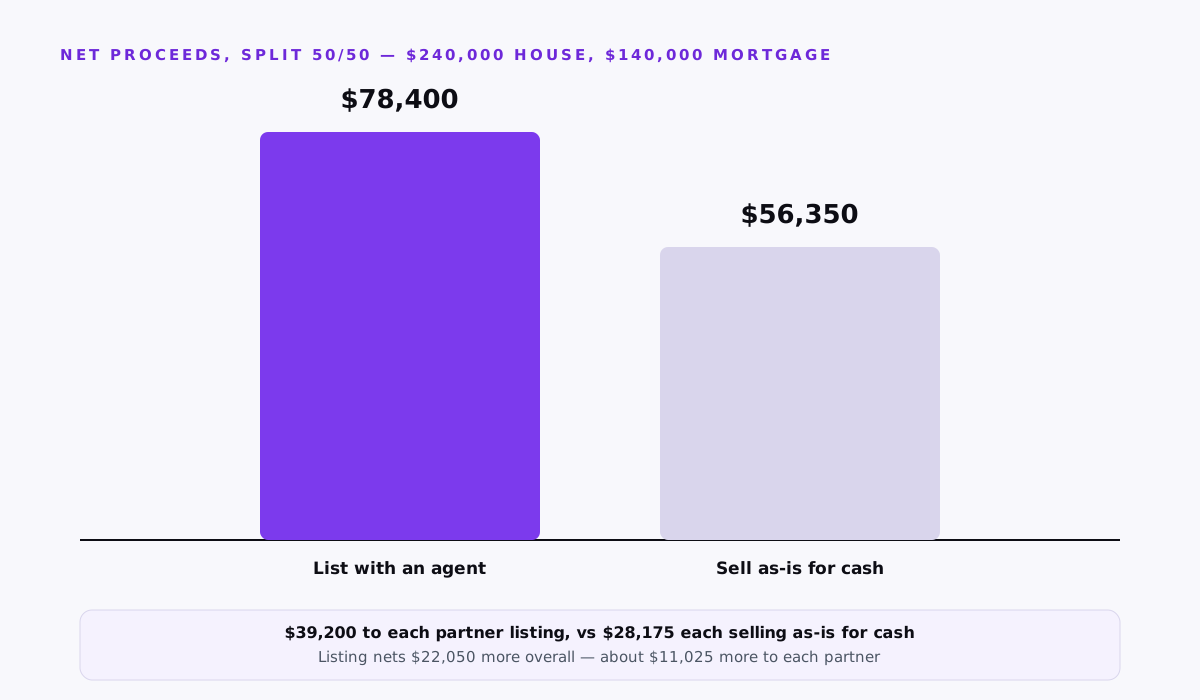
Take a house worth $240,000 on the open market, with a $140,000 mortgage balance, owned 50/50 as tenants in common by an unmarried couple splitting up.
Line
List with an agent
Sell as-is for cash
Sale price
$240,000
$198,000
Agent commission (5.5%)
−$13,200
$0
Seller closing costs
−$3,600
−$1,000
Holding costs
−$4,800 (3 months)
−$650 (2 weeks)
Mortgage payoff
−$140,000
−$140,000
Net proceeds
$78,400
$56,350
Each partner's half
$39,200
$28,175
Listing nets $22,050 more, split two waysRestar Acquisitions · worked example from this page
Listing nets $22,050 more, or about $11,025 each. On a house in decent condition where both partners can agree to cooperate through a roughly 90-day process, that is the right answer and we would say so. A cash sale earns its lower price when the two of you cannot cooperate long enough to complete a retail listing, when one partner needs their share of equity immediately, or when a partition filing is already on the table and both sides would rather avoid the cost and time of litigating it. Our cash offer vs listing net-proceeds guide runs this arithmetic in more depth.
Alternatives worth naming
Keep co-owning it, as a rental or for one partner's continued use, with a written agreement covering who pays what and an exit mechanism for later. Underused, and sometimes the right call if the relationship ended amicably.
Refinance-and-buyout, covered above, if one partner wants to keep the house and can qualify alone.
Mediation before litigation. A single mediation session is dramatically cheaper than a partition filing and resolves most of these without ever reaching a courtroom.
What to actually do
1. Pull the recorded deed and confirm exactly how title is held.
2. Find any written agreement — a cohabitation agreement, a promissory note for a down payment, anything signed when you bought the house.
3. Get a current mortgage payoff figure and a realistic value opinion before any conversation about numbers.
4. Try to agree in writing first — a sale, a buyout, or continued co-ownership with clear terms.
5. If you can't agree, talk to a real estate attorney about a partition action before either of you does anything unilateral, like stopping mortgage payments or changing locks — both can complicate your legal position.
6. Be careful with anyone who pressures you to sign over your share quickly or asks for money up front to "handle" the situation. This is the same advance-fee pattern the CFPB warns about in foreclosure relief scams, and people going through a breakup are targeted the same way.
Common questions
Can my ex force me to sell our house if we weren't married?
If you are both tenants in common or joint tenants, yes — either owner generally has the right to file a partition action, and courts rarely deny it outright. The process usually offers a buyout option first, and only orders a forced sale if no buyout happens.
What if only my name is on the deed but my partner paid part of the mortgage?
They may still have a legal claim, but it is not automatic the way a spouse's would be. It typically depends on a written agreement, evidence of their contributions, or a state-specific legal theory like unjust enrichment. Talk to a real estate attorney early — this is one of the more fact-specific corners of property law.
How is equity split between unmarried co-owners?
By ownership share as recorded on the deed, adjusted for documented unequal contributions if you agree to that adjustment or a court orders it in a partition action. Without an agreement, courts generally start from the deed's stated shares, commonly 50/50 for joint tenants.
How long does a partition action take?
Commonly several months to over a year, depending on whether the other owner contests it and your local court's schedule. Most people settle or agree to a buyout before it reaches a forced sale, because of the time and legal costs involved.
Do we need a lawyer if we already agree on everything?
It is still worth having a real estate attorney or the closing agent put the agreement in writing and confirm the deed and mortgage payoff are handled correctly. Verbal agreements between former partners are the most common source of disputes that later end up in court.
If you can agree to list it and cooperate through a roughly 90-day process, the arithmetic in our cash offer vs listing net-proceeds guide shows that route usually nets more, and we would say so on the phone.
Where we are useful is the harder version: you cannot agree, a partition filing is already on the table, or one of you needs your share of the equity now rather than in three to six months. Send the address and we will send a written offer within 24 hours with the comparable sales it came from. No cost, no obligation. Start at tell us about the property.
Every offer on this site is underwritten by a person, not a form. If the
numbers do not work for you, say so and I will tell you what would.
Also from Restar
Want the data behind all of this?
Restar Acquisitions is the acquisitions arm of Restar — a housing-market analytics
platform tracking 180+ metrics across every U.S. market, with composite scores and 12-month
price forecasts. The numbers on this page come from the same work.