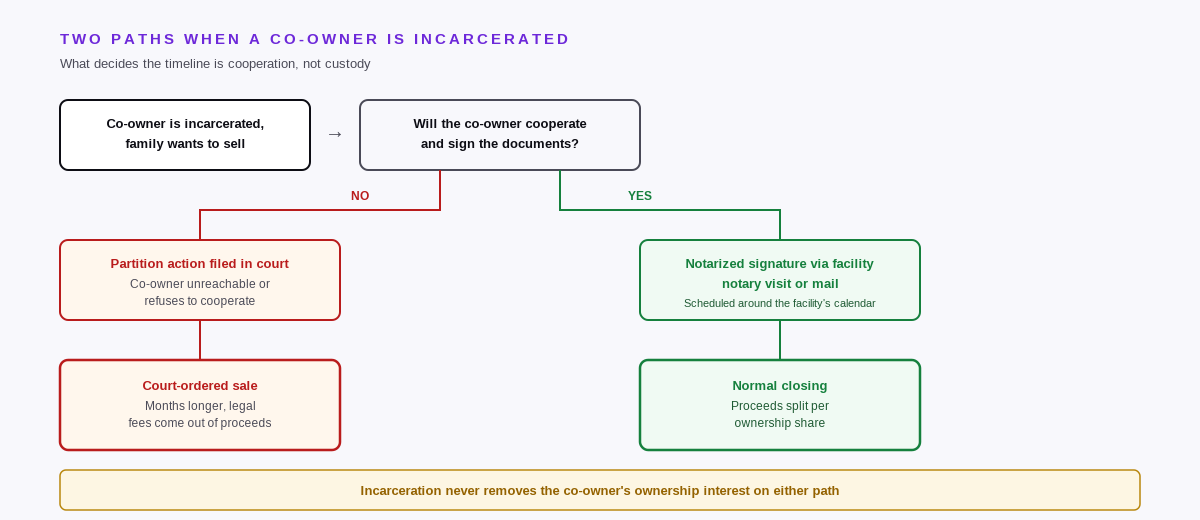
Selling a house when a co-owner is incarcerated is legally possible in every state Restar buys in. Prison does not erase someone's ownership interest in real estate, and it does not erase their right to consent to a sale. An incarcerated co-owner still owns their share and generally still has to sign to sell it, the same as any other owner on the deed. You can get that signature notarized inside most facilities, use a power of attorney signed before incarceration if one exists and covers real estate, or, if the co-owner will not cooperate or cannot be reached, file a partition action to force a sale through the court.

Step 1 of 5
Tell us about the property and where things stand with the co-owner. We'll send a written cash offer within 24 hours.
You’ll talk to Trevor McAmis, Owner & Acquisitions Lead
(313) 710-6129
Takes about two minutes. Your address is never shared.
Educational only. This explains how these situations generally work. It is not legal, tax or financial advice, and the rules differ by state. Talk to an attorney or CPA about your own situation before you act on any of it.
This is general education, not legal advice. Talk to a real estate attorney familiar with partition actions about your specific deed, state, and facility before you rely on anything here.
A conviction and a prison sentence change where someone lives. They do not, on their own, change who owns what. Whether the deed names the co-owners as joint tenants or tenants in common, each owner keeps their recorded share for as long as they hold it, and selling the whole property generally requires every titled owner's signature, incarcerated or not.
There are a small number of situations where someone else can sign in the incarcerated co-owner's place, and it is worth knowing them up front because they get confused with each other constantly: a valid, still-effective power of attorney that the incarcerated co-owner signed while competent and that specifically covers real estate transactions; a court-appointed guardian or conservator, but only if the co-owner has been found by a court to be truly incapacitated, which is a separate legal question from simply being in custody (see our guide on selling a house during guardianship or conservatorship); or a partition action, which forces a sale through the courts without the uncooperative owner's agreement.
Outside of those three, the remaining co-owners cannot sign on an incarcerated owner's behalf just because reaching them is harder or the situation feels urgent.
Most states allow a notary to travel into a jail or prison and notarize a signature there, and the National Notary Association's own guidance for members confirms this is a routine, if logistically involved, part of the job: a notary contacts the facility in advance, gets approved for a visit, and works within whatever security setup the facility requires, sometimes signing through a plexiglass partition with documents passed by a guard. The National Notary Association has published a practical guide to notarizing for prison inmates covering exactly this process.
Three things cause most of the delay in practice. ID. People in custody usually surrender their regular ID on intake, and an inmate ID card is not automatically acceptable to every notary. Some states explicitly authorize it. Florida, one of the states Restar buys in, permits notaries to accept an inmate ID issued after January 1, 1991 by the Florida Department of Corrections. Confirm what ID your facility issues and whether a notary in that state will accept it before you schedule anything.
Facility scheduling. The notary visit, and getting documents in and out of the facility at all, runs on the facility's mail and visitation calendar, not yours. Build in a week or two of lead time rather than assuming a next-day appointment.
No remote option, usually. Remote online notarization has become common for ordinary real estate closings, but it depends on a webcam, an internet connection, and a smartphone or computer the signer controls. Most people in custody do not have access to any of that, so an in-person visit is typically the only path.
Often, yes. A power of attorney does not expire just because the person who signed it goes to prison. What controls whether it still works is the document itself, not the signer's address.
Two things decide it. First, was the principal legally competent, meaning mentally capable of understanding what they were signing, at the time they signed? Incarceration is a question of physical custody, not mental competence, and the two are not the same thing. A document signed by a competent person before they were ever charged with anything is not retroactively invalidated by what happened to them afterward. Cornell Law School's Legal Information Institute explains the general mechanics of a power of attorney, including that a standard power of attorney generally stays effective only while the principal is alive and competent, while a durable power of attorney is written to survive the principal's later incapacity.
Second, does the document cover real estate? A power of attorney limited to banking or medical decisions will not let an agent sign a deed. You need one broad enough, or specific enough, to authorize selling real property, and in most states that document also has to be recorded with the county recorder or register of deeds where the property sits before a closing agent will accept the agent's signature in place of the owner's.
One state's statute is worth flagging because it shows how differently incarceration and incapacity get treated under the law. North Carolina's Uniform Power of Attorney Act defines “incapacity,” for the purpose of triggering a springing power of attorney, to include being “detained, including incarcerated in a penal system” (N.C.G.S. §32C-1-102). That is not a rule that incarceration cancels a power of attorney. It is the opposite: the law anticipates an agent stepping in for someone who is incarcerated, rather than treating custody as a reason the document stops working.
If the incarcerated co-owner refuses to sign, cannot be located, or simply will not respond to mail or calls, the remaining owners cannot force a sale on their own. Property law does not make an exception for a co-owner who is difficult to reach. What it does provide is a partition action: a lawsuit that asks a court to order the property sold and the proceeds divided, without needing every owner's agreement.
Our guide on the cost of a partition action covers the full cost breakdown, the timeline, and how the Uniform Partition of Heirs Property Act changes the process in some states, so that math is not repeated here. The short version for this situation: a correctional facility address is a valid address for legal service, so the fact that a co-owner is incarcerated does not prevent them from being served or notified about the case. It is slower and more expensive than a cooperative sale, generally months at minimum, and the legal costs come out of the sale proceeds before anyone gets paid.
This comes up often enough with inherited property specifically that it is worth a mention: a 2023 USDA Forest Service study counted more than 444,000 heirs' property parcels nationwide, covering over 9.2 million acres. Several siblings or relatives inheriting a house together, with one of them incarcerated, is a common enough shape of this problem that it is not a rare edge case.
Historically, a number of states had “civil death” statutes that treated a person convicted of a serious crime, especially one serving a life sentence, as having lost a broad set of civil rights, in some old statutes including property rights. That doctrine has been almost entirely abolished. By the mid-1950s most states had repealed or struck down formal civil death laws, and courts that have reviewed the remaining ones have generally rejected them. As of this writing, Rhode Island is the one state still actively enforcing a version of civil death affecting people serving life sentences, and even there, its state Supreme Court has struck down the part of the statute that cut off a prisoner's right to sue. Rhode Island is not one of the 14 states Restar buys in.
New York, one of Restar's states, still has a statute on the books with civil-death-adjacent language. Civil Rights Law Section 79 suspends certain civil and political rights, including holding public office, during a prison sentence. But the very next section of the same law, Section 79-b, states directly that “a conviction of a person for any crime, does not work a forfeiture of any property, real or personal, or any right or interest therein” (N.Y. Civil Rights Law §79-b). So even in the one state in our footprint with any lingering civil-death-style language, real property ownership is explicitly protected by the same statute.
We did not find a current, operative civil death provision affecting real property ownership in any of the 14 states Restar buys in: Alabama, Arizona, Florida, Georgia, Indiana, Maryland, Michigan, Missouri, North Carolina, Nevada, New York, Ohio, Pennsylvania, or Texas. State law changes, so confirm current status with a real estate attorney if you have any doubt, but do not assume a co-owner's incarceration has stripped their ownership without checking first.
Example: two siblings co-own a $210,000 house as tenants in common, 50/50, with a $95,000 mortgage balance. One sibling is incarcerated but cooperative, and the family arranges a facility notary visit to get a signed listing agreement and, later, the closing documents.
| Line | List with an agent | Sell as-is for cash |
|---|---|---|
| Sale price | $210,000 | $176,000 |
| Agent commission (5.5%) | −$11,550 | $0 |
| Seller closing costs | −$3,100 | −$900 |
| Holding costs | −$4,200 (≈4 months) | −$400 (≈3 weeks) |
| Mortgage payoff | −$95,000 | −$95,000 |
| Net proceeds | $96,150 | $79,700 |
| Each sibling's half | $48,075 | $39,850 |
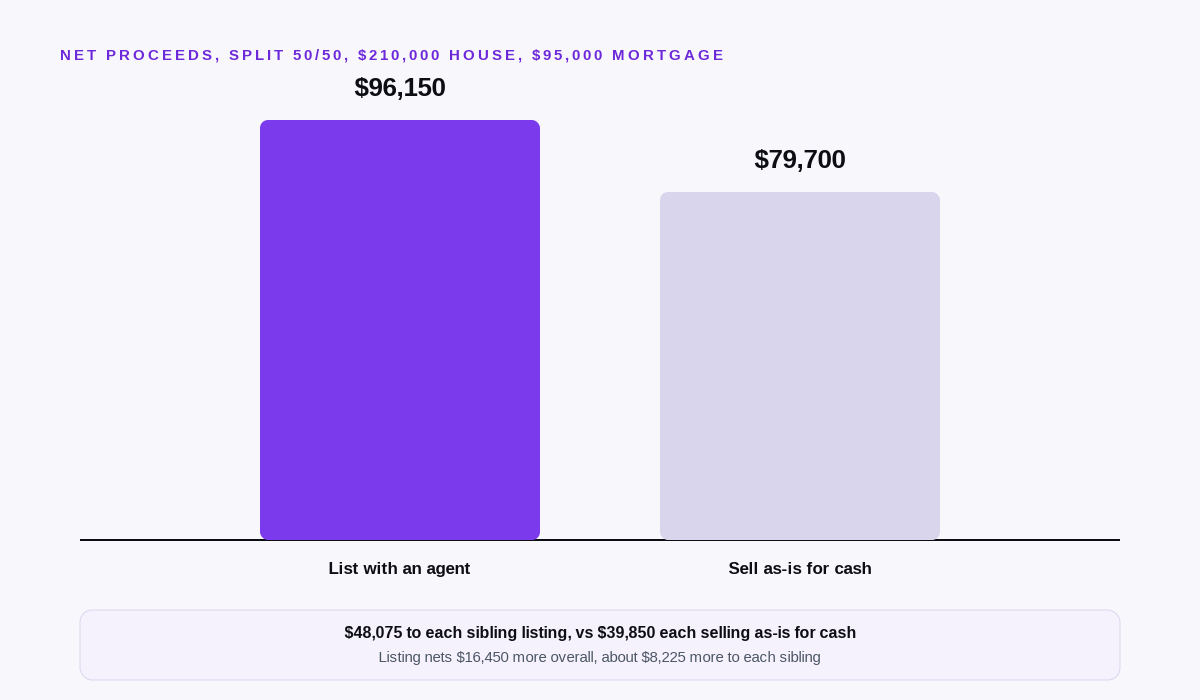
Listing nets $16,450 more between the two of them, or $8,225 each. On a house in reasonable condition, where both siblings can get a notarized signature arranged through the facility and stay in communication, that is the better route and we would tell you so. The extra time a facility notary visit adds, usually a week or two of scheduling, is a small piece of the roughly four-month listing timeline above. A cash sale earns its lower price when the family cannot wait that long, when the incarcerated co-owner's cooperation is uncertain, or when a partition filing is already on the table because cooperation has broken down entirely. In the uncooperative scenario, the legal fees from a contested partition action commonly run well into five figures on top of a slower timeline, which the cost of a partition action guide breaks down in detail.
Mediation or direct family negotiation. A single conversation, sometimes with a neutral third party, resolves more of these situations than litigation does, and it is dramatically cheaper than a partition filing.
Waiting until release, if the sentence is short enough and the family can afford to hold the property that long. Not realistic for most sentences, but worth a straight calculation before ruling it out.
A guardian or conservator, if the incarcerated co-owner is truly incapacitated for reasons beyond being in custody, such as a diagnosed cognitive condition. See our guide on selling a house during guardianship or conservatorship for how that process works.
A partition action, covered above, when none of the other options get the co-owner's cooperation and real money is at stake.
Pull the deed first and confirm exactly how title is held and whose signatures a sale will require. Find out if a power of attorney exists, when it was signed, and whether it specifically covers real estate. Call the facility to ask about notary visits and mail procedures before you assume anything about timing. And talk to a real estate attorney familiar with partition actions early, especially if the co-owner is unreachable or unwilling to cooperate, rather than after months have already passed.
Restar Acquisitions buys houses as-is for cash in 69 markets across Alabama, Arizona, Florida, Georgia, Indiana, Maryland, Michigan, Missouri, North Carolina, Nevada, New York, Ohio, Pennsylvania, and Texas. We send a written offer within 24 hours, no repairs and no commissions, and you pick the closing date. If listing nets you more once everyone can sign, we will tell you that too. Start at tell us about the property.
If the co-owner is cooperative and you can get a facility notary visit scheduled, listing with an agent usually nets more once everyone can sign. We'll tell you that on the phone.
Where we're useful is the harder version: a partition filing is already on the table, the co-owner can't be reached, or the family needs certainty now rather than in several months. Send the address and we'll send a written offer within 24 hours with the comparable sales it came from. No repairs, no commissions, and you pick the closing date. Start at tell us about the property.
All guides · Cost of a partition action · Selling a house with an unmarried co-owner · Selling a house during guardianship or conservatorship
Step 1 of 5
No obligation, no fees, no repairs. We respond the same day.
You’ll talk to Trevor McAmis, Owner & Acquisitions Lead
(313) 710-6129
Takes about two minutes. Your address is never shared.