<b>A court-appointed guardian or conservator generally cannot sell a ward's house on their own authority — the guardianship appointment itself doesn't include that power.</b> Selling real property almost always requires a separate petition to the court, notice to interested parties, and in many states a bond increase tied directly to the sale proceeds, before a closing can happen at all. Here's how that process actually works, and the honest tradeoff between a financed buyer and a cash buyer once you clear it.
Step 1 of 5
Tell us about the property and where you are in the court process and we'll send a written cash offer within 24 hours, structured to work with your guardianship timeline. No repairs, no commissions, no financing contingency to worry about after the judge signs off.
You’ll talk to Trevor McAmis, Owner & Acquisitions Lead
(313) 710-6129
Takes about two minutes. Or call (313) 710-6129 — we answer.
Educational only. This explains how these situations generally work. It is not legal, tax or financial advice, and the rules differ by state — talk to an attorney or CPA about your own situation before you act on any of it.
These three roles get confused constantly, and the difference matters a lot here. A power-of-attorney agent's authority to sell exists the moment the principal signs a valid document while competent, with no court involved at all — see selling a parent's house with power of attorney for how that works. An executor's authority to sell exists only after the owner has died, under the will and the probate code. A guardian or conservator's authority exists only because a court granted it while the ward is still alive but has been found legally unable to manage their own affairs — and in most states, that appointment on its own does not include permission to sell real property.
Florida is explicit about this: under the 2026 Florida Statutes, a guardian needs court approval under a specific petition before selling, mortgaging, or leasing the ward's real property, including the homestead (Fla. Stat. §744.441(12)). North Carolina requires the guardian to file a separate special proceeding seeking the court's authority and approval before a sale can happen. Texas allows an application for a court order to sell real property when the sale “appears necessary or advisable” (Tex. Estates Code ch.1158) — a separate step from the guardianship appointment itself.
If there's a dispute among family members about whether the sale should happen at all, that's a different problem than the guardianship-approval process covered here — when heirs cannot agree to sell covers that situation, and selling a house during a will contest covers disputes over who should inherit in the first place.
This is general education, not legal advice. Guardianship and conservatorship law, and exactly what counts as court approval, varies significantly by state — talk to an elder-law or probate attorney about your specific situation before you file anything.
Guardians and conservators are frequently required to post a surety bond before being granted authority over the ward's assets, and a large home sale can force that bond to increase right when you need to close. North Carolina's statute spells this out directly: before receiving sale proceeds, the guardian must furnish a new bond or increase an existing one to cover them, set at twice the amount of the proceeds — or 1.25 times the proceeds if the surety is a bonding company (N.C.G.S. §35A-1231).
Florida ties the required bond amount to the cash and liquid assets under the guardian's control, with the court having discretion to increase or reduce it as circumstances change (Fla. Stat. §744.351) — which in practice means a six-figure home sale can trigger a court review of the bond amount on its own, separate from the sale-approval petition itself.
The practical point: budget time and money for a possible bond increase alongside the sale-approval petition, not after it. A surety company doesn't issue a larger bond instantly, and if the bond isn't in place when the court wants to release sale proceeds, that's one more thing that can delay a closing that's already waiting on a judge.
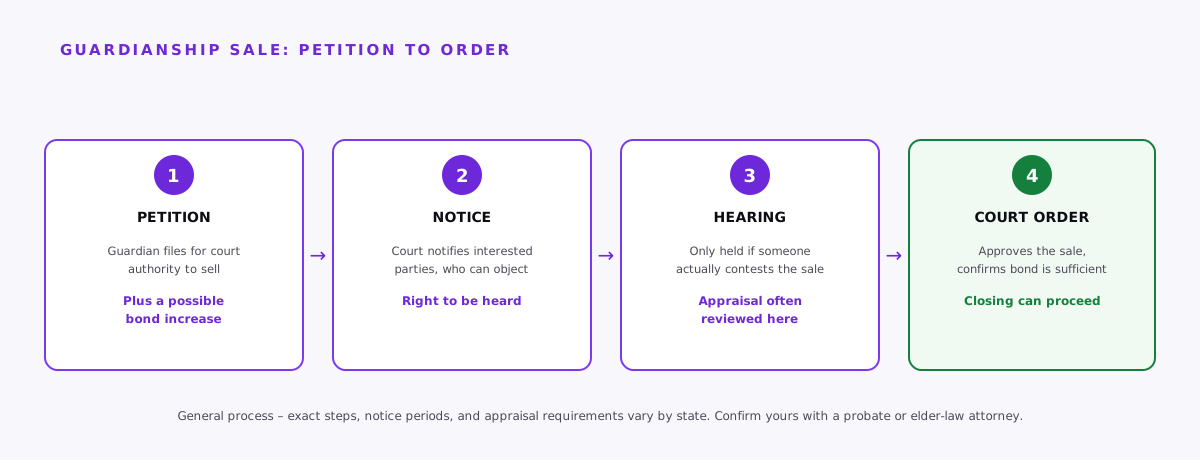
The exact mechanics vary by state, but the shape is similar almost everywhere: the guardian files a petition or application asking the court for authority to sell, the court issues notice (sometimes called a citation) to interested parties who have a right to object, a hearing is held only if someone actually contests the sale, and the court then issues an order approving the sale and confirming the bond is sufficient. Texas's current Estates Code provisions governing guardianship sales (Tex. Estates Code ch.1158) took effect January 1, 2014, replacing the state's former Probate Code.
An independent appraisal to set a minimum sale price is common but not always mandatory — Texas law, for example, gives the court discretion to require one rather than making it automatic in every case (Tex. Estates Code §1351.003(c)). Where it is required, expect that appraisal to anchor what price the court will actually approve, which matters if you're comparing a retail listing price against a cash offer before you file.
Realistic added timeline, per several elder-law and probate practice estimates (not a government-published figure): roughly 30 to 90 days beyond what a normal sale by a competent owner would take, mostly spent waiting for the court's calendar rather than for a buyer.
The sale closing doesn't end the court's oversight. Guardianships commonly require an ongoing accounting of everything that moves through the estate — Florida, for example, requires an annual accounting submitted under oath covering all money in and out of the guardianship, due by April 1 each year (Fla. Stat. §744.3678). Sale proceeds generally have to be tracked and reported the same way the rest of the ward's assets are, not disbursed freely once a closing happens.
Some states also offer a narrower version of guardianship scoped to a single transaction — authorizing just the home sale rather than full ongoing management of the ward's affairs — which can be faster and less burdensome than a full guardianship if that's all that's actually needed. Ask a local elder-law attorney whether your state offers something like this before assuming a full guardianship is the only path.
Worked example, illustrative only: a $220,000 house, with a roughly 45-day court approval process ahead of either buyer — that part of the timeline is the same no matter who buys.
| Court approval, then a financed retail buyer | Court approval, then a cash buyer | |
|---|---|---|
| Court process | ~45 days (practitioner estimate), same either way | ~45 days (practitioner estimate), same either way |
| After approval | ~70 days to list, find a financed buyer, and close | ~1–2 weeks to close, offer already in place before the order |
| Total timeline | ≈ 115 days | ≈ 55–59 days |
| Risk after the judge signs off | If the buyer's financing falls through, the guardian may have to return to court for a new order approving a new sale | No financing contingency to fail after approval |
| Sale price | $220,000 | Below $220,000 retail — reflects speed and removed financing risk, not a quote |
| Commission/closing | −$12,320 commission (5.6%), −$3,300 closing costs | $0 commission, −$800 title/escrow-only closing |
| Net to the estate | ~$204,380, ≈ 115 days total | ~$197,200, ≈ 55–59 days total |
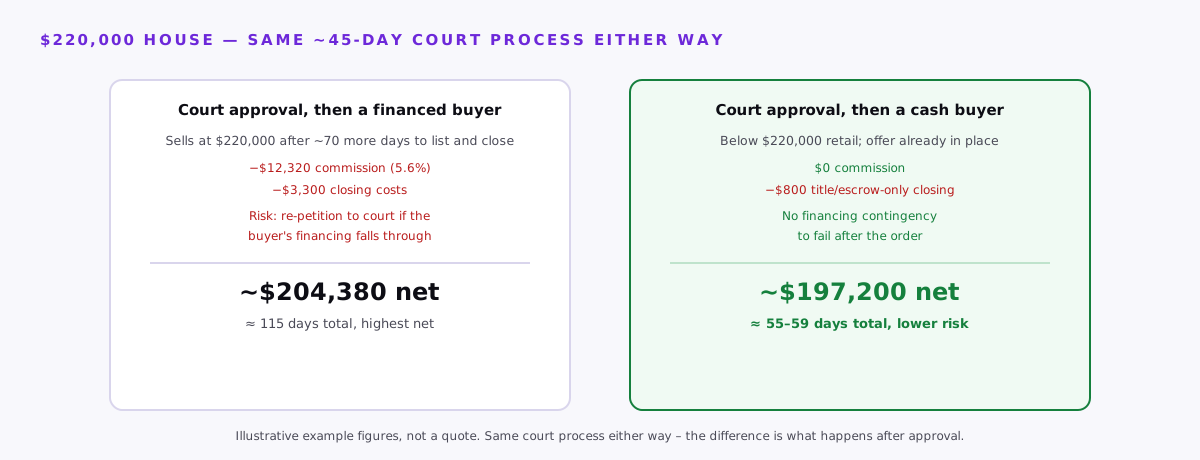
The honest read: a financed retail buyer nets more here, and that's the real number — but it also means betting that a lender's underwriting goes smoothly for a buyer who committed before the court order, with the risk of restarting the approval process if that financing falls through after the fact. A cash buyer nets less, but removes that specific re-petition risk, since there's no loan to fall through once the court has already signed off.
Alternatives worth checking before you file anything:
Restar Acquisitions buys houses as-is for cash in Alabama, Arizona, Florida, Georgia, Indiana, Maryland, Michigan, Missouri, New York, North Carolina, Ohio, and Texas. We give a written offer within 24 hours, no repairs or commissions required, and we can work within a guardianship court's timeline. We're a direct buyer, not your attorney, and we don't represent the guardian, the ward, or the court in this process.
This article is for general education only and isn't legal advice. Guardianship and conservatorship procedure, bond requirements, and sale-approval rules vary significantly by state — confirm the specific requirements in your state with an elder-law or probate attorney before you file a petition or accept an offer.
A cash offer removes one real risk from this process: a financed buyer's loan falling through after a judge has already approved a specific sale to a specific buyer, which can mean going back to court for a new order.
You'll get a written offer within 24 hours, no repairs or commissions required, and we can work on the timeline your court process requires. We're a direct buyer, not your attorney, and this isn't legal advice.
All guides · Selling a parent's house with power of attorney · Selling a house during a will contest · When heirs cannot agree to sell
Step 1 of 5
No obligation, no fees, no repairs. We respond the same day.
You’ll talk to Trevor McAmis, Owner & Acquisitions Lead
(313) 710-6129
Takes about two minutes. Or call (313) 710-6129 — we answer.