<b>Yes, you can sell a house titled in an LLC, and most of the sale mechanics are the same as selling as an individual.</b> What changes is the paperwork at closing — a title company will want your operating agreement, a certificate of good standing, and a signed resolution naming who can sign for the LLC — and, if there's a mortgage tied to your personal name sitting under that LLC-held title, a due-on-sale risk that most sellers don't realize is there until someone asks about it. Most people who end up with a house titled in an LLC got there one of three ways: an attorney recommended it for liability protection on a rental, the house passed through an estate that was already LLC-held, or a landlord moved title into an entity years ago and mostly forgot about it until it was time to sell. None of those paths is a problem by itself. The friction shows up in three specific places — the mortgage, the closing documents, and the taxes — and all three are fixable once you know what to check.

Step 1 of 5
Send the address and we'll tell you honestly what a cash sale nets you compared to listing, entity documents included.
You’ll talk to Trevor McAmis, Owner & Acquisitions Lead
(313) 710-6129
Takes about two minutes. Or call (313) 710-6129 — we answer.
Educational only. This explains how these situations generally work. It is not legal, tax or financial advice, and the rules differ by state — talk to an attorney or CPA about your own situation before you act on any of it.
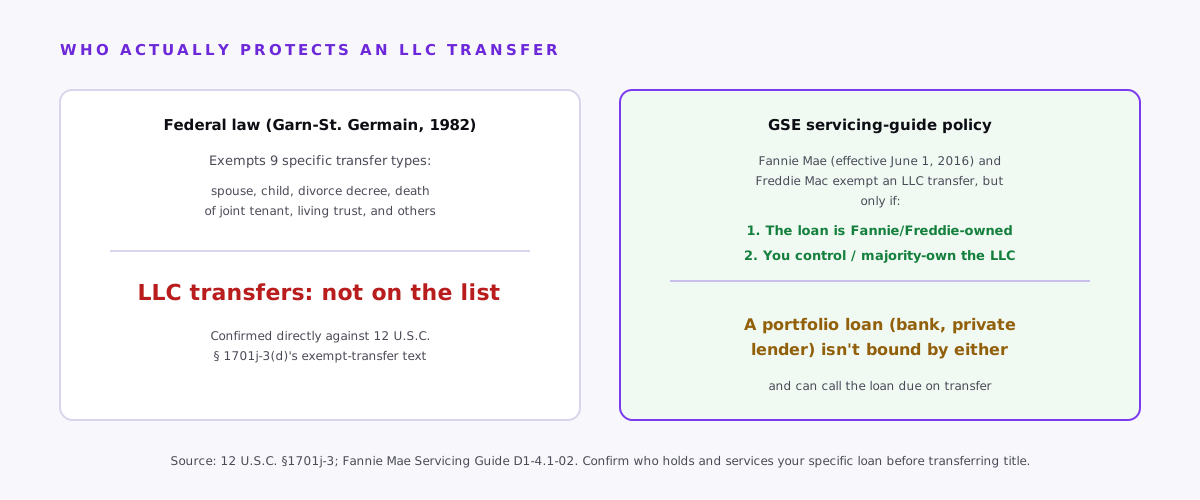
It can, and the federal law most people assume protects them doesn't actually cover this. The Garn-St. Germain Depository Institutions Act of 1982 (12 U.S.C. § 1701j-3) lists nine specific transfers a lender can't call due — transfers to a spouse or child, a transfer on death to a relative, a divorce-decree transfer, a transfer into a living trust where you remain the beneficiary, and a few others. A transfer into an LLC is not on that list.
What actually protects most owners here isn't the federal statute — it's a policy the loan servicer itself adopted. Fannie Mae's Servicing Guide (section D1-4.1-02) treats a transfer into an LLC as exempt from due-on-sale enforcement, but only under specific conditions: the loan has to be one Fannie Mae purchased or securitized on or after June 1, 2016, and the LLC has to be controlled by you — Fannie Mae's language requires the original borrower to control the LLC or hold a majority interest in it. Freddie Mac maintains a similar servicing-guide carve-out requiring the original borrower to be the LLC's managing member. Both are loan-servicer policies, not statutory rights, and both come with a catch: if you ever want to refinance that loan, Fannie Mae's guide requires the property to move back into a natural person's name first.
That means the protection has real edges:
If you're not sure which of these applies to your loan, the honest answer is to call your servicer and ask directly, or have a real estate attorney pull your note and check who actually holds and services it before you transfer anything. Guessing wrong here is how a seller ends up with a lender demanding full payoff at the worst possible moment.
Selling as an LLC adds a specific, predictable paperwork list that an individual seller never has to produce, and it's worth gathering before you sign a listing agreement or a purchase contract rather than after. Title and settlement companies across different states ask for a consistent set of documents to confirm the entity is real, in good standing, and that the person signing actually has authority to bind it. Here's what to expect:
None of this is hard to produce if your LLC is in good order, but it's exactly the kind of thing that stalls a closing by a week or two when it isn't — a lapsed annual filing, an operating agreement that doesn't actually name a managing member, or a member who's since become unreachable. Pull these documents before you go under contract, not after.
On the buyer's side, if your buyer is financing the purchase, their lender is more likely to scrutinize the deal closely if your LLC acquired the house recently and is reselling it fast. That's not an LLC-specific rule; Fannie Mae's Selling Guide generally permits non-arm's-length transactions but requires extra documentation to confirm fair-market value when a deal looks like one, regardless of whether the seller is an individual or an entity. An LLC that picked up a distressed property and is reselling it quickly is simply more likely to trip that review than a seller who's owned the house for a decade. (Note: the well-known 90-day anti-flipping rule is an FHA buyer-financing requirement, not a Fannie Mae one — don't confuse the two if your buyer mentions it.)
Generally, yes — and this surprises a lot of LLC sellers who assume an entity is treated differently than an individual homeowner. State disclosure statutes are almost always written around the type of transaction happening, not the legal identity of who's signing as seller, so an LLC doesn't quietly get a pass on telling a buyer about a known problem. Checking several of the states Restar Acquisitions buys in directly confirms the pattern:
The practical takeaway: titling a house in an LLC doesn't quietly exempt you from telling a buyer about a bad roof or a failed septic system. If you know about a defect, disclose it the same way you would if the house were in your own name.
This is where the kind of LLC you have actually changes the answer, and it's the question most sellers get wrong by assuming moving title into an entity automatically protects or automatically forfeits the exclusion. The modern Section 121 exclusion itself dates to the Taxpayer Relief Act of 1997, which replaced the old one-time-use exclusion and rollover rules with the ownership-and-use test still in force today — living in the home for at least 24 of the previous 60 months — and nothing in that statute mentions LLCs at all, which is exactly why the answer depends on IRS entity-classification rules instead.
A single-member LLC is a disregarded entity for tax purposes — the IRS confirms directly it treats an LLC with one member as not separate from its owner unless the owner has filed Form 8832 to elect corporate treatment. Under 26 CFR § 1.121-1(c)(3)(ii), where a residence is owned by a disregarded single-owner entity, the IRS looks through the LLC and treats you, the member, as the owner for purposes of the Section 121 home-sale exclusion. In plain terms: if you lived in the house as your primary residence and then moved title into a single-member LLC you control, the exclusion — up to $250,000 of gain tax-free if you're single, $500,000 married filing jointly, provided you meet the ownership-and-use test — isn't automatically lost just because title sits in the LLC.
A multi-member LLC is different. It defaults to partnership tax treatment, filing its own return (Form 1065), and it's the partnership — not any individual member — that's treated as the taxpayer holding the property. Tax practitioners are consistent on the practical result: the Section 121 personal-residence exclusion generally doesn't apply to a house held inside a multi-member LLC, because no individual member is personally “using” the property as their own residence in the way the statute requires. If you're in this situation and the numbers are significant, get a CPA to confirm your specific facts before you assume either outcome.
A 1031 exchange is a different tool entirely, and it only applies if the house was a rental or investment property, not a residence you lived in. The IRS is explicit that property used primarily for personal use — a primary residence, a second home — doesn't qualify for like-kind exchange treatment. If your LLC-held house was a rental, a 1031 exchange may be available to defer the gain into another investment property; if it was your home, it isn't the right tool regardless of who holds title. See our guide to 1031 exchange vs selling for cash for how that tradeoff actually plays out.
A standard homeowner's policy (HO-3) is written to a named insured, and most personal-lines carriers won't issue or keep that kind of policy once an LLC — not a person — holds title. This isn't a law; it's underwriting practice, because personal-lines products are built around individual occupant-owners, not business entities. Property held in an LLC is typically moved onto a landlord or dwelling-fire policy, or a small commercial policy, instead. If you transferred title into an LLC and never changed the insurance to match, there's a real chance your current policy doesn't actually have a named insured that matches who holds title — worth checking before anything happens to the house, not after.
None of the LLC-specific friction above is something a cash buyer has to underwrite around the way a financed retail buyer's lender does. Restar Acquisitions doesn't need your buyer's mortgage to close, so the due-on-sale question, the flip-timing review, and the entity-seller documentation checklist don't create the same risk of a deal falling through during underwriting that they can on a financed sale.
That doesn't mean a cash offer is automatically the better math — it's usually a lower gross number, in exchange for speed and certainty. Here's what that tradeoff actually looks like on a $240,000 LLC-held rental with $14,000 in deferred maintenance:
| Retail listing | Cash sale | |
|---|---|---|
| List / offer price | $240,000 | $205,000 |
| Repairs before listing | −$14,000 | $0 (sold as-is) |
| Agent commission (~5.5%) | −$13,200 | $0 |
| Seller closing costs | −$3,600 | −$1,200 |
| Carrying costs during listing (3–4 months) | −$5,400 | $0 |
| Entity-seller documentation / underwriting delay risk | Real risk of a stalled or re-traded deal | Not a factor |
| Net to seller | ~$203,800, in 3–4+ months, if the deal doesn't stall | ~$203,800, in 1–2 weeks, with certainty |
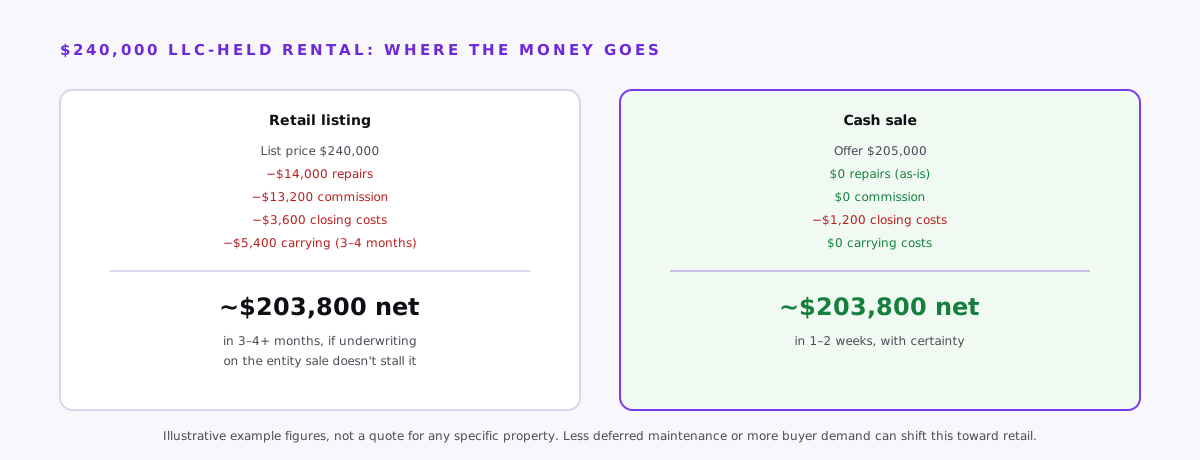
In this example the numbers land close to even once repairs, commission, and carrying costs are counted honestly — the real difference is time and certainty, not a guaranteed dollar gap. A house with less deferred maintenance and more buyer demand will usually net meaningfully more by listing. Run your own numbers rather than assuming either path wins by default — and if an agent gives you a strong reason to believe retail nets substantially more after a real accounting of repairs, commission, and carrying time, that's worth listening to.
Restar Acquisitions buys houses as-is for cash in 45 markets across Alabama, Arizona, Florida, Georgia, Indiana, Maryland, Michigan, Missouri, New York, North Carolina, Ohio, and Texas, and we're used to closing with an LLC or other entity on the seller's side — the documentation checklist above is routine for us, not a reason to slow down. We give a written offer within 24 hours, there are no repairs or commissions, and you pick the closing date. We're a direct buyer, not a real estate agent or broker, and we don't represent you in the transaction.
Alternatives worth checking before you decide:
This article is for general education only and isn't legal, tax, or insurance advice. LLC transfer rules, state disclosure laws, and loan servicing policies vary and change over time. Talk to a real estate attorney, a CPA, and your loan servicer about your specific LLC and mortgage before making a decision.
We'll give you a written offer within 24 hours and we're used to closing with entity sellers — operating agreement, resolution, and all. If listing retail would net you more after a real accounting, we'll say so.
All guides · Cash offer vs listing net proceeds · How cash home buyers calculate offers · Capital gains tax when you sell your house
Step 1 of 5
No obligation, no fees, no repairs. We respond the same day.
You’ll talk to Trevor McAmis, Owner & Acquisitions Lead
(313) 710-6129
Takes about two minutes. Or call (313) 710-6129 — we answer.