Every market page publishes the numbers behind its offer. See the math
Home › Guides › 1031 Exchange vs Selling for Cash: What a Landlord Actually Nets
Guide
1031 Exchange vs Selling for Cash: What a Landlord Actually Nets
A 1031 exchange and a cash sale solve two different problems, and most articles on this pretend one is simply smarter than the other. It isn't a smarter-or-dumber question — it's a want-another-rental-or-not question. Here's the real mechanics of an exchange, what it costs and risks that a cash sale doesn't, and the arithmetic to decide which one actually fits what you want next.
Takes about two minutes. Or call
(313) 710-6129 — we answer.
Educational only. This explains how these situations generally work. It is not legal, tax or financial advice, and the rules differ by state — talk to an attorney or CPA about your own situation before you act on any of it.
1031 Exchange vs Selling for Cash: the Short Answer
A 1031 exchange lets a landlord defer capital gains and depreciation-recapture tax by rolling the sale proceeds into another investment property through a qualified intermediary, on a strict 45-day identification and 180-day closing timeline. A straight cash sale pays both tax bills now, in exchange for certainty, speed, and being done with the property for good.
This is educational information, not tax advice. Whether a 1031 exchange is available or advisable for your property depends on facts specific to your situation. Talk to a CPA or 1031 qualified intermediary before you decide.
What a 1031 Exchange Actually Requires
Section 1031 of the Internal Revenue Code lets you defer gain on the sale of real property held for investment or business use — a rental house qualifies; your personal residence doesn't — by exchanging it for other “like-kind” real property. For real estate, “like-kind” is a broad standard: a single-family rental can exchange for a duplex, a commercial building, or a share of a larger property, as long as both sides are U.S. real property held for investment or business use. See the IRS's own explainer, Like-Kind Exchanges: Real Estate Tax Tips, and the statute at 26 U.S.C. § 1031.
The mechanism has one absolutely load-bearing rule: you can never touch the sale proceeds. The IRS states this plainly in its own sales, trades and exchanges FAQ — you avoid “actual or constructive receipt” of the money by using a safe harbor, almost always a qualified intermediary (QI), who holds the funds between closings and uses them to acquire the replacement property on your behalf. If the money is credited to your account, or even briefly available to you, the exchange is disqualified and the sale becomes fully taxable. The QI can't be your agent, attorney, accountant, or anyone related to you — it has to be an independent party.
Two deadlines run from the day your original property closes, and neither is extended by the other: 45 days to identify, in writing, the replacement property or properties you intend to acquire, and 180 days total, not 45 plus 180, to actually close on the replacement. See the 2025 Instructions for Form 8824. Both are calendar days, and in practice there is essentially no extension available outside a federally declared disaster. You can identify up to three potential replacement properties regardless of their combined value (the “3-property rule”), or more than three as long as their combined value doesn't exceed 200% of what you sold — and if you blow past both limits, the exchange still survives if you end up acquiring at least 95% of the value of everything you identified.
What It Costs, and What It Risks, That a Cash Sale Doesn't
A qualified intermediary charges a fee for a standard exchange — commonly cited in the range of roughly $600 to $1,500 for a straightforward single-property exchange, running higher, into the thousands, for something more complex like a reverse exchange or a multi-property deal. That's a real cost a cash sale simply doesn't have.
The bigger cost is execution risk. A cash sale closes on a date you agree to, with nothing else riding on it. A 1031 exchange has a hard 45-day clock to lock in a replacement property and a hard 180-day clock to actually close on it — and real estate deals fall through for all the ordinary reasons: financing, appraisal, inspection, a seller who gets a better offer. If your replacement deal collapses and you don't have a usable backup among your other identified properties, the exchange fails, the original sale becomes fully taxable in that year, and the QI fee is already spent.
There's also boot to watch for: if you receive any cash, or the debt on your replacement property is lower than the debt you had on the property you sold, that difference is taxed immediately as boot, even though the rest of the exchange defers normally. A 1031 doesn't have to be all-or-nothing — it can be a partial deferral with a partial tax bill, and it's easy to trigger boot by accident if you're not tracking the debt and cash carefully.
What It Defers, Not Eliminates
A 1031 exchange defers both your capital gains tax and your depreciation-recapture tax — the unrecaptured Section 1250 gain covered in our depreciation recapture guide — it doesn't erase either one. The deferred gain simply rolls into the substituted basis of your new property, which means it's still sitting there, waiting, the next time you sell without exchanging again.
There's one legitimate way that deferred gain disappears rather than just delays: if you hold the exchanged property until you die, your heirs generally receive a stepped-up basis to the property's fair market value at your date of death, under the separate basis rules in IRC § 1014. That step-up can permanently eliminate the gain you spent years deferring — a strategy sometimes called “swap till you drop” in tax-planning circles. It's a real and accurate point, but it's a basis-at-death rule, not something the IRS publishes as official 1031 guidance, so treat it as a long-term estate consideration rather than a reason to exchange a property you're not otherwise interested in continuing to own.
One more wrinkle worth a mention: if your rental has been through cost segregation and includes reclassified personal-property components — appliances, certain fixtures, carpet — a 1031 exchange does not defer the recapture on those components. That portion is taxed as ordinary income in the year of the exchange regardless of what you do with the real property.
The Passive Option: Delaware Statutory Trusts
If you want the tax deferral but you're genuinely done managing tenants and toilets, a Delaware Statutory Trust (DST) is a 1031-eligible option. Under IRS Revenue Ruling 2004-86, a beneficial interest in a properly structured DST counts as a direct interest in real property for 1031 purposes, which means exchanging into one satisfies the like-kind requirement. The tradeoff is passivity in both directions: a professional sponsor manages the property, but you also give up control — you can't direct day-to-day decisions, and the trust generally can't raise new capital or renegotiate its debt after the offering closes. For a landlord who wants out of active management without cashing out entirely, it's worth knowing this option exists; it's not something to enter into without your own due diligence on the specific sponsor and offering.
The Comparison That Actually Matters
This isn't a question of which option is objectively smarter — it's a question of what you actually want next. Exchanging is common enough that it's worth taking seriously as an option: research by professors David Ling and Milena Petrova, examining CoStar transaction data from 2010 through 2020, estimated that 1031 exchanges accounted for roughly 10% to 20% of all commercial real estate transactions in that period.
A 1031 exchange makes sense if you want to keep being a landlord: redeploying your equity into a bigger, better, or more passive property (including a DST), and you're in a position to execute a tight, deadline-driven transaction without your finances or your patience depending on it going perfectly.
A cash sale makes sense if you're actually done. You pay the capital gains and depreciation recapture now, but you get certainty and speed with none of the 45-day scramble, none of the 180-day deadline, and no risk of a busted exchange turning your tax-deferred plan into a fully taxable sale you didn't budget for.
Working the Numbers on One Property
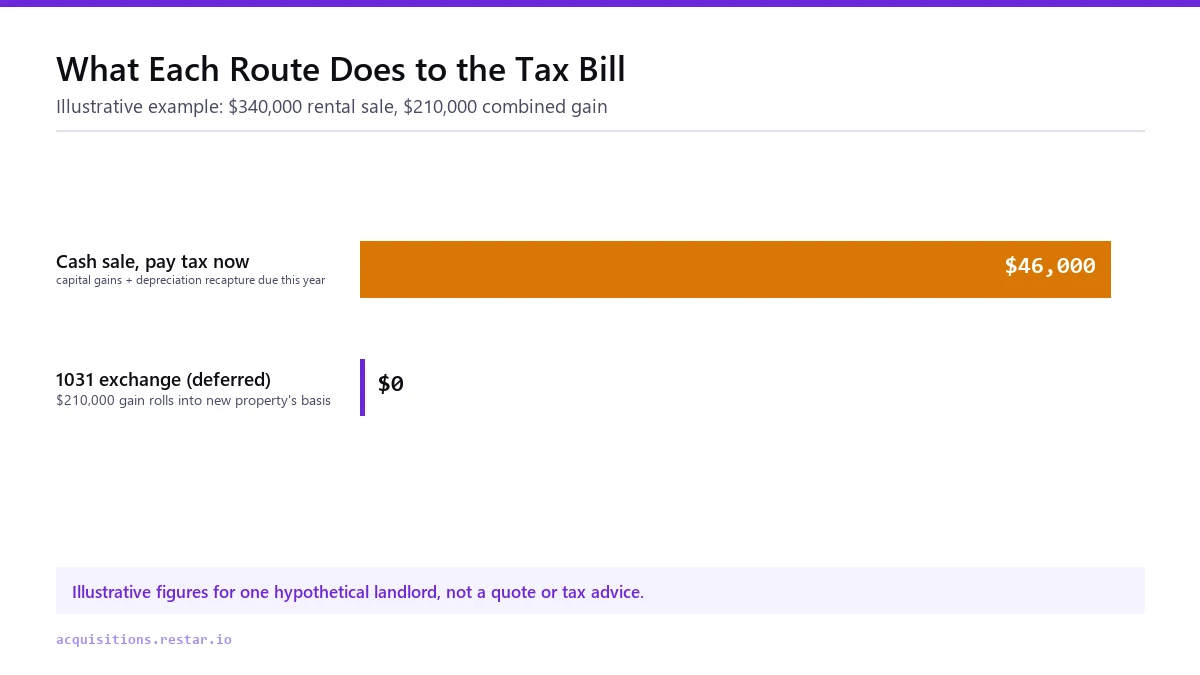
A landlord sells a rental for $340,000 with $210,000 in combined capital gain and depreciation recapture exposure at the point of sale.
Route
What happens to the tax bill
Time to close
What it requires
Cash sale, pay the tax now
~$46,000 combined capital gains + recapture tax due this year (illustrative, depends on bracket and state)
2–3 weeks
Nothing beyond an ordinary sale — no deadlines, no intermediary
1031 exchange into a new rental
$0 due now; the full $210,000 gain rolls into the new property's basis
45 days to identify, up to 180 days to close
A qualified intermediary (~$600–$1,500 fee), a replacement property that fits the timeline, and no cash or debt relief taken as boot
What each route does to the tax billRestar Acquisitions · illustrative example, $340,000 sale with $210,000 in combined gain
The exchange defers a real amount of money — but only if the replacement deal actually closes inside 180 days. If it doesn't, the landlord is back to owing the full tax bill anyway, just later and with a QI fee already spent. That execution risk is the honest price of the deferral, and it's worth weighing against how much you actually want another rental property versus simply being finished.
Ling & Petrova, “The Tax and Economic Impacts of Section 1031 Like-Kind Exchanges in Real Estate,” Oct. 2020 — icsc.com
Common questions
What is the 45-day rule in a 1031 exchange?
You have 45 calendar days from the closing of your original property to identify, in writing, the replacement property or properties you intend to acquire. This deadline is not extended by the 180-day closing deadline — both run from the same starting date.
Can you do a 1031 exchange on a house you lived in?
No. Section 1031 only applies to real property held for investment or business use. A personal residence doesn't qualify, though a separate rule (IRC § 121) offers its own gain exclusion for a primary residence.
Does a 1031 exchange eliminate depreciation recapture?
It defers both the capital gains tax and the depreciation-recapture tax by rolling them into the new property's basis — it doesn't erase either one, unless you hold the replacement property until death, at which point your heirs' stepped-up basis can permanently eliminate the deferred gain.
What happens if a 1031 exchange fails?
If you can't identify a replacement within 45 days, or can't close within 180 days, the exchange fails and the original sale becomes a fully taxable transaction in that tax year — as if you'd simply sold for cash, except you've also paid a qualified intermediary's fee along the way.
Is a 1031 exchange worth it for a small rental property?
It depends on whether you want another rental property. If you're planning to keep investing in real estate, deferring the tax to redeploy the full proceeds can be valuable. If you're done being a landlord, paying the tax now with a cash sale avoids the deadline risk entirely.
Want the number for the cash-sale side of this comparison?
If you want to keep investing in real estate, a 1031 exchange is very likely the better move — and we'd tell you that before anything else. If you're actually done being a landlord, you need a real figure for the cash column, not a guess.
Send us the property here and we'll tell you within 24 hours what we would pay and when we could close, no 45-day clock and no qualified intermediary required.
Every offer on this site is underwritten by a person, not a form. If the
numbers do not work for you, say so and I will tell you what would.
Also from Restar
Want the data behind all of this?
Restar Acquisitions is the acquisitions arm of Restar — a housing-market analytics
platform tracking 180+ metrics across every U.S. market, with composite scores and 12-month
price forecasts. The numbers on this page come from the same work.