Capital gains tax when you sell your house is not a tax on the sale price. It is a tax on the gain above your adjusted basis, and for most people selling the house they actually live in, a $250,000 or $500,000 exclusion makes the bill zero. The exceptions are worth knowing before you assume that applies to you.

Step 1 of 5
Send the address. We will tell you what it is worth as-is, in writing, within 24 hours.
You’ll talk to Trevor McAmis, Owner & Acquisitions Lead
(313) 710-6129
Takes about two minutes. Or call (313) 710-6129 — we answer.
Educational only. This explains how these situations generally work. It is not legal, tax or financial advice, and the rules differ by state — talk to an attorney or CPA about your own situation before you act on any of it.
Capital gains tax when you sell your house applies only to the gain above your adjusted basis, and most primary-residence sellers owe nothing because up to $250,000 of that gain is excluded for a single filer, $500,000 for a married couple filing jointly.
The exclusion requires owning and living in the house at least 24 months out of the five years before the sale, though a partial version can apply if you sell earlier for a qualifying reason.
This is educational information, not tax advice. Basis, gain, and exclusion eligibility depend on your specific purchase history, improvements, and filing situation. Talk to a CPA before you rely on any figure here for your own return.
Gain is not the sale price. It is the amount realized — sale price minus selling expenses like commission and closing costs — minus your adjusted basis, which is what you paid plus what you spent on qualifying improvements, according to IRS Publication 523.
Improvements add to basis; repairs and routine maintenance do not. A new roof, a kitchen remodel, an addition, or a new HVAC system count. Repainting a wall or fixing a leaky faucet does not — the distinction is whether the work adds value or extends useful life, versus simply keeping the house in its existing condition.
Worked example: a couple bought a house for $150,000 and spent $30,000 on a kitchen remodel and a new roof over the years they owned it, for an adjusted basis of $180,000. They sell for $260,000, paying 5.5% commission and 1.5% closing costs — 7%, or $18,200 — leaving an amount realized of $241,800. Gain is $241,800 minus $180,000, or $61,800.
That $61,800 is the number the exclusion gets measured against, not the $260,000 sale price and not the raw $110,000 difference between sale price and original purchase price. Keep receipts for improvements — they are the only thing standing between a seller and paying tax on money that was actually a home-improvement invoice, not profit.
Under IRS Topic 701, a seller can exclude up to $250,000 of gain if filing single, or $500,000 if married filing jointly, provided both the ownership test and the use test are met: the home was owned for at least 24 months and used as a main home for at least 24 months, out of the five years ending on the sale date. The two 24-month periods do not have to be the same stretch of time, and you generally cannot have used the exclusion on a different sale within the prior two years.
On the worked example above, the couple's $61,800 gain is fully covered by either the $250,000 or the $500,000 exclusion — the tax bill is $0, and this is the ordinary outcome for most sellers of a moderately priced primary residence they have owned for a while. The exclusion is large enough that federal capital gains tax simply is not the deciding factor for most people selling the house they actually live in.
Where the exclusion does not fully apply is a different fact pattern: a house owned for decades in an area that appreciated sharply, a second home or rental that was never a primary residence, or a sale that closes before the 24-month clock runs.
A sale before the full 24-month test is met is not automatically a full tax bill. Publication 523 allows a partial exclusion where the primary reason for the sale is a qualifying work-related move, a health reason, or certain unforeseeable circumstances. For a work move, the safe harbor is a new job location at least 50 miles farther from the home than the old job was — our guide to selling a house for a job relocation covers that test in detail.
The formula: take the shortest of how long you lived in the home, how long you owned it, or how long since your last exclusion, in days; divide by 730; multiply by the full exclusion amount.
Worked example: a single filer sells after exactly 365 days of ownership and use due to a qualifying job relocation. 365 ÷ 730 = 0.5, so the available exclusion is 0.5 × $250,000 = $125,000. If their adjusted basis was $150,000 and improvements added $10,000 more, for a basis of $160,000, and they sold for $230,000 minus 7% selling costs ($16,100) for an amount realized of $213,900, the gain is $213,900 minus $160,000, or $53,900. Because $53,900 is well under the $125,000 partial exclusion, the tax owed is again $0.
That is the pattern worth understanding: for most moderately priced homes, even a partial exclusion is large enough to absorb the entire gain. The exclusion becomes the deciding factor only on larger gains, which the next section works through.
Take a house held for many years in an area that appreciated heavily: adjusted basis of $300,000, sold for $650,000 minus 7% selling costs ($45,500) for an amount realized of $604,500. Gain is $304,500.
A married couple filing jointly excludes the full $500,000 available to them, and the $304,500 gain is entirely covered — $0 owed. A single filer only gets $250,000, leaving $54,500 of gain exposed. Per IRS Topic 409, long-term capital gains — property held over a year — are taxed federally at 0%, 15%, or 20% depending on total taxable income, and higher earners can also owe the 3.8% Net Investment Income Tax on top. At the 15% federal rate that $54,500 costs roughly $8,175, plus up to $2,071 more if NIIT applies — call it $10,246 at the higher end, before any state tax.
One more wrinkle: if the house was ever a rental before becoming, or after being, your primary residence, any depreciation claimed during the rental period is not covered by the exclusion and is recaptured separately. Our guide to selling a rental property with tenants covers how that recapture is calculated. A house that was always your own home, start to finish, does not carry that complication.
Rarely, for a straightforward primary residence sale — and this is worth saying plainly because it is easy to assume a smaller cash-sale price also means a smaller tax bill and therefore call it a wash. It usually does not work out that way, because both routes are typically shielded by the same exclusion.
A house worth $190,000 repaired, needing $16,000 of work, adjusted basis $110,000:
| Line | Repair, then list | Sell as-is for cash |
|---|---|---|
| Sale price | $190,000 | $137,200 |
| Repairs | −$16,000 | $0 |
| Agent commission (5.5%) | −$10,450 | $0 |
| Seller closing costs (1.5%) | −$2,850 | $0 — we cover standard closing costs |
| Buyer concessions (1%) | −$1,900 | $0 |
| Holding, 6 months at $1,050 | −$6,300 | −$788 (3 weeks) |
| You keep | $152,500 | $136,412 |
The cash figure follows how cash home buyers calculate offers: $190,000 after-repair value, less $16,000 of repairs, less $20,800 of resale and holding costs, less $16,000 of margin.
Amount realized on the retail sale is roughly $174,800, against a $110,000 basis, for a gain near $64,800. Amount realized on the cash sale is the $137,200 purchase price with no selling expenses to subtract, against the same $110,000 basis, for a gain near $27,200. Both figures sit far below the $250,000/$500,000 exclusion, so both routes owe $0 in federal capital-gains tax for a qualifying primary residence — the tax line does not move the decision here.
Listing wins by $16,088 on the money that actually reaches your account, tax questions aside. The exclusion changes the answer only on a large, long-held gain like the $650,000 example above, or on a house that was a rental at some point — check the depreciation-recapture question specifically before assuming either route is tax-free.
A worked illustration on one hypothetical property. Not a quote, not a prediction about your house, and not tax advice for your specific return.
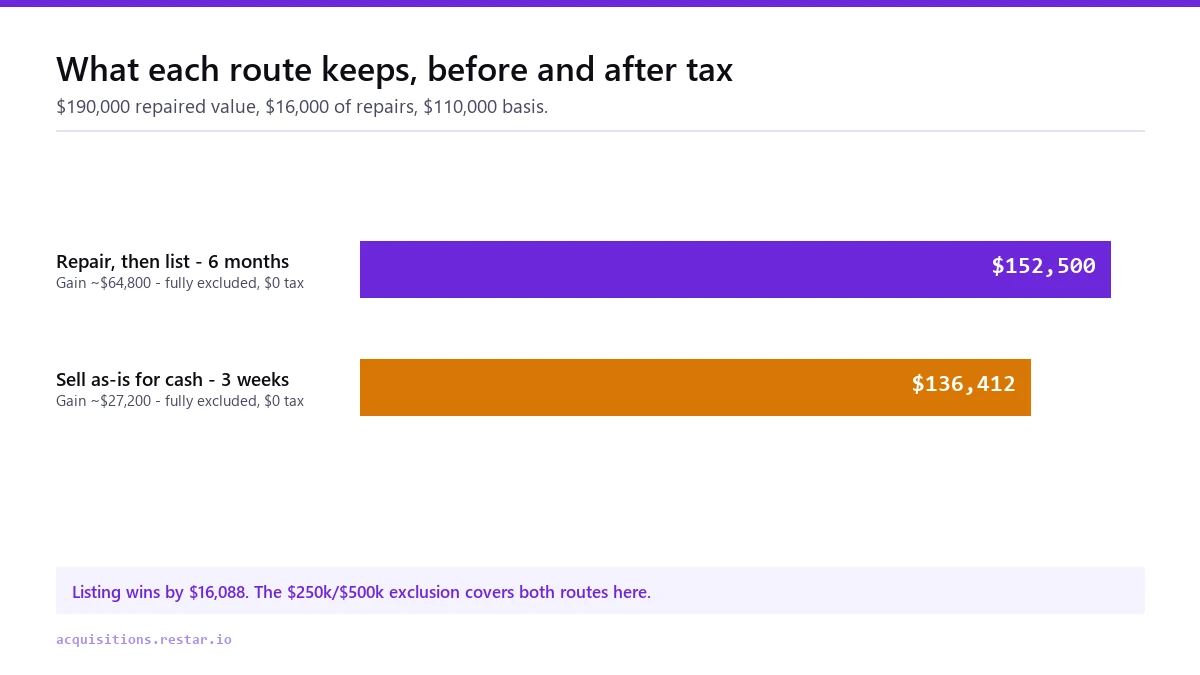
Send us the address. We will send back a written cash offer and, if it is useful, walk through roughly what your basis and gain look like on the back of it — though the actual tax return is between you and your CPA. On the worked example below, listing wins by $16,088, and we will tell you that plainly rather than let a smaller headline price look like the whole story.
All guides · Selling a house for a job relocation · Capital gains on inherited property · Cash offer vs. listing net proceeds
Step 1 of 5
No obligation, no fees, no repairs. We respond the same day.
You’ll talk to Trevor McAmis, Owner & Acquisitions Lead
(313) 710-6129
Takes about two minutes. Or call (313) 710-6129 — we answer.