A house previously used to cultivate marijuana in quantity — legally licensed or not — commonly has bypassed electrical wiring, chronic mold from the high humidity growing requires, and structural changes made to vent or support the operation. None of our 12 markets has a disclosure form with a dedicated line for this the way several states do for former meth labs, but general material-defect disclosure duties still cover it, and Fannie Mae's own guide excludes properties showing evidence of commercial cultivation from conventional financing. Remediation can run from a few thousand dollars to well into five figures depending on what's actually wrong.

Step 1 of 5
Tell us about the property. We'll give you a straight read on what it's worth and whether remediating first or selling as-is makes more sense.
You’ll talk to Trevor McAmis, Owner & Acquisitions Lead
(313) 710-6129
Takes about two minutes. Or call (313) 710-6129 — we answer.
Educational only. This explains how these situations generally work. It is not legal, tax or financial advice, and the rules differ by state — talk to an attorney or CPA about your own situation before you act on any of it.
The defining damage isn't one thing — it's three, stacked on top of each other. Growers commonly bypass the electric meter or overload circuits, since an indoor grow can draw several times a normal household's power; home-inspector trade group InterNACHI documents real cases of wiring tapped directly into utility lines ahead of the meter. The sustained humidity grow lights and irrigation require causes mold inspectors describe as unusually uniform throughout a room, and the DEA has been quoted describing grow operations as a recurring cause of house fires and blown electrical transformers.
Growers often also cut vents through walls or roofs, reinforce floors for the weight of soil and lighting rigs, or wall off rooms entirely — changes a standard inspection will usually catch even once the equipment is gone. We could not confirm a widely circulated “40% higher fire risk” figure against any fire department, NFPA, or insurer dataset — treat that number, if you see it elsewhere, as unverified. A 2013 Colorado State University Department of Environmental Health Sciences study directly sampled 30 homes previously used as grow operations and found airborne mold spores were the dominant hazard, with surface THC residue present but at non-hazardous levels.
None of our 12 states' disclosure forms has a line item for former cannabis cultivation the way several have for meth. Texas's standard seller disclosure form, for example, asks specifically about prior methamphetamine manufacturing but has no equivalent marijuana-cultivation question — a former grow house there would only surface through the general electrical-systems and material-defect questions.
Florida has no state-mandated disclosure form at all; the duty comes from case law requiring sellers to disclose known facts that materially affect value and aren't readily observable, and the state's narrow stigmatized-property exemption statute covers only prior deaths, homicide, and HIV/AIDS status, not drug cultivation or physical damage. The pattern holds across the states we checked: the physical damage falls under ordinary material-defect disclosure duty, not under any stigma-specific carve-out, which means it's covered whether or not your state has a “stigmatized property” law at all — our guide to selling a stigmatized house covers that distinction in more depth.
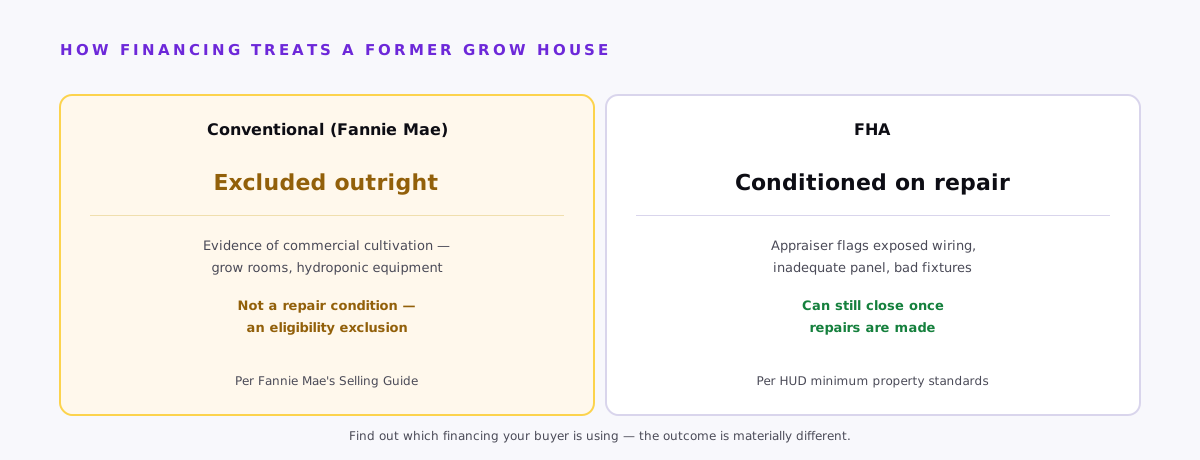
This is the detail that catches sellers off guard most often. Fannie Mae's Selling Guide explicitly lists evidence of commercial marijuana production — grow rooms, hydroponic equipment — as grounds to exclude a property from conventional loan eligibility outright, not just a condition to repair.
FHA appraisers are separately required to flag frayed or exposed wiring, an inadequate electrical panel, and non-functioning fixtures, which conditions the loan on repair before closing rather than ruling the property out entirely. That's a meaningfully different outcome than Fannie Mae's flat exclusion, and one more reason to find out early which type of financing your buyer actually has.
No published cost survey breaks out former-grow-house remediation specifically, so the figures below are general mold remediation costs (see our guide to selling a house with mold for more detail) and electrical remediation costs applied to this situation, not grow-house-specific data. Mold remediation commonly runs $10–$25 per square foot, with most whole-home jobs landing between $1,200 and $3,750. Rewiring runs $800–$2,500 per room, or $8,000–$30,000 for a full-house rewire depending on size and how much of the bypassed or damaged wiring has to come out.
Structural patching — closed-off vents, reinforced floor sections — adds on top of that and varies too widely to generalize. On insurance: standard homeowner policies and underwriters vary in how they treat a disclosed former grow operation, with some insurers excluding damage tied to illegal cultivation and others not — there's no single rule, so this is worth confirming with your own carrier rather than assuming either way.
Say a house would be worth $230,000 retail with no issues, and a former grow operation left bypassed wiring in two rooms and mold across the main living area — a $14,000 rewire and a $3,500 mold remediation, plus the appraisal and reinspection a financed buyer's lender will require afterward.
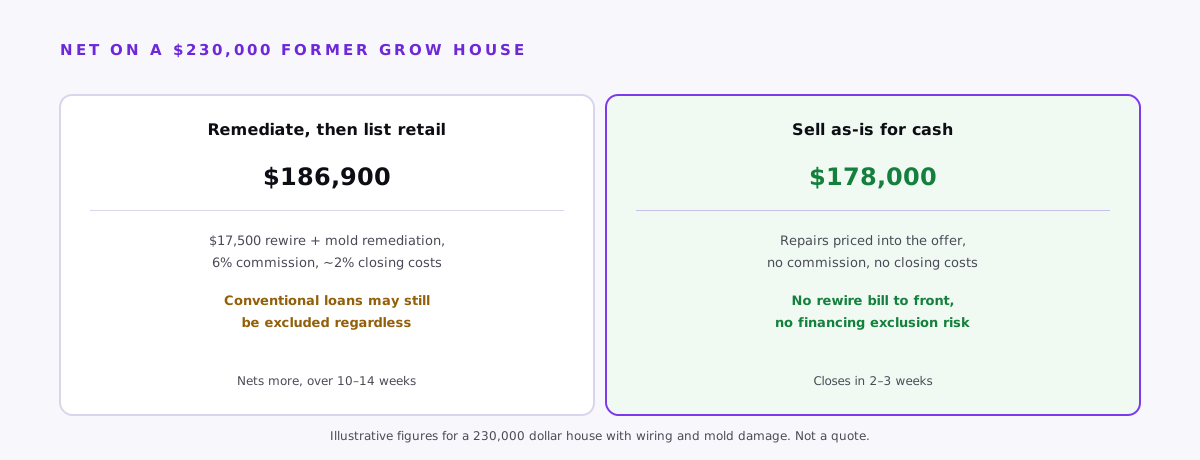
| Remediate, then list retail | Sell as-is for cash | |
|---|---|---|
| Starting value | $230,000 | $230,000 |
| Rewiring + mold remediation | −$17,500 (paid upfront) | $0 |
| Agent commission (6%) | −$13,800 | $0 |
| Seller closing costs (~2%) | −$4,600 | $0 |
| Holding costs during remediation + listing (~10 weeks) | −$2,200 | $0 |
| As-is cash offer | — | $178,000 |
| Net to seller | $186,900 | $178,000 |
| Timeline | 10–14 weeks, conventional financing may still be excluded | 2–3 weeks |
Remediating first nets roughly $8,900 more here, and it's the only path that reliably opens up conventional financing at all given Fannie Mae's exclusion. A cash sale is the option for sellers who can't front $17,500 before a confirmed sale, or who inherited or acquired the house and don't want to manage a rewire and mold job themselves.
Remediate fully, then list retail. Nets the most and is the only route likely to qualify for conventional financing, if you can front the repair cost and manage the work.
Disclose and list as-is at a discount. Some buyers — particularly investors — will still make an offer reflecting the repair cost they'll take on, without you fronting it.
Sell as-is for cash. Skips fronting remediation cost and the financing exclusion question entirely, in exchange for a lower price. Send us the property here and we'll give you a straight read on the numbers.
Six of our 12 markets — Arizona, Maryland, Michigan, Missouri, New York, and Ohio — have adult-use cannabis programs, and Alabama and Florida have medical-only programs; whether the operation that caused the damage was ever legally licensed doesn't change any state's disclosure form or Fannie Mae's financing exclusion — the physical condition and the financing outcome are the same either way.
This article is general educational information, not legal advice. Disclosure duties and financing treatment are state- and lender-specific — confirm your situation with a real estate attorney and your buyer's lender directly.
If a former grow operation means a rewire, mold remediation, and a possible conventional-financing exclusion before you could even list, we can make a cash offer that prices the damage in directly — no repair invoice to front, no reinspection to pass.
Send us the property here and we'll walk you through the numbers.
All guides · Selling a house with mold · Selling a stigmatized house · Selling a house that was a former meth lab
Step 1 of 5
No obligation, no fees, no repairs. We respond the same day.
You’ll talk to Trevor McAmis, Owner & Acquisitions Lead
(313) 710-6129
Takes about two minutes. Or call (313) 710-6129 — we answer.
