Selling a house that was a former meth lab is legal everywhere, but what you owe a buyer and what a buyer's lender will require both depend heavily on your state and on whether the property was used to manufacture the drug or just to smoke it, which are legally different situations. Several of our operating states have specific disclosure or certified-cleanup statutes; others have none at all. This guide covers which states actually regulate this, what decontamination realistically costs, how to check a property's own history, and why a financed sale is often blocked until clearance testing is complete — which is the honest, non-hyped reason a cash sale is frequently the realistic path before that testing happens.
Step 1 of 5
Send the address and we'll tell you honestly how the cash number compares to clearing it first.
You’ll talk to Trevor McAmis, Owner & Acquisitions Lead
(313) 710-6129
Takes about two minutes. Or call (313) 710-6129 — we answer.
Educational only. This explains how these situations generally work. It is not legal, tax or financial advice, and the rules differ by state — talk to an attorney or CPA about your own situation before you act on any of it.
This is educational information, not legal advice. State law on this varies significantly and changes; talk to a real estate attorney licensed in your state about your specific property and disclosure obligations before you list or sign anything.
The law treats a former drug-manufacturing lab very differently from a house where meth was only smoked. A manufacturing bust typically involves police or DEA seizure and is what activates most state statutory cleanup and disclosure frameworks. Surface contamination from manufacturing can be dramatically higher and more variable than from use — published studies range from under 0.1 to as high as 16,000 micrograms per 100 square centimeters depending on the cooking method and surface. Contamination from simulated smoking sessions, by contrast, is far lower, generally in the 0.02–5.1 microgram range in published research. Most state statutes are written around the manufacturing/lab trigger specifically, not general use — though a seller with actual knowledge of any known contamination, manufacturing or use, likely still carries a general common-law disclosure duty in most states even where no specific statute applies.
There is no federal law requiring disclosure of either situation. The federal government's only direct involvement is the Methamphetamine Remediation Research Act of 2007, which directed the EPA to publish voluntary cleanup guidelines — not a disclosure mandate, and not binding on any state (EPA: Voluntary Guidelines for Methamphetamine and Fentanyl Laboratory Cleanup). Everything below is state law, and it varies a lot.
Coverage is uneven across our operating footprint. Missouri, Texas, Ohio, Indiana, and North Carolina all have specific statutes; Georgia has confirmed none; several of our other states have no statewide statute we could verify, so check your own state's current law before assuming either way.
Missouri (RSMo § 442.606): if you have actual knowledge the property was used to manufacture methamphetamine, or was the residence of someone convicted of specific meth-related offenses, you must disclose it in writing — regardless of whether a conviction occurred on your watch.
Texas (Property Code § 5.008): the standard TREC Seller's Disclosure Notice includes a specific line item for “previous use of premises for manufacture of methamphetamine,” and disclosure is required if the seller has knowledge.
Ohio (R.C. § 5302.30/.31, and the remediation framework in R.C. Chapter 3744, added by the 131st General Assembly's 2016 Senate Bill 113): owners must disclose known prior meth manufacture, and a certified remediation process governs re-occupancy.
Indiana (410 IAC 38, the state's contaminated-property inspection and cleanup program, alongside the general “hazardous conditions” question on the state's residential disclosure form): confirmed contamination above the state's action level triggers a mandatory cleanup obligation before reoccupancy.
North Carolina (N.C.G.S. § 130A-284 and its administrative rules): confirmed meth-lab properties must be decontaminated before reoccupancy; state real estate licensing guidance says a seller or agent who knows or reasonably should know of former lab use must disclose it unless remediation is complete and properly documented, in which case disclosure isn't required.
Georgia: no statute requiring disclosure or certified cleanup of a former meth property — only the general criminal manufacturing offense exists in state law, confirmed by investigative reporting. A Georgia buyer who wants to know a property's history has to check independently.
Alabama, Arizona, Florida, Maryland, Michigan, New York: we could not confirm a comprehensive statewide meth-property disclosure or certified-cleanup statute in these states as of this writing; some may have local ordinances. Don't assume either way — a real estate attorney in your specific state can confirm current law before you list.
If you're not sure whether a house you own, inherited, or are considering buying has a documented history, the DEA maintains a National Clandestine Laboratory Register — a free, public, address-searchable database of law-enforcement-reported lab and dumpsite locations. Reporting to it by state and local police is voluntary, not mandatory: no federal law requires an agency to report an incident, which is why the registry significantly undercounts real cases and doesn't verify entries — treat a clean search result as inconclusive, not as proof (WESA: reporting to the DEA's clandestine lab registry is voluntary and undercounts real cases).
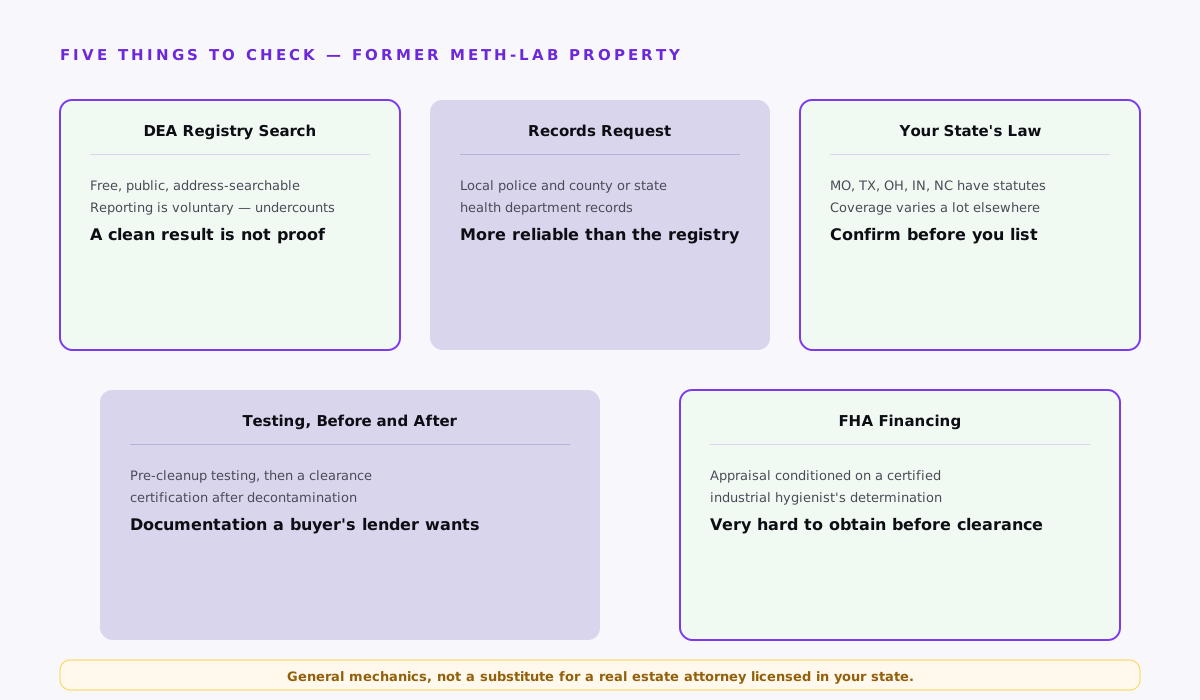
A more reliable path in states with a statutory program (Missouri, Indiana, Ohio, North Carolina) is a direct records request to the local police department and county or state health department, since those agencies maintain the records tied to their own confirmed-contamination and cleanup programs. If you inherited a house or bought it years ago without being told its history, and a genuine check turns up nothing, most states' disclosure statutes are written around actual knowledge — you generally aren't liable for failing to uncover a history nobody told you about and reasonable diligence didn't surface.
EPA's Voluntary Guidelines, updated in 2013, cover cleanup procedure and testing protocol in detail but don't publish a national dollar figure — the closest thing to a citable number since that 2013 update comes from remediation industry data instead. As of 2026, multiple decontamination companies converge on a broadly consistent range: full decontamination typically runs $5,000 to $20,000 for a typical case, running as high as $120,000 for severe contamination. Porous materials — drywall, carpet, insulation — generally have to be removed and replaced rather than cleaned, and HVAC systems often need full cleaning or replacement since ductwork recirculates contamination throughout the house. Pre-cleanup testing typically runs $500–$1,500, and post-cleanup clearance certification testing another $500–$2,000.
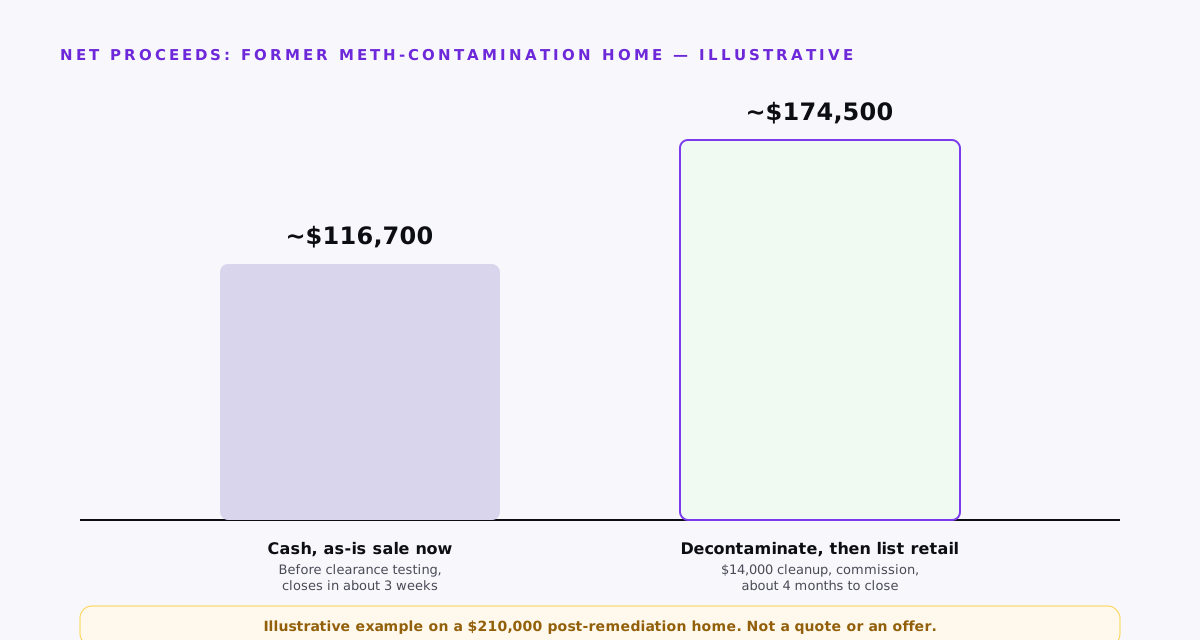
Illustrative example (a $210,000 post-remediation home, not a quote or offer). Decontaminate-then-list-retail path: retail sale price after certified clearance, $210,000, minus decontamination (testing, HVAC, porous-material removal, clearance certification) $14,000, minus agent commission (~5.5%) $11,550, minus seller closing costs (~1.5%) $3,150, minus holding costs during a 4-month testing-and-remediation timeline $6,800 — net proceeds roughly $174,500. Cash, as-is sale path before clearance testing is done: an offer reflecting the unresolved status and the buyer's own remediation risk, $118,000, no decontamination cost, no commission, and 3 weeks instead of 4 months — net proceeds roughly $116,700.
The decontaminate-first path nets about $57,800 more in this example, but it means fronting $14,000-plus before you have a confirmed buyer and waiting out testing and remediation scheduling. It also matters for financing directly: mortgage-industry guidance on HUD's FHA appraisal standards (Handbook 4000.1) describes a requirement that if an appraiser has evidence a property is contaminated by methamphetamine, by manufacture or by use, the appraisal be made subject to certification from a qualified industrial hygienist that the property is safe for habitation (industry summary of the FHA position on meth-impacted homes) — which in practice makes an FHA loan on an uncleared property difficult to obtain until that certification exists. That financing hurdle, more than any stigma, is a real, honest reason cash buyers make up a larger share of the realistic buyer pool for these properties before clearance testing is complete.
Test, decontaminate, and get clearance certification before you list. The worked example above shows this route nets the most, but it means fronting the cleanup bill yourself and working around testing and remediation scheduling before a buyer ever sees the house.
List it now, as-is, disclosed where your state requires it, without waiting for clearance testing. You avoid paying for cleanup upfront, but the realistic buyer pool narrows mostly to cash buyers — conventional and FHA lenders generally won't fund a purchase on a property that's still flagged as contaminated.
Request records first if you're not sure of the property's actual history. A police and health-department records check, and a DEA registry search understood as incomplete rather than conclusive, can clarify whether you're even dealing with a confirmed case before you spend money on testing.
A cash sale, as-is, now, before any testing or cleanup happens. The quickest way out of an unresolved contamination status, at a lower price than a certified, financeable retail sale would bring.
Mold and other indoor-air issues follow a similar disclosure-and-financing pattern and are covered separately in our guide on selling a house with mold. For the general math of a retail sale versus a cash sale independent of this specific situation, see our guide on cash offers versus listing net proceeds.
We'll give you a written offer within 24 hours and can buy a formerly contaminated property as-is, before decontamination and clearance testing — and if remediating first and listing nets you more, we'll say so.
All guides · Cash offer vs listing net proceeds · Selling a house with mold · Selling a damaged house
Step 1 of 5
No obligation, no fees, no repairs. We respond the same day.
You’ll talk to Trevor McAmis, Owner & Acquisitions Lead
(313) 710-6129
Takes about two minutes. Or call (313) 710-6129 — we answer.
