A “stigmatized property” is a house whose market value or desirability is affected by something other than its physical condition — a death, a crime, a reputation, or a registered offender living nearby. In most states, including nine of the twelve we buy in, you are not legally required to disclose any of it — but you generally can't lie if a buyer asks you directly. This guide walks through what the law actually requires state by state, what credible research says about the real effect on value, and the honest tradeoff between pricing it in yourself and letting a cash sale skip the question.

Step 1 of 5
Tell us about the house. We'll give you a straight read on what it's worth and whether a cash sale makes more sense than listing it.
You’ll talk to Trevor McAmis, Owner & Acquisitions Lead
(313) 710-6129
Takes about two minutes. Or call (313) 710-6129 — we answer.
Educational only. This explains how these situations generally work. It is not legal, tax or financial advice, and the rules differ by state — talk to an attorney or CPA about your own situation before you act on any of it.
In most states — including Arizona, Florida, Georgia, Indiana, Maryland, Missouri, New York, North Carolina, and Texas — a death, a crime, or a seller's or occupant's HIV/AIDS status is not legally considered a “material fact,” so you have no statutory duty to volunteer it. Alabama, Michigan, and Ohio have no statute addressing this at all. In nearly every state, if a buyer asks you directly, you generally cannot lie in your answer.
Whether listing with full disclosure or selling as-is for cash nets you more depends on the specific history and how much time has passed. The rest of this page walks through the state-by-state rule, what the research says about real value impact, and the honest math.
This article is general educational information, not legal advice. Stigmatized-property disclosure law is genuinely state-specific and the stakes of getting it wrong are real. Talk to a real estate attorney licensed in your state before deciding what to disclose and when.
The term covers anything that affects how a buyer feels about a house without affecting its physical condition: a death on the property (by any cause), a crime that occurred there, a reputation for being haunted, a current or former occupant's HIV/AIDS status, or a registered sex offender living nearby. It's a legally distinct category from a physical-defect disclosure — a death doesn't make the roof leak, and the law in most states treats it differently from a mold or foundation problem for exactly that reason.
That distinction matters for sellers of an inherited house in particular. A house that comes to you through a parent's or relative's death at home is, by this definition, technically a stigmatized property even though nothing about the home itself changed — see our guide to selling an inherited house for the broader probate and tax side of that situation.
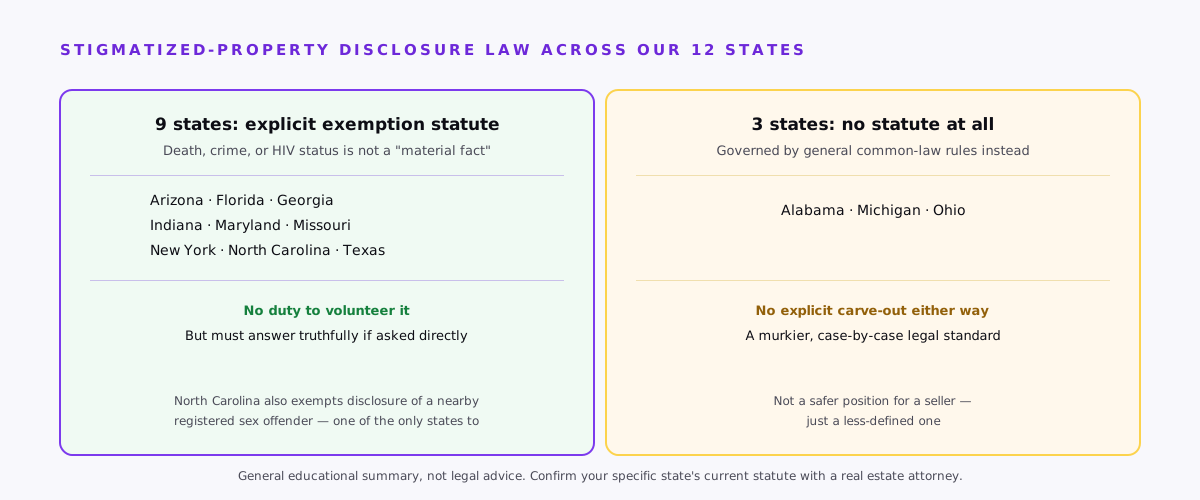
Nine of the twelve states we buy in have a specific statute on this: Arizona (A.R.S. § 32-2156), Florida (Fla. Stat. § 689.25), Georgia (O.C.G.A. § 44-1-16), Indiana (IC § 32-21-6-5), Maryland (Real Property § 2-120), Missouri (Mo. Rev. Stat. § 442.600), New York (RPL § 443-a), North Carolina (N.C.G.S. § 39-50), and Texas (Prop. Code § 5.008(c)).
Every one of these nine statutes follows roughly the same pattern: a death, a felony, or an occupant's HIV/AIDS status is declared not to be a material fact, and the seller and any agent are immune from liability for not bringing it up.
Alabama, Michigan, and Ohio have no statute addressing this at all. That's not the same as the issue being settled in the seller's favor — it means the question falls back to each state's general common-law rules on nondisclosure, which is a murkier and more case-by-case standard than an explicit carve-out. Ohio's own residential disclosure form (Ohio Rev. Code § 5302.30) covers only physical condition — water, sewer, structure, hazardous materials — and says nothing about death or stigma either way.
North Carolina is one of the only states that also specifically addresses a nearby registered sex offender, treating that fact the same way as a death on the property: not something the seller has to disclose. In the handful of other states we checked, this is generally treated as the buyer's own responsibility to research through the public sex-offender registry, not a seller disclosure duty.
Every one of the nine statutes above draws the same line: you don't have to bring it up, but if the buyer or their agent asks you a direct question about it, you generally have to answer truthfully. Georgia's statute adds a specific wrinkle worth knowing — it relieves a seller of even that “answer truthfully” duty where answering would itself violate the federal Fair Housing Act, which is exactly the situation with HIV/AIDS status.
That federal layer is why HIV/AIDS status gets carved out of state disclosure law in the first place, not added to it. HUD treats HIV infection as a protected “handicap” under the Fair Housing Act (42 U.S.C. § 3604(f)), and disclosing someone's HIV status to a prospective buyer could itself facilitate discrimination against a protected class. The state exemptions exist to prevent that conflict, not to let a seller hide something unrelated to fair housing.
Two peer-reviewed studies give real, traceable numbers, though neither is a formula you can apply to your specific house. A 2019 Southern Economic Journal study on the Columbine shooting found nearby property values dropped 5.7% in the first year after the event, averaging 3.1% over the following eleven years as the effect faded.
A separate 2020 study in Environmental Economics and Policy Studies looked at apartment units where a death occurred: a homicide cut nearby rents roughly 10% immediately, decaying to no measurable effect after seven to eight years — while a suicide or accidental fire death showed no statistically significant rent effect at all in that same study.
The pattern across both: the kind of death or crime matters, the effect fades meaningfully within a matter of years, not decades, and a natural or non-violent death appears to carry little to no measurable discount on its own. NAR's own published guidance on stigmatized properties cites this same research and recommends pricing the home below comparable unaffected properties rather than assuming no adjustment is needed — without naming one universal percentage, because there isn't one (National Association of REALTORS: Stigmatized Properties).
Take an illustrative $250,000 house, unaffected value, where a violent death occurred two years ago and the history is locally known. Listing retail: a reasonable stigma-adjusted asking price might run roughly 8–10% below comparable unaffected homes based on the research above, call it $225,000–$230,000, minus a typical 6% agent commission (about $13,500–$13,800) and 2% closing costs (about $4,500–$4,600), for a net in the rough range of $207,000–$211,600 — before accounting for the real risk that a financed buyer who learns the history mid-contract (from a neighbor, an inspector's small talk, or their own research) renegotiates the price or walks days before closing.
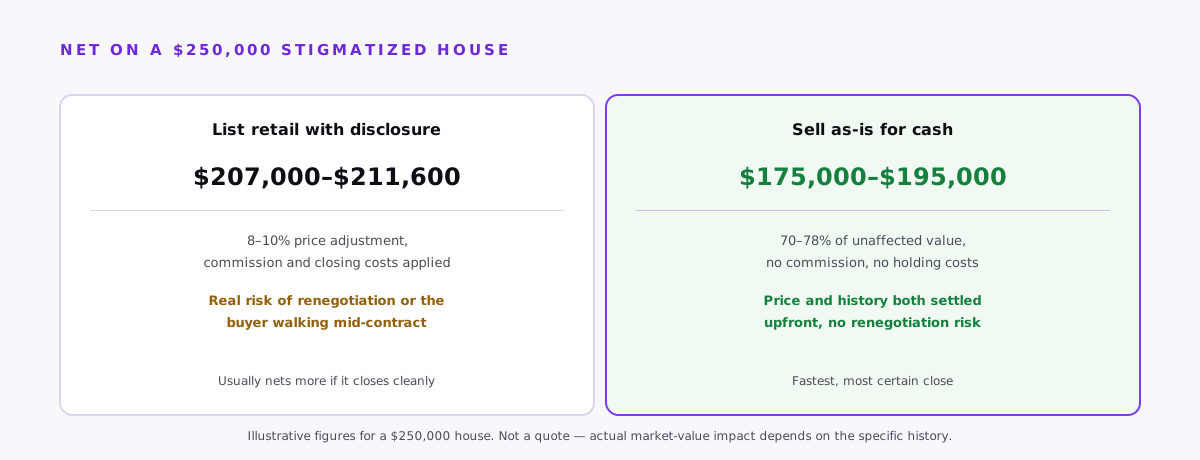
A cash offer, typically in the 70–78% range of unaffected value for a house in otherwise sellable condition, would run roughly $175,000–$195,000 here — less than the retail net above, with no commission and no holding costs, but also no renegotiation risk, because the buyer is pricing the history in once, upfront, rather than discovering it partway through a financed closing. The retail route typically nets more if the sale closes cleanly — the real variable this niche adds is the chance it doesn't. Run your own numbers against our broader cash offer vs. listing net proceeds breakdown before deciding.
In most of our markets, the law gives you room to not volunteer this history — but it doesn't give you room to lie if asked directly, and three of our states leave the question to murkier common-law rules entirely. Real research shows the price effect is measurable but fades over a few years, especially for anything short of a violent crime. A retail sale, done carefully with the right disclosure strategy, usually nets more than a cash sale — the honest tradeoff is that a cash sale removes the risk of a financed deal collapsing mid-contract once the history surfaces. Send us the address and we'll give you a straight number for comparison.
If the house came to you through a death in the family, or carries a history you'd rather not negotiate around with a string of retail buyers, we can make a cash offer that already accounts for it — no re-disclosure to every new prospective buyer, no appraiser comp fight, no deal falling apart three weeks into a financed closing.
Send us the property here and we'll walk you through the numbers.
All guides · Selling an inherited house · Cash offer vs listing net proceeds · How cash home buyers calculate offers
Step 1 of 5
No obligation, no fees, no repairs. We respond the same day.
You’ll talk to Trevor McAmis, Owner & Acquisitions Lead
(313) 710-6129
Takes about two minutes. Or call (313) 710-6129 — we answer.
