A house inside a special needs trust does not sell like an ordinary house. The trustee signs, not the beneficiary, because the trust holds title. And the type of special needs trust changes what happens to the money: a first-party trust funded with the beneficiary's own settlement or inheritance owes Medicaid repayment out of the proceeds when the beneficiary dies, while a third-party trust funded by a parent or relative owes nothing back, ever. Selling itself rarely threatens the beneficiary's SSI or Medicaid, as long as the proceeds stay inside the trust instead of landing in the beneficiary's own hands. This page covers who signs, what to confirm first, and the real numbers.

Step 1 of 5
Send the address and tell us whether the trust is first-party or third-party. We will work around the trust's paperwork.
You’ll talk to Trevor McAmis, Owner & Acquisitions Lead
(313) 710-6129
Takes about two minutes. Your address is never shared.
Educational only. This explains how these situations generally work. It is not legal, tax or financial advice, and the rules differ by state. Talk to an attorney or CPA about your own situation before you act on any of it.
The trustee sells, not the beneficiary, since the trust holds title. A first-party special needs trust, funded with the beneficiary's own money, owes Medicaid repayment from the trust when the beneficiary dies. A third-party trust, funded by someone else, owes Medicaid nothing. Keep sale proceeds inside the trust and the beneficiary's SSI and Medicaid stay intact.
This is educational information about how special needs trust sales generally work. It is not legal or tax advice, and special needs trust rules vary by state and by trust.
The trust holds legal title, so the trustee signs every sale document, not the beneficiary. A title company will want to see the trust instrument or a short certification of trust, proof of who the current trustee is, and confirmation the trust grants power to sell real estate before it will insure the closing.
Most special needs trusts name a parent, sibling, professional fiduciary, or a bank trust department as trustee, specifically because the beneficiary's disability is often the reason the trust exists in the first place. Even if the beneficiary lives in the house and wants to move, their signature on a deed or purchase agreement does not convey anything. Only the trustee can sign.
Read the trust document before listing. Most well-drafted special needs trusts grant the trustee power to sell real property, but some require co-trustee consent, notice to a care manager, or a court's approval before selling the beneficiary's primary residence, particularly where a guardianship or conservatorship overlaps with the trust. Do not assume the power to sell exists just because the trust owns the house.
It depends entirely on how the trust was funded, and this is the single most important distinction in this guide. A first-party special needs trust, created with the beneficiary's own settlement, inheritance, or back pay, is a payback trust under 42 U.S.C. § 1396p(d)(4)(A): Medicaid is repaid from whatever remains in the trust when the beneficiary dies, up to what it paid in benefits. A third-party trust, funded by a parent, grandparent, or anyone other than the beneficiary, owes Medicaid nothing, ever.
Selling the house itself does not trigger Medicaid's payback claim. Payback happens at the beneficiary's death, against whatever the trust holds at that point, not at the moment of a sale. A trustee who sells the house and keeps the money in the trust, or uses it to buy a replacement home titled the same way, has not done anything that accelerates what Medicaid is owed.
Pooled special needs trusts, run by nonprofits that combine many beneficiaries' sub-accounts for investment purposes while keeping each beneficiary's funds separately tracked, are generally treated under the same first-party payback rule when funded with the beneficiary's own money, sometimes with a portion retained by the nonprofit instead of returned to Medicaid. They are a narrower option worth knowing exists, not the default structure.
If the trust is first-party and a state previously recorded a lien against the property for past Medicaid-funded care, the trustee should request a payoff figure from the Medicaid agency early, the same way a mortgage payoff works. Our guide on Medicaid estate recovery and selling the house covers that payoff mechanic in detail.
Medicaid's willingness to enforce payback is not abstract. KFF reports that Medicaid paid for 44% of the $147 billion the US spent on institutional long-term care in 2023, which is the scale of spending the payback rule exists to recover. The Special Needs Alliance's explanation of buying and selling a house inside a special needs trust draws the same first-party/third-party line this page does.
Usually not, if the trustee handles it correctly. The trust, not the beneficiary, holds title and receives the proceeds, and assets properly held in a qualifying special needs trust are already excluded from the beneficiary's own countable resources for SSI and Medicaid. The risk is paying proceeds directly to the beneficiary instead of keeping them in the trust.
SSI's resource limit has not moved since 1989: $2,000 for an individual, $3,000 for a couple, confirmed directly in the Social Security Administration's own policy manual. Sale proceeds that land in the beneficiary's personal bank account, even briefly, count toward that limit and can end eligibility for the month. Proceeds that go straight into the trust's own account do not.
The safer mechanics: have the closing agent wire sale proceeds directly to the trust's bank or brokerage account, never to the beneficiary personally, and if the plan is to buy a replacement home, title the new house in the trust exactly the way the old one was titled. If there is any gap between selling one house and buying the next, confirm with the trust's bank or care manager how proceeds should be held during that gap so they are not mistaken for the beneficiary's own funds.
A handful of items need to be settled before a special needs trust lists a house or accepts an offer, and skipping them is what turns a routine sale into a benefits problem or a title delay.
The numbers below work the same for a special needs trust as they do for any other seller, with one wrinkle: the trustee is deciding for someone who cannot easily absorb a bad outcome, so the arithmetic matters more, not less.
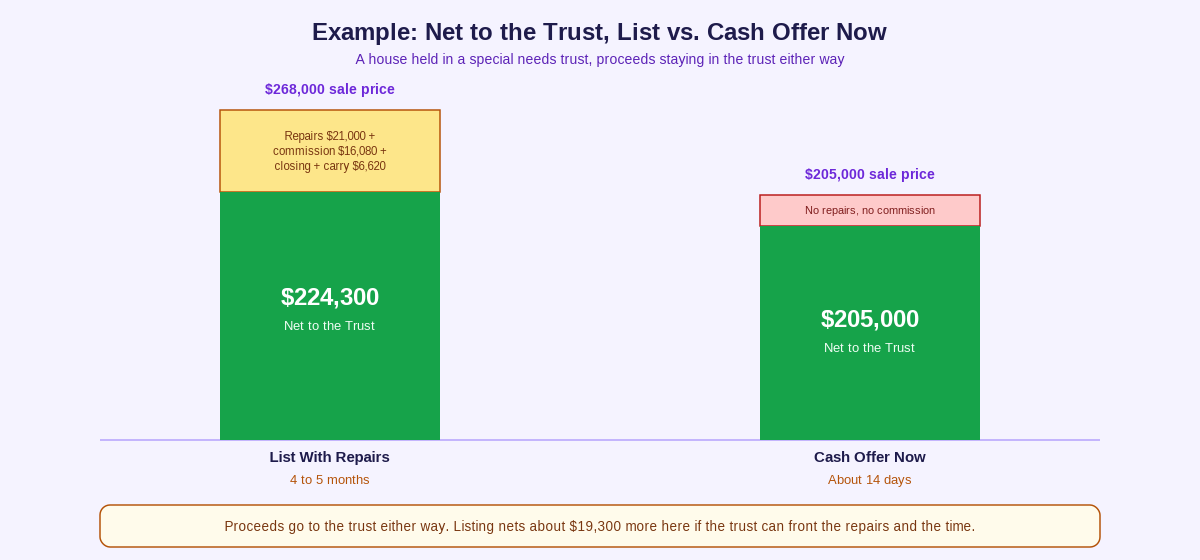
Example: A first-party special needs trust owns a two-story house the beneficiary can no longer use safely because of the stairs, and the trustee wants to sell it and buy a single-story, wheelchair-accessible replacement, keeping title and proceeds inside the trust the whole time. The house would list for about $268,000 after $21,000 of repairs (roof, HVAC, flooring). A cash buyer offers $205,000 as-is.
| List With Repairs | Cash Offer Now | |
|---|---|---|
| Sale price | $268,000 | $205,000 |
| Repairs | −$21,000 | $0 |
| Agent commission (6%) | −$16,080 | $0 |
| Closing costs | −$4,020 | covered by buyer |
| Holding costs | −$2,600 | about $0 |
| Net to the trust | $224,300 | $205,000 |
| Timeline | 4 to 5 months | about 14 days |
Listing nets $19,300 more here. That is the real cost of speed on this house. Listing is the better number if the trust can front $21,000 in repairs and the beneficiary's housing situation can tolerate four to five more months in the current house. A cash sale is the better fit if the beneficiary already needs to move into a specific accessible home on a tight timeline, or the trust cannot fund repairs and holding costs without touching the beneficiary's monthly support money.
A sale is not the only option, and for a trust whose whole purpose is protecting someone who cannot easily recover from a bad decision, it is worth looking at what else is on the table before signing anything.
For most special needs trusts with a house in reasonable shape, the better number is usually listing it, the same as it would be for any other seller, because the open market pays more than a direct cash buyer once repairs and a normal marketing period are part of the picture.
A cash sale earns its place when the beneficiary needs to move on a real timeline, when the trust cannot fund repairs or months of carrying costs without touching the beneficiary's support money, or when a co-trustee or care situation makes a long listing impractical. If that describes the trust you're administering, we buy houses as-is in 69 markets across 14 states, give a written offer within 24 hours, charge no commissions, and let the trust pick the closing date. If the numbers above say listing nets more for this specific house, we will tell you that instead of pushing a sale that doesn't serve the beneficiary.
If you are a trustee weighing a cash sale, send us the address and we will give a written offer within 24 hours, so there is a documented number sitting in the trust file alongside whatever a listing would realistically net.
Send us the property here. We buy as-is in 69 markets across 14 states, charge no commissions, and let the trust pick the closing date. If listing nets the trust more, we will tell you that instead.
All guides · Selling a house held in a standard trust · Medicaid estate recovery: selling the house · Selling a house to pay for nursing home or assisted living care
Step 1 of 5
No obligation, no fees, no repairs. We respond the same day.
You’ll talk to Trevor McAmis, Owner & Acquisitions Lead
(313) 710-6129
Takes about two minutes. Your address is never shared.