Selling a house held in a land trust works one of two ways: the trustee signs a deed to the buyer like a normal sale, or the beneficiary simply assigns their beneficial interest without recording anything. Which path fits depends on whether there's a mortgage, which state the trust sits in, and what the buyer's lender or title company needs to see on record.

Step 1 of 5
Tell us about the property and the trust structure. We'll look at the title situation before you decide anything.
You’ll talk to Trevor McAmis, Owner & Acquisitions Lead
(313) 710-6129
Takes about two minutes. Your address is never shared.
Educational only. This explains how these situations generally work. It is not legal, tax or financial advice, and the rules differ by state. Talk to an attorney or CPA about your own situation before you act on any of it.
A land trust splits ownership into two pieces. A trustee, often a title-holding trust company, holds the bare legal title to the property. The real owner holds a "beneficial interest" in the trust, which spells out who controls the property, who collects the rent or sale proceeds, and who can direct the trustee to sign documents.
That split matters for one big reason: in the states that recognize this structure, the beneficiary's interest is treated as personal property, not real property. Illinois' land trust statutes define it this way directly. The Illinois Land Trust Beneficial Interest Disclosure Act (765 ILCS 405/1) defines a "land trust" as an arrangement "under which the title to real property, both legal and equitable, is held by a trustee... and under which the interest of the beneficiary is personal property only." Florida's land trust law, F.S. 689.071, the Florida Land Trust Act, says something similar: a recorded instrument vests "legal and equitable title, and full rights of ownership" in the trustee, and if the recorded instrument or trust agreement says the beneficiary's interest is personal property, "such provision is controlling for all purposes."
That personal-property classification is what makes the second sale method, below, possible at all.
There are two ways to get a land-trust property into a new owner's hands. One moves legal title through a recorded deed, the way most home sales happen. The other transfers only the beneficiary's personal-property interest in the trust, without touching the deed or the public record at all. Both get a buyer into the property; they just get there through different paperwork, different closing steps, and different risk to a seller with a mortgage still in place.
Path one: the trustee signs a deed. This looks like a conventional closing. The trustee, acting on the beneficiary's written direction, signs and delivers a trustee's deed to the buyer. That deed gets recorded in the county land records just like any other deed. The public record shows the trust coming off title and the new owner going on. Title insurance underwriting on this path looks a lot like underwriting any other deed sale, because the thing being insured (legal title) is changing hands in the normal, recorded way.
Path two: the beneficiary assigns the beneficial interest. Instead of a deed, the beneficiary signs an assignment transferring their beneficial interest to the buyer. The trustee stays on title. Nothing about the property itself gets recorded anywhere. This is the mechanism that makes land trusts useful for privacy (the public record never shows who controls the property) and it's also the mechanism some wholesale-style and off-market deals use, since an assignment can close faster and with less paperwork than a deed.
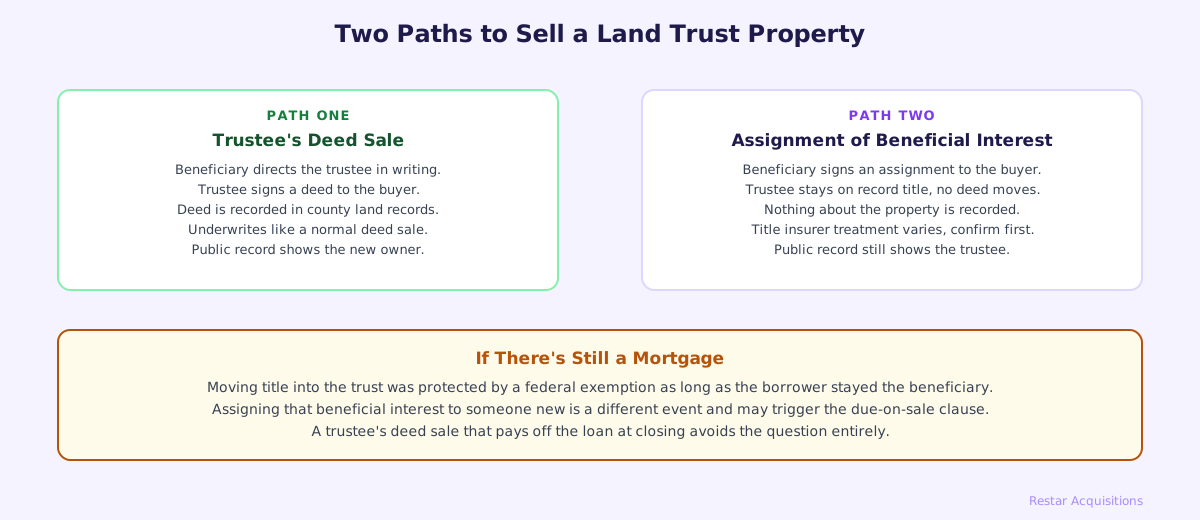
The tradeoff: because nothing records, a title company insuring a purchase of the beneficial interest is being asked to stand behind a transaction that the public land records don't show at all. Some title insurers handle this routinely for land trust closings; others want extra underwriting steps or won't insure an assignment-only purchase the same way they'd insure a deed purchase. We could not find one universal, nationwide rule that applies to every title insurer, so if a buyer wants to purchase a beneficial interest instead of taking a deed, the right move is to ask the closing title company how they want to structure it before anyone signs anything.
| Trustee's Deed Sale | Assignment of Beneficial Interest | |
|---|---|---|
| What's recorded | A new trustee's deed, in the county land records | Nothing. The trustee stays on record title |
| Who signs | The trustee, on the beneficiary's written direction | The beneficiary, assigning their personal-property interest |
| Title insurance | Underwritten like a standard deed sale in most cases | Varies by insurer; confirm with the closing title company first |
| Public record shows | The new owner | Still the trustee; the real owner is private |
| Typical use | Standard sale, financed purchases, most residential deals | Off-market deals, speed, privacy, keeping an existing loan in place |
Restar Acquisitions buys in Alabama, Arizona, Florida, Georgia, Indiana, Maryland, Michigan, Missouri, North Carolina, Nevada, New York, Ohio, Pennsylvania, and Texas. Of those, Florida is the one with a dedicated land trust statute: F.S. 689.071, the Florida Land Trust Act, directly addresses how title vests in the trustee and how a beneficial interest can be defined as personal property.
The other states we serve don't have a standalone land trust act on their books the way Florida (and, outside our footprint, Illinois) does. That doesn't mean a land trust can't exist in Alabama, Arizona, Georgia, Indiana, Maryland, Michigan, Missouri, North Carolina, Nevada, Ohio, Pennsylvania, or Texas. Trustee-held title and beneficial-interest arrangements can generally be built under those states' general trust and property law. But without a dedicated statute spelling out that the beneficiary's interest is personal property, the legal footing is less settled, and how a given county recorder, title company, or lender treats the arrangement can vary. If your land trust was set up in one of these states, or the trust agreement was drafted under Illinois or Florida law but the property sits somewhere else, confirm how your specific county recorder and title company treat the arrangement before you rely on it for a sale.
This is the part sellers skip past and shouldn't. If a mortgage is still attached to the property inside the land trust, selling the beneficial interest to a new owner is a different event than the original move of the house into the trust, and the two are not protected by the same federal rule. Understanding that difference before a closing happens matters more than almost anything else in this guide.
Federal law, specifically the Garn-St. Germain Depository Institutions Act (12 U.S.C. § 1701j-3), generally lets a lender call a loan due in full when the property is transferred or sold, unless the transfer fits one of a list of exemptions. One of those exemptions, confirmed directly from the statute text, covers "a transfer into an inter vivos trust in which the borrower is and remains a beneficiary and which does not relate to a transfer of rights of occupancy in the property."
Read that exemption carefully. It protects the original move of title into the trust, as long as the borrower stays the beneficiary. It does not, on its plain text, say anything about what happens when that beneficiary later sells or assigns their beneficial interest to someone else. Once the beneficial interest moves to a new owner, the borrower is no longer "the beneficiary," and the fact pattern the exemption describes no longer matches. We're not aware of a settled, universal answer on how every lender treats that second transfer, and it varies by loan servicer and by exactly how the assignment is papered. The safe assumption for a seller with an existing mortgage is that assigning the beneficial interest could trigger the due-on-sale clause, even though putting the property into the trust in the first place did not.
If the mortgage is still active, three practical paths exist: talk to the lender directly before doing anything, since some servicers will approve a transfer rather than call a loan that's being paid on time; structure the sale as a standard trustee's deed sale instead, where the loan gets paid off at closing like any other sale; or have an attorney review whether the specific assignment language keeps the original borrower involved in a way that avoids tripping the clause. None of these are guaranteed, and this is general information, not a verdict on your loan. Talk to a real estate attorney about your specific trust document, your mortgage, and your state before you sign anything.
The math below is worked out on one property, because the numbers change the decision more than the legal structure does. Whether the sale happens through a trustee's deed or an assignment of the beneficial interest, the seller still has to choose between a faster, lower cash number and a slower, higher number that depends on repairs, financing, and a buyer showing up and closing on time.
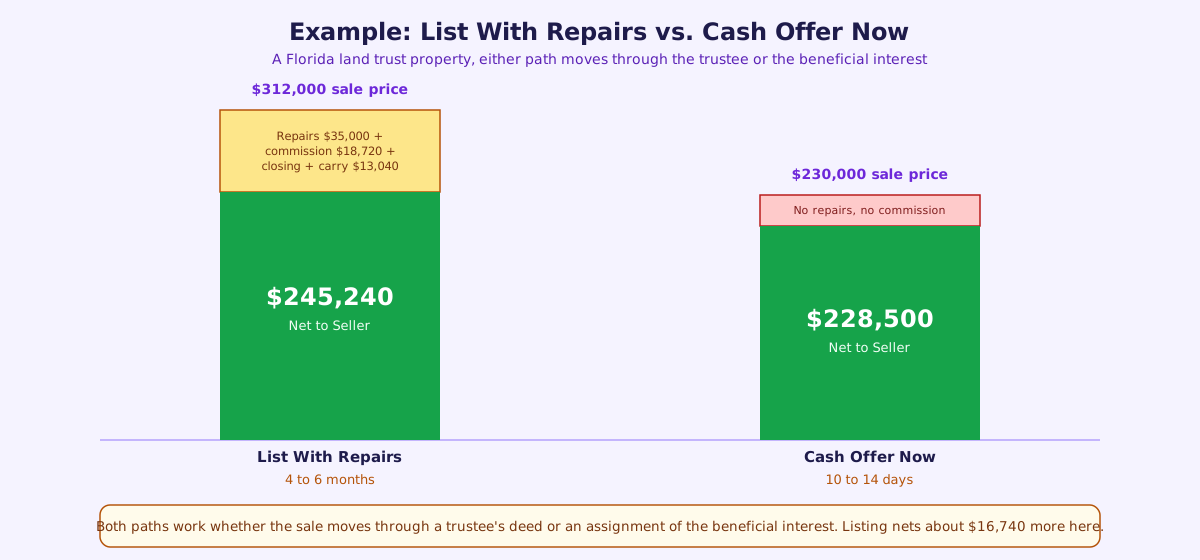
Example: a beneficiary holds a single-family home in a Florida land trust. The house needs about thirty-five thousand dollars in repairs (roof, flooring, HVAC) before it would show well on the retail market. After those repairs, it would likely list and sell around three hundred twelve thousand dollars.
| List With Repairs | Cash Offer Now | |
|---|---|---|
| Sale price | $312,000 | $230,000 |
| Repairs (paid upfront) | -$35,000 | $0 |
| Agent commission (6%) | -$18,720 | $0 |
| Closing costs / concessions (2%) | -$6,240 | $0 |
| Carrying costs (repairs + listing period) | -$6,800 | ~$0 |
| Net to seller | $245,240 | $228,500 |
| Timeline | 4 to 6 months | 10 to 14 days |
The cash offer nets about sixteen thousand dollars less in this example. That's real money. Listing wins here on pure dollars if the beneficiary can front thirty-five thousand dollars in repair costs, qualify for or already have the cash to cover carrying costs for several months, and is comfortable with the trust (and the sale) taking four to six months to close. If any of those three things isn't true, especially if there's no cash on hand for repairs or the beneficiary needs the trust settled quickly, the math changes fast: every month of carrying costs, every point of price softness during a longer listing, and the real chance of a financed buyer's deal falling through can erase that sixteen-thousand-dollar gap or flip it the other way.
A full sale of the beneficial interest or the property itself isn't the only move available to a beneficiary who doesn't want to deal with any of the questions above right now. Keeping the trust in place, working something out with the lender, or converting the structure before selling are all reasonable paths depending on how much time and cash the beneficiary has.
Keep the trust and rent the property. If the trust document allows it and the beneficiary doesn't need the cash now, renting keeps the asset and the mortgage (if any) in place without triggering a sale or transfer at all.
Convert to a standard sale instead of an assignment. If a mortgage is in the picture and due-on-sale risk is a real concern, doing a trustee's-deed sale that pays off the loan at closing sidesteps the question entirely, because the loan is gone, not transferred.
Talk to the lender before the beneficiary assigns anything. Some servicers will formally approve an assumption or transfer, especially on a loan with a strong payment history, rather than calling it due.
Have the trust terminated and title deeded out first, if the beneficiary wants a cleaner path and local law makes that straightforward, then sell the property conventionally.
For a related situation without the land trust complexity, see our guide on selling a house held in a standard revocable or irrevocable trust and our guide on selling a house titled in an LLC, which covers a different but related due-on-sale question. If the mortgage is the main concern, our guide on due-on-sale clause risk in a subject-to sale goes deeper into how lenders typically respond.
We buy land trust properties both ways: we can work with the trustee on a standard trustee's-deed closing, or, where the structure and the lender situation support it, purchase a beneficial interest directly. Either way, we give a written offer within twenty-four hours, buy the property as-is with no repairs required, charge no commissions, and let the seller pick the closing date. If the math in this guide says listing nets more for your specific property, we'll tell you that instead of pushing a sale that doesn't serve you.
Send us the property here and we'll look at the trust structure, the title situation, and the numbers before you decide anything.
All guides · Selling a house held in a standard trust · Selling a house titled in an LLC · Due-on-sale clause risk in a subject-to sale
Step 1 of 5
No obligation, no fees, no repairs. We respond the same day.
You’ll talk to Trevor McAmis, Owner & Acquisitions Lead
(313) 710-6129
Takes about two minutes. Your address is never shared.
