A due-on-sale clause lets your mortgage lender demand full payoff the moment title to the house transfers. A subject-to sale transfers the deed to a buyer while your name stays on the loan. If the lender calls that clause, you, not the buyer, are the one who owes the balance and faces foreclosure.

Step 1 of 5
Send the address. We will show you what paying off the existing balance at closing actually nets you, side by side with any subject-to offer you are considering.
You’ll talk to Trevor McAmis, Owner & Acquisitions Lead
(313) 710-6129
Takes about two minutes. Your address is never shared.
Educational only. This explains how these situations generally work. It is not legal, tax or financial advice, and the rules differ by state. Talk to an attorney or CPA about your own situation before you act on any of it.
A due-on-sale clause gives your lender the right to demand the entire remaining loan balance the moment title to the house changes hands. In a subject-to sale, title transfers to the buyer but your name, and your liability, stay on the original loan. If the lender ever exercises that right, you are the one who has to pay or face foreclosure, not the buyer.
A subject-to sale is a different arrangement from a formal loan assumption, where the lender knowingly approves the new buyer and releases you from the note, covered in our guide on what an assumable mortgage is worth when you sell. It's also different from seller financing, where you become the lender and hold a note instead of continuing to pay someone else's, covered in the cost of seller financing vs a cash sale. Subject-to is specifically the case where the existing loan quietly stays exactly as it was, in your name, while someone else lives in and controls the house.
Lenders write a due-on-sale clause into almost every mortgage so they can call the loan due in full whenever the property is sold or transferred without their approval. The right is not just boilerplate. It is backed by federal law: the Garn-St-Germain Depository Institutions Act of 1982 (12 U.S.C. § 1701j-3) makes due-on-sale clauses enforceable nationwide and overrides any state law that tried to limit them.
The same federal law carves out a short list of transfers a lender cannot call due, no matter what the mortgage contract says: a transfer to a relative after the borrower's death, a transfer where a spouse or child becomes an owner, a transfer that happens as part of a divorce or legal separation settlement, and a transfer into a living trust where the borrower remains a beneficiary and keeps living there. A subject-to sale to an unrelated buyer, investor or not, is not on that list. The CFPB has documented that even people who do qualify for one of these exceptions, like a divorce transfer, often run into servicer confusion trying to use it, which gives a sense of how little flexibility exists outside the exceptions Congress actually wrote down.
Fannie Mae, Freddie Mac and FHA go further than that federal floor in specific, narrow cases. Fannie Mae's Servicing Guide requires servicers to process certain ownership transfers, including to a spouse, child, parent, sibling or grandparent who then occupies the home, without reviewing or approving the transfer at all. FHA has its own version for divorce: if the spouse who keeps the home stays in it and has made the payments for at least six months, the loan can often be assumed without the due-on-sale clause ever being triggered. None of those carve-outs cover a sale to an outside investor who takes over payments on a house they didn't live in before. A subject-to sale sits squarely in the territory the clause was written for.
In a subject-to sale, the seller signs a deed and the county records the buyer as the new owner. What does not happen: the mortgage is never paid off, refinanced, or moved into the buyer's name. The loan, the monthly statement, and the legal obligation to pay it all stay exactly where they were, attached to the seller's name and credit file. The buyer simply starts sending the mortgage payment to the servicer each month, often through the seller's existing account or an auto-pay arrangement set up at closing.
Nothing about this requires the lender's knowledge, and most subject-to deals are structured so the servicer doesn't find out right away. Buyers sometimes route title through a trust or an LLC, hoping it slows down detection. It can, for a while. It does not change who the servicer can come after if the clause gets triggered: the seller, because the seller is still the named borrower on the note, regardless of who is living in the house or who is cutting the monthly check.
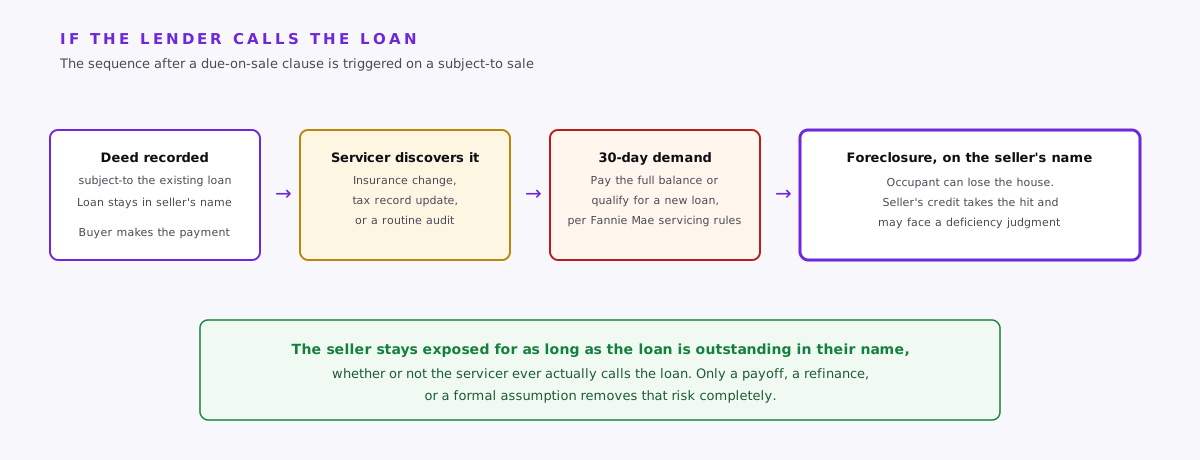
The due-on-sale clause Congress made enforceable in 1982 still runs on a fairly standard 30-day clock today: once a servicer discovers the transfer, usually through a change in homeowners insurance, a tax record update, or a routine audit, it sends notice that the loan is due and payable, and Fannie Mae's servicing rules direct the servicer to give the new occupant 30 days to either pay the full balance or qualify for a new loan in their own name. If neither happens, the servicer moves to foreclosure.
Here is the part that gets left out of most subject-to pitches: the foreclosure that follows is a foreclosure on the seller's loan, filed against the seller's name, because the seller, not the buyer, signed the note. The new occupant can lose the house. The original seller can lose their credit standing, get pursued for any shortfall, and spend money on a lawyer, even though they haven't lived in the house in months or years and no longer control what happens to it.
A real estate attorney licensed in your state can tell you exactly what your exposure would look like if this happened to you, including whether your state allows a deficiency judgment against you after a foreclosure sale, since that protection varies a great deal from state to state.
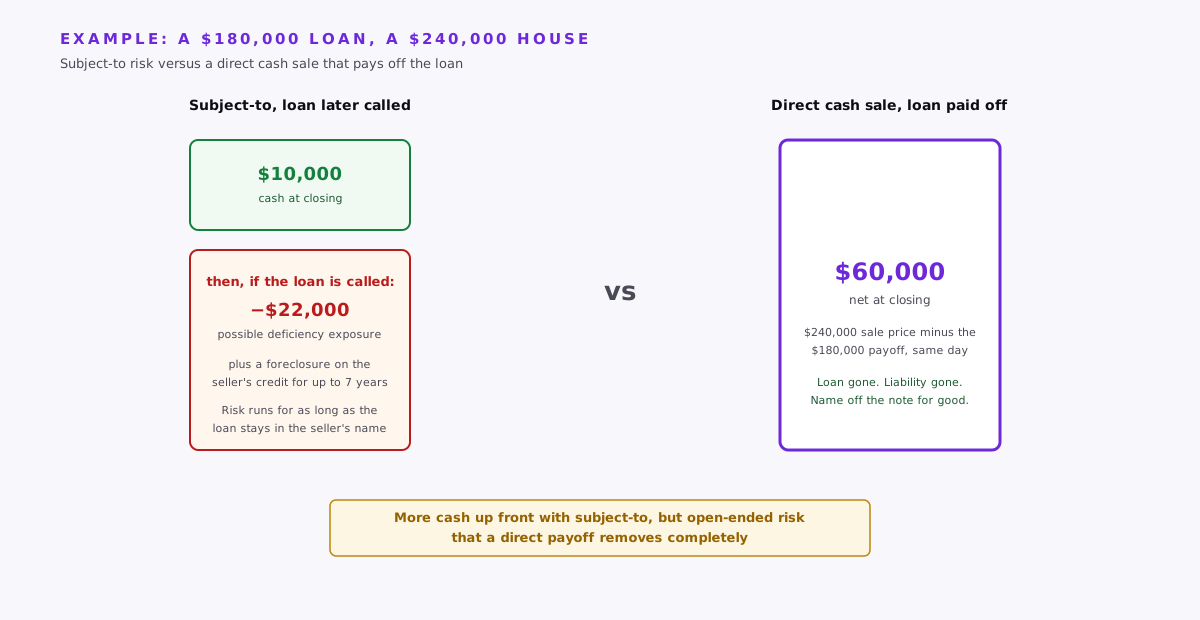
Example: a seller has a $180,000 mortgage balance at a 3.2% rate on a house worth $240,000. An investor offers to take the deed subject-to the existing loan, hands the seller $10,000 cash at closing, and starts making the roughly $778 monthly payment. A year later, with the balance paid down to only about $176,000 (early payments on a low-rate loan are mostly interest, so the balance barely moves), the servicer discovers the transfer and calls the loan.
The servicer gives 30 days to pay the $176,000 balance in full or qualify for a new loan. The investor who bought subject-to specifically to avoid a lender's underwriting can't suddenly qualify for a $176,000 mortgage in a month. The seller, who no longer owns or controls the house, can't refinance a property that isn't theirs either. Thirty days pass with no payoff. The servicer forecloses.
Say the house sells at the foreclosure auction for $162,000, below its $240,000 market value, which is typical for a forced sale. After the $176,000 balance and roughly $8,000 of foreclosure costs and fees, the sale leaves a $22,000 shortfall. In a state that allows deficiency judgments, the lender can pursue the seller, the name still on the note, for that $22,000. The foreclosure also lands on the seller's credit report for up to seven years and can cost 100 points or more off a credit score that was in good standing before the sale.
| At the moment of sale | Subject-to sale, loan later called | Direct cash sale, loan paid off at closing |
|---|---|---|
| Who stays on the mortgage note | Seller, for as long as the loan is outstanding | No one. Loan is paid off the same day |
| Cash to seller at closing | $10,000 | $60,000 ($240,000 sale price minus $180,000 payoff) |
| If the lender calls the loan | 30-day demand for $176,000, then foreclosure if unpaid | Not applicable. Loan no longer exists |
| Foreclosure shortfall exposure | Up to $22,000 in this example, depending on state law | $0 |
| Credit impact to seller | Foreclosure on credit report for up to 7 years | None from this transaction |
| Legal fees to seller | Real, if the lender pursues a deficiency judgment | $0 |
That $22,000 shortfall and the credit damage are not guaranteed outcomes. They only happen if the lender calls the loan and the foreclosure sale price falls short of the balance. But they are a real, possible outcome that a seller who takes $10,000 and signs a deed subject-to has no control over once that deed is recorded.
A subject-to sale is not automatically a scam, and it is not automatically a disaster either. Plenty of these deals close, the buyer keeps paying for years, the loan eventually gets refinanced or paid off, and the lender never sends a notice. Reliable data on how often a due-on-sale clause actually gets called is not published anywhere, so no one, including us, can give you real odds on it.
What's true in every subject-to deal, called or not, is that the seller carries open-ended personal liability on a loan they no longer control, for as long as that loan stays in their name, which can be years. A straight cash sale that pays off the loan at closing costs the seller some of the upside an investor is offering in exchange for taking on that risk, but it ends the liability the same day it ends the ownership. The tradeoff is real money weighed against an open-ended risk that is rarely explained in full to the seller signing the deed. If you want the broader pattern of red flags that show up in cash-buyer pitches generally, not just this one, see how to tell if a cash home buyer offer is a scam.
A seller who wants to be fully free of a mortgage has several paths that don't involve leaving their name on a loan they no longer control. Which one fits depends on how much equity is in the house, how much time there is, and whether the existing loan is even assumable.
If you're holding a mortgage you can no longer control, or weighing a subject-to offer against something that actually ends your liability, we buy houses as-is, cover standard closing costs, and send a written offer within 24 hours. You pick the closing date. At closing, we pay off whatever is left on your existing loan directly, and your name comes off the note for good, no subject-to arrangement, no waiting to find out whether a servicer ever notices.
All guides · What an assumable mortgage is worth when you sell · Cost of seller financing vs a cash sale · How to tell if a cash home buyer offer is a scam
Step 1 of 5
No obligation, no fees, no repairs. We respond the same day.
You’ll talk to Trevor McAmis, Owner & Acquisitions Lead
(313) 710-6129
Takes about two minutes. Your address is never shared.
