Selling a house for a job relocation is different from an ordinary sale in three specific ways: you are usually on a deadline set by someone else, you may qualify for a tax break most people never hear about if you have not owned the place two full years, and every week the sale drags on can mean paying for two households at once instead of one.

Step 1 of 5
Send the address. We will tell you what it is worth as-is and give you a closing date that actually matches your start date.
You’ll talk to Trevor McAmis, Owner & Acquisitions Lead
(313) 710-6129
Takes about two minutes. Or call (313) 710-6129 — we answer.
Educational only. This explains how these situations generally work. It is not legal, tax or financial advice, and the rules differ by state — talk to an attorney or CPA about your own situation before you act on any of it.
Selling a house for a job relocation puts you on a deadline the buyer market does not care about, but a qualifying move at least 50 miles farther from home can also unlock a valuable partial capital-gains tax exclusion worth checking before you assume none applies.
The bigger financial risk for most people is not tax — it is paying rent in the new city while still carrying the old house every month it sits unsold.
This is educational information, not legal or tax advice. Whether a specific move qualifies for the partial exclusion, and how much of your gain it actually shelters, depends on facts specific to your job change, your ownership history and your filing status. Talk to a CPA before you rely on any of it.
Everyone has heard of the capital-gains exclusion on a primary residence — up to $250,000 of gain excluded for a single filer, $500,000 for a married couple filing jointly, under IRS Topic 701. Fewer people know that it normally requires owning and living in the house for at least 24 months out of the five years before the sale.
A job relocation frequently means selling before that clock runs out. Under IRS Publication 523, a sale that fails the full two-year test can still qualify for a partial exclusion if the primary reason for the sale is a work-related move that meets a specific distance test: your new job location has to be at least 50 miles farther from the home you sold than your old job location was. Health reasons and certain unforeseeable circumstances carry their own tests and are covered in the same publication.
The partial exclusion is not prorated by some vague fairness formula — it is a specific calculation. Take the shortest of how long you lived in the house, how long you owned it, or how long since you last claimed the exclusion on a different sale, measured in days, divide by 730, and multiply by the full exclusion amount.
Worked example: a single filer buys a house, is transferred to an office 60 miles farther away exactly one year later — 365 of the required 730 days — and sells. 365 ÷ 730 = 0.5, so the exclusion available is half of $250,000, or $125,000, rather than zero. For a married couple filing jointly under the same facts it is half of $500,000, or $250,000. Our companion guide, capital gains tax when you sell your house, walks through how that number gets applied against your actual gain, which for most moderately priced houses covers the whole thing.
The point that gets missed: selling early because of work is not automatically a tax problem. It can still be a tax non-event, provided the move genuinely clears the distance test and you can show the job change is the real reason for the sale, not a convenient label on a sale you wanted anyway for other reasons.
Tax is the part people worry about. Double housing cost is the part that actually drains a bank account, and it is simple arithmetic rather than a tax rule.
Say the new job comes with a lease at $1,650 a month in the new city, and the old house still carries a $1,450 monthly payment — mortgage, tax and insurance — while it sits on the market. Every month between move-out and closing costs $1,650 on top of whatever the house itself costs to hold, and that money does not come out of the sale proceeds. It comes out of a paycheck that is also funding a new city.
| Route | Time to closing | Double-housing cost |
|---|---|---|
| Repair, then list retail | 5 months | $8,250 |
| Sell as-is for cash | 3 weeks | $1,238 |
That is a $7,012 difference in out-of-pocket rent stacked on top of a mortgage — money that never shows up on either side's closing statement, which is exactly why it gets left out of most net-proceeds comparisons. It is real, and it belongs in the decision.
It cuts the other way too. If the sale nets meaningfully more by listing — and on the worked example below it does — the extra weeks of double housing can still be the cheaper overall choice once you compare it against the gap in proceeds. The number that decides it is the difference between the two, not either one in isolation.
Once you are physically gone, ordinary parts of a sale get harder, and they are worth planning before the move rather than after.
None of this is exotic. It just has to be arranged before you are 800 miles away trying to arrange it, and it is the part of a relocation sale that a rushed move most often gets wrong.
Selling is not the only option, and for some relocations it is not the best one. If the job change is temporary, if the local rental market comfortably covers the mortgage, tax and insurance, or if you are not ready to give up the property, renting it out and revisiting a sale later is a genuine alternative — particularly if you expect to move back within the 3-year lookback that still lets a later sale qualify for the exclusion.
It is not free of cost or risk. Being a landlord from another state means either hiring a property manager, typically 8% to 10% of monthly rent, or fielding maintenance calls remotely. Depreciation you claim while renting reduces your basis and gets recaptured as taxable gain when you eventually do sell — our guide to selling a rental property with tenants works through that math. And it delays realizing whatever equity is in the house today, at a price the market may not repeat.
The honest version: renting makes sense when the numbers cash-flow and you actually intend to come back or hold the asset. It is a worse plan when it is really just deferring a decision you are not ready to make, because deferred maintenance and a distant tenant relationship both tend to get expensive.
A house worth $230,000 once repaired, needing $20,000 of work — paint, flooring, a few years of deferred maintenance that a relocating owner has not had time to address.
| Line | Repair, then list | Sell as-is for cash |
|---|---|---|
| Sale price | $230,000 | $163,350 |
| Repairs | −$20,000 | $0 |
| Agent commission (5.5%) | −$12,650 | $0 |
| Seller closing costs (1.5%) | −$3,450 | $0 — we cover standard closing costs |
| Buyer concessions (1%) | −$2,300 | $0 |
| Holding, 5 months at $1,450 | −$7,250 | −$1,088 (3 weeks) |
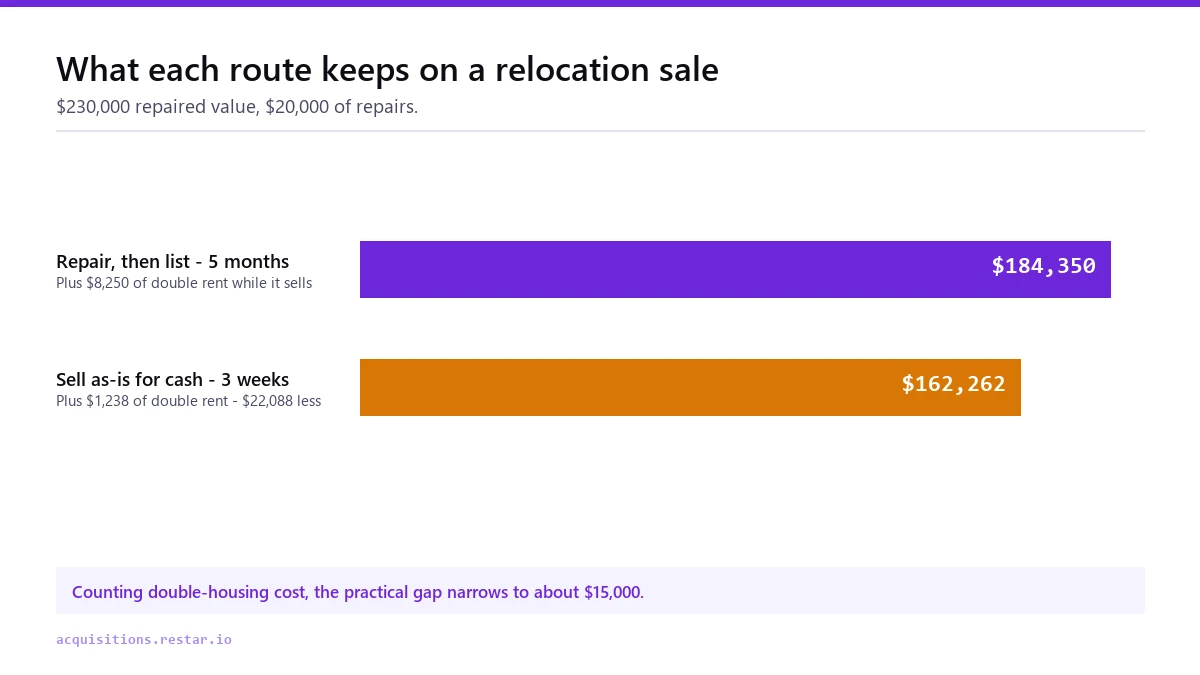
| You keep | $184,350 | $162,262 |
The cash figure is built the same way as how cash home buyers calculate offers: $230,000 after-repair value, less $20,000 of repairs, less $24,650 of resale and holding costs — resale commission $12,650, resale closing $3,450, purchase closing $1,300 and five months' carry $7,250 — less $22,000 of margin.
A worked illustration on one hypothetical property. Not a quote, not a prediction about your house.
Listing wins by $22,088 before you add back the double-housing savings from the section above, which brings the practical gap to roughly $15,000 once both are counted. That is the number a relocating seller with the time, the repair budget and someone local to manage it should weigh against three flights, a contractor found by phone, and a closing that has to happen before a start date that will not move.
Send us the address and we will put a written cash offer in front of you within 24 hours, with a closing date you pick — including one that lines up with a move that is already booked. On the worked example below, a repaired retail listing keeps $22,088 more than our route, so if you have five months, the cash to fix the place up and someone local to manage it while you are gone, listing is the better math and we will say so plainly.
Where none of those three things are true — the move is in three weeks, the repair budget does not exist, or there is nobody left in town to hand a key to — that is the situation this route is actually built for. Send us the property here.
All guides · Capital gains tax when you sell your house · Cash offer vs. listing net proceeds · Holding costs of a vacant house
Step 1 of 5
No obligation, no fees, no repairs. We respond the same day.
You’ll talk to Trevor McAmis, Owner & Acquisitions Lead
(313) 710-6129
Takes about two minutes. Or call (313) 710-6129 — we answer.