<b>Adverse possession is a legal doctrine that can let someone who has occupied part of your land openly, continuously, and without your permission for a set number of years claim legal ownership of it.</b> Selling a house facing an adverse possession claim is still possible, but the claim clouds your title, and most lenders and title insurers won't close a financed sale until it's resolved through a settlement, a quiet title action, or an insured workaround.
Step 1 of 5
Tell us about the property and we'll send a written cash offer within 24 hours that accounts for the claim directly, no repairs, no commissions, and you pick the closing date.
You’ll talk to Trevor McAmis, Owner & Acquisitions Lead
(313) 710-6129
Takes about two minutes. Or call (313) 710-6129 — we answer.
Educational only. This explains how these situations generally work. It is not legal, tax or financial advice, and the rules differ by state — talk to an attorney or CPA about your own situation before you act on any of it.
Adverse possession is a doctrine under state property law that allows someone who isn't the record owner to gain legal title to land (or an easement over it) if they've possessed it a certain way for long enough. Cornell Law School's Legal Information Institute defines it as a means by which a person who possesses the land of another for an extended period of time may be able to claim legal title to that land, provided the possession meets several specific tests at the same time, for the full statutory period.
Those tests generally are hostile (without the owner's permission), actual (real physical use, not just a paper claim), open and notorious (visible enough that a reasonable owner would notice), exclusive (used as an owner would, not shared with the public), and continuous (no meaningful break for the entire statutory period). Some states also recognize a faster path if the claimant has “color of title” — a defective deed or document that looks like it grants ownership even though it doesn't — or has been paying the property taxes on the disputed land, which can shorten the required period.
There is no single national number, and anyone who quotes you one flat figure for “how many years” is oversimplifying. Statutory periods are set state by state and commonly range from roughly 5 years up to 20 years or more, often shorter when the claimant has color of title or has been paying property taxes on the land.
Two real examples, confirmed directly against each state's own code: North Carolina requires 20 years of adverse possession under known and visible lines, with no color of title needed, under N.C. Gen. Stat. § 1-40. Florida allows a much shorter 7-year path when the occupant has color of title — a recorded instrument that purports to convey the property — under Fla. Stat. § 95.16. Other states fall at various points between those two, and some set separate, shorter periods for claims made under color of title versus claims made without it. The only way to know your state's actual rule, and whether it applies to your specific facts, is to have a real estate attorney in that state review the claim.
This is the part that catches most sellers off guard: you don't need to have lost a lawsuit for a sale to stall. The mere existence of a credible, asserted adverse possession claim is usually enough to freeze a financed deal, because of how title insurance and mortgage underwriting work.
A title insurer's job is to confirm marketable title and insure against defects in it. An unresolved adverse possession claim — whether it's a pending lawsuit, a demand letter, or just a fence that's been in the wrong place for decades with the neighbor now asserting rights — typically shows up as a specific exception on the title commitment, or causes the underwriter to decline to insure the affected portion, or the whole parcel, at all. Cornell's Legal Information Institute entry on quiet title actions describes exactly this kind of cloud as the reason the action exists: to resolve competing claims to the same piece of real property before title can be considered clear.
Mortgage lenders follow the title insurer's lead. Conventional, FHA, and VA underwriting all require the lender's title policy to insure over any defect before the loan can fund, and most underwriters simply won't close over an open, unresolved ownership dispute. That knocks out the large majority of your buyer pool before a single showing happens, because most retail buyers need financing to purchase a house.
Here's a realistic, worked example. Say your house would be worth about $270,000 on the open market with clean title. A neighbor's fence has enclosed a strip along your rear property line for more than two decades, and the neighbor has now sent a letter asserting an ownership claim to that strip under adverse possession.
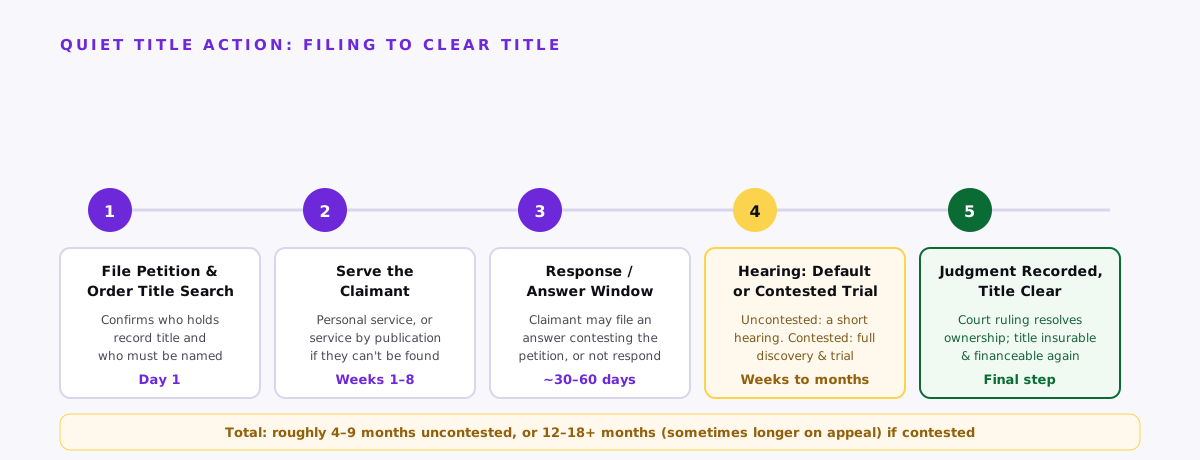
Clearing title first, then listing retail. You'd need to resolve the claim — through a quiet title action if a negotiated settlement doesn't work — before most buyers' lenders would touch the property. Using the cost and timeline figures from our own guide on the cost of a quiet title action, an uncontested case runs around $3,400 and takes roughly 4 to 9 months; a contested case, where the claimant actually appears and fights it, commonly runs $5,000 to $8,000 or more and takes 12 to 18 months, sometimes longer if anyone appeals. Add the commission (about 5.5%, or roughly $14,850), repairs to list competitively (call it $8,000), and holding costs while the legal process runs its course (roughly $9,000 over 9 to 12 months), and a contested quiet title case nets you something like $270,000 − $14,850 − $8,000 − $9,000 − $6,500 = roughly $231,650, but only after the better part of a year, and only if the litigation goes your way.
Selling as-is to a buyer who takes on the title risk. A direct cash buyer who isn't relying on a lender or standard title insurance to fund the purchase can close without waiting for the claim to be resolved first. The price reflects that risk and the work the buyer may still have to do after closing: on the same property, that might land around $200,000, closing in roughly 2 to 4 weeks, with no legal spend, no repairs, and no commission required from you.
| Cleared-title retail sale | Clouded-title cash sale (as-is) | |
|---|---|---|
| Price | ~$270,000 list / ~$231,650 net | ~$200,000 |
| Upfront legal/repair/commission cost | ~$38,350 (commission, repairs, quiet title, holding costs) | $0 |
| Typical timeline | 9–18+ months | 2–4 weeks |
| Certainty | Depends on litigation outcome; claimant can contest, win, or appeal | High — no financing contingency, no litigation outcome to wait on |
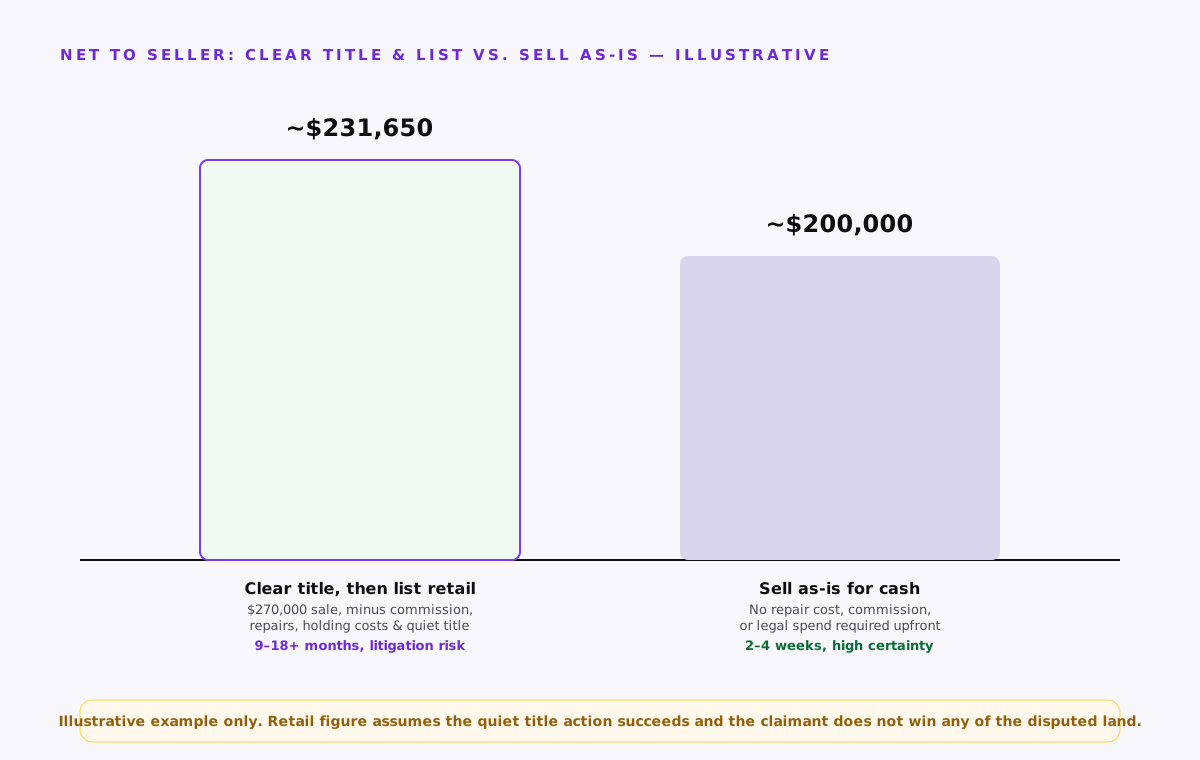
The retail path nets more money on paper if the litigation resolves in your favor — that's the honest comparison, and we won't pretend otherwise. What the bigger number doesn't show is the cash you have to put up before you see a dime, the better-part-of-a-year wait, and the real possibility the claimant wins some or all of the disputed land, which would reduce what you're even entitled to sell. The cash path trades some of that dollar amount for speed and certainty today, with the title risk handled by a buyer who isn't depending on a lender's sign-off to close.
You generally have four realistic paths, and they aren't mutually exclusive.
Negotiate a buyout or settlement with the claimant. Many disputes resolve faster and cheaper than litigation once both sides put a number on it. You might pay the claimant to sign a quitclaim deed releasing any claim to the disputed strip, or agree to a boundary line agreement that formally resets the property line. Get any agreement recorded at the county before you rely on it — a verbal understanding doesn't clear title.
File a quiet title action. This is the formal court process to get a judge to rule on who actually owns the disputed land, clearing the cloud once a judgment is entered. It's the most reliable way to get title insurable again if negotiation fails, but it costs real money and takes months, as shown above, with no guaranteed outcome if the claimant has a strong case.
Arrange a title indemnity or escrow holdback. In some deals, a title insurer will agree to insure over the claim for an added premium, or the parties agree to hold back a portion of sale proceeds in escrow to cover the cost of resolving the dispute after closing. This can let a sale close sooner than full litigation, but it depends on a willing title company and a buyer comfortable with the arrangement, and it's not available in every market or on every claim.
Sell as-is to a direct cash buyer. Skips the financing contingency and the requirement that title be fully clear before closing, since the buyer is accounting for the dispute directly in the price rather than requiring it resolved first. This is often the fastest way to a closed sale when you don't want to spend months, or more, in litigation.
A fifth option worth naming honestly: in some cases, if the disputed area is small relative to the whole parcel and the claim looks strong, it can make more sense to concede the strip and sell the remainder than to spend years and thousands of dollars fighting over a sliver of yard. That's a judgment call specific to your facts, not a general recommendation.
This article is educational only and is not legal advice. Adverse possession law, statutory periods, and the color-of-title and tax-payment rules that can shorten them vary significantly by state and depend heavily on the specific facts of your situation. Talk to a real estate attorney licensed in your state before deciding how to respond to a claim, negotiating with a claimant, or filing anything in court. This is a related but distinct problem from a squatter occupying your house, which involves someone without any ownership claim physically present in the property, or a forged deed, which is a fraudulent conveyance rather than a possession-based claim — each has different legal mechanics and different fixes.
A direct cash offer accounts for an adverse possession claim in the number itself, so you're not stuck choosing between months of litigation, a buyout negotiation, or listing and hoping a buyer's lender tolerates the title exception.
You'll get a written offer within 24 hours, no repairs or commissions required, and you pick the closing date. We're a direct buyer, not an attorney, agent, or broker, and nothing here is legal advice — talk to a real estate attorney about your specific claim and state.
All guides · Cost of a quiet title action · Selling a house with squatters · Selling a house with a forged deed
Step 1 of 5
No obligation, no fees, no repairs. We respond the same day.
You’ll talk to Trevor McAmis, Owner & Acquisitions Lead
(313) 710-6129
Takes about two minutes. Or call (313) 710-6129 — we answer.