Every market page publishes the numbers behind its offer. See the math
Home › Guides › Selling a House With Squatters: The Actual Removal Process
Guide
Selling a House With Squatters: The Actual Removal Process
Selling a house with squatters is legal, and almost everything written about “squatters’ rights” conflates two completely different bodies of law, which is what makes the situation feel scarier than it is. One is about how you get an unauthorized occupant out. The other is about the extremely rare circumstance in which someone could eventually claim to own the place. You are dealing with the first one. Here is the real removal process, state by state where it differs, and what it costs to wait.
Takes about two minutes. Or call
(313) 710-6129 — we answer.
Educational only. This explains how these situations generally work. It is not legal, tax or financial advice, and the rules differ by state — talk to an attorney or CPA about your own situation before you act on any of it.
Selling a house with squatters: the short answer
Selling a house with squatters is legal once they're removed, but a title company will not close with an unauthorized occupant in place — removal is a legal process, not a lockout. Most states use the standard eviction process; Florida, Georgia and Texas now let owners request police removal without a full eviction case.
This is educational information, not legal advice. Removal procedures, notice periods and the elements of a trespass or unlawful-detainer claim are set by state law and differ significantly. Confirm the current process in your state and county with a local attorney or your sheriff's civil division before you act.
Two different laws, and only one applies to you
This is worth separating cleanly, because the internet blends them and sellers panic accordingly.
Removal law governs how an owner gets an unauthorized occupant out of a property. This is what you need.
Adverse possession law governs the rare set of circumstances in which someone who has openly, continuously, exclusively and “hostilely” possessed land for a long statutory period — commonly a decade or more, and in several states two decades or more — can ask a court to award them title. It exists in some form in every state. It also requires years of uncontested, visible possession, often combined with paying the property taxes and sometimes holding a defective deed (“color of title”). A person who let themselves into a vacant house last month, or six months ago, is nowhere near meeting it, and the moment you assert your ownership — by posting notice, filing in court, or simply demanding they leave — the clock either never started or stops. If anyone tells you a squatter “gets the house” after 30 days, that is not the law in any of the states we buy in.
Where the confusion earns its keep is that a squatter who has been in a property long enough, with a colorable claim, genuinely can slow a sale down and needs a real attorney, not a guide. That is uncommon. The common case is: somebody moved into a house that looked empty, and you need them out before you can convey clear title.
What you cannot do, no matter how obviously you own the house
Because it is your house, the instinct is to just handle it — change the locks, shut off the utilities, move their things to the curb. In the large majority of states this is illegal “self-help eviction,” even against someone with no legal right to be there, and it can expose you to a lawsuit from the very person you are trying to remove, plus give them a sympathetic story in front of a judge. The law generally requires the same thing whether the occupant is a squatter or a nonpaying tenant: a court process, or in the newer fast-track states, a specific statutory procedure involving law enforcement — not you.
Secure the property from the outside (fencing, boarding unused entrances, motion lighting), document everything with dated photos, and start the legal process below. Do not enter and confront anyone yourself.
Selling a house with squatters: the standard process in most states
In the majority of states, removing a squatter runs through essentially the same civil process used to evict a nonpaying tenant, sometimes filed as an “unlawful detainer” and sometimes folded into the regular eviction statute:
Serve a written notice to vacate. Because there is no lease, many states allow a shorter notice than a tenant would get — commonly a matter of days — but the exact form and period is set by your state's code.
File in court if they do not leave. This is a real case with a hearing date, typically weeks out rather than months, but a contested case (the occupant claims a lease, claims to be a co-owner, or simply does not show up and delays) can run considerably longer.
Get a judgment and a writ of possession. The court order, not your demand, is what authorizes removal.
Have the sheriff enforce it. A sheriff's deputy — not you — physically removes the occupant and their belongings under the writ.
Filing a police report for trespassing at the outset is worth doing regardless of state, because it creates a timestamped record that you did not authorize the occupancy — evidence that matters if the case is ever contested. This is the sequence that governs selling a house with squatters almost everywhere outside the three fast-track states below.
The fast-track states — and two of them are ours
Since 2024, three states have created a separate, faster statutory path specifically for squatters, distinct from the standard eviction process above. Two of them are markets we buy in.
Florida (Fla. Stat. § 82.036, enacted 2024). A residential property owner can file a sworn complaint with the sheriff stating that an unauthorized person is occupying the dwelling, has no lease, is not a current or former tenant, and is not a family member of the owner. Once the sheriff verifies ownership, the statute directs the sheriff to notify the occupant in writing to vacate immediately, and to remove them if they do not comply or cannot produce proof of a legal right to occupy — without a separate eviction lawsuit.
Georgia (Georgia Squatter Reform Act, HB 1017, effective 2024). An owner files a sworn property affidavit in magistrate court stating that the occupant has no rental agreement and no legal right to be there. The occupant can file a counter-affidavit disputing it, which triggers a prompt, non-jury hearing; if they do not, the statute provides for expedited ejectment through law enforcement, generally within a matter of days rather than the weeks a standard eviction takes.
Texas (Property Code Chapter 24B, created by SB 1333, effective September 1, 2025). An owner submits a sworn affidavit to the sheriff or constable stating the occupant entered without consent, is not a family member, and has no landlord-tenant relationship with the owner. Once verified, the sheriff or constable can remove the occupant directly, with criminal trespass charges available under Penal Code § 30.05.
If your property is in Florida, Georgia or Texas, ask a local attorney specifically about these statutes before defaulting to a standard eviction filing — they exist to be faster, and using the general process when the fast one applies just costs you weeks. In Alabama, Arizona, Indiana, Maryland, Michigan, New York, North Carolina and Ohio, the standard court process above is what currently applies; check with a local landlord-tenant or real estate attorney, since several state legislatures are actively considering similar bills.
What waiting actually costs you
Every week a property sits occupied and unresolved is a week it cannot be shown, appraised, inspected or closed on, and the carrying costs do not pause for a court date.
Line item
Monthly cost
Property taxes and insurance (escrowed or paid directly)
$380
Utilities kept on for security systems and inspections
$90
Mortgage payment, if one exists
$1,240
Lost rent or lost sale carrying cost, opportunity basis
$1,400
Total per month of delay
$3,110
A standard eviction that takes six to ten weeks from notice to writ of possession, including a contested hearing, runs roughly $4,354 to $7,257 in carrying costs alone on the figures above (about $104 a day), before attorney and filing fees of a few hundred to low thousands of dollars depending on whether it is contested. That is the real argument for using a fast-track statute where one applies, and for not trying to handle it yourself in a way that gets the case thrown out on a technicality and restarts the clock.
The honest math once the property is clear
The financial side of selling a house with squatters only starts once you have possession back, and the decision from there is the same one covered in how cash home buyers calculate offers: repair and list, list as-is, or sell for cash. A vacant house that was recently occupied by squatters typically needs a deeper-than-average cleanout and inspection for damage, theft of fixtures or copper, and any needed re-securing — real costs, but rarely structural.
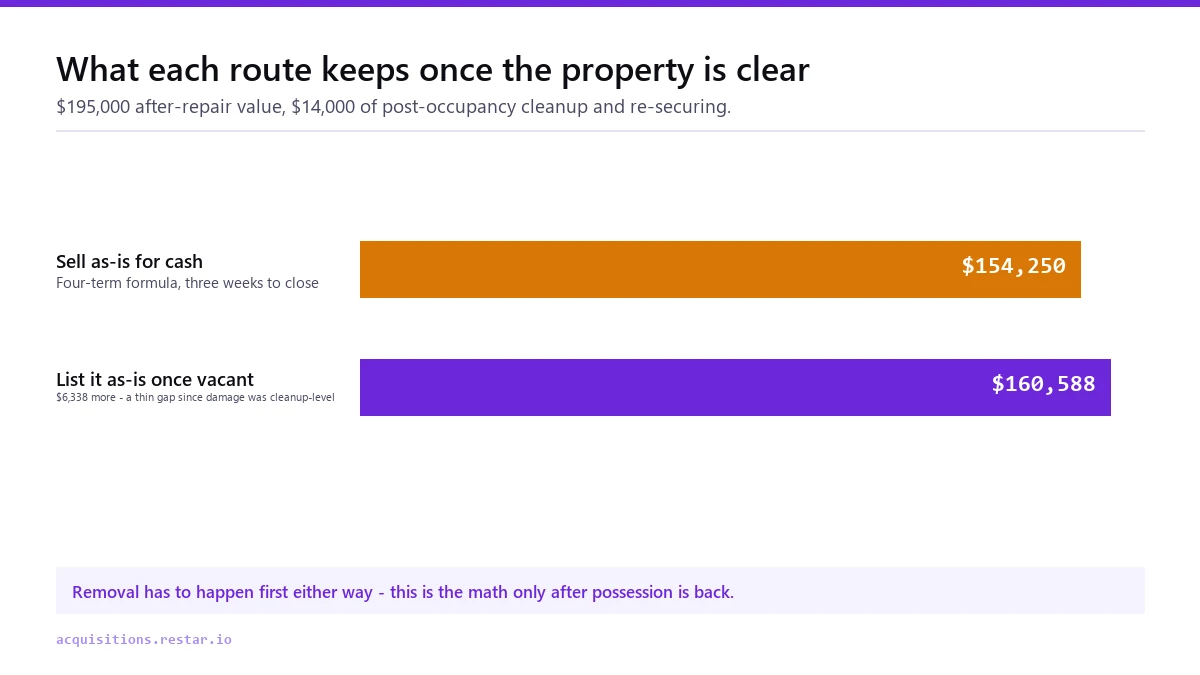
Take a $195,000 (after-repair value) three-bedroom house that needs $14,000 of cleanup, repair and re-securing after a squatter is removed, with $9,750 in resale and holding costs and a $17,000 margin built into a cash offer using the four-term formula: $195,000 − $14,000 − $9,750 − $17,000 = $154,250.
Listing it as-is once vacant, at a market discount of roughly 40% of the repair figure, prices it at $195,000 − $14,000 − $5,600 = $175,400. After a 5.5% commission ($9,647), 1.5% seller closing costs ($2,631), 1% buyer concessions ($1,754) and two months of holding ($780), that nets $160,588 — about $6,338 more than the cash figure, a thin gap because the repair scope here is modest cleanup rather than structural work.
What each route keeps once the property is clearRestar Acquisitions · worked example from this page
A worked illustration on one hypothetical property. Not a quote, not a prediction about your house, and not a fixed formula we apply.
If the occupancy caused real damage — a stripped HVAC system, plumbing theft, fire from an unattended space heater — run the numbers again with your contractor's actual bid; the routes can separate by tens of thousands of dollars either way, and only your own repair estimate tells you which route wins.
Alternatives, and when each makes sense
Standard eviction/unlawful detainer — the default everywhere; slower, and the only option outside Florida, Georgia and Texas.
The state fast-track statute — faster where it applies; confirm eligibility with a local attorney before filing.
A licensed property manager or attorney who handles this routinely — worth the fee if you are out of state or cannot manage the court filings yourself.
Selling to us with the occupant still in place — we look at properties with an unresolved occupancy case by case and will tell you plainly whether it is one we can help with or one that needs to go through the court process first, because in many states we cannot take title while an unauthorized occupant remains.
Common questions
Can I just change the locks on a squatter since it's my house?
In most states, no — this is "self-help eviction" and it is illegal even against someone with no legal right to be there. It can expose you to a lawsuit and can undermine your own case in court. Secure the property from the outside, document the occupancy, and use the legal removal process for your state.
Do squatters really get to keep the house after 30 days?
No. That claim confuses removal law with adverse possession, a separate and much slower doctrine that generally requires a decade or more of open, continuous, exclusive possession — in several states two decades or more — plus other elements like paying the property taxes. Nobody acquires ownership from a few weeks or months of unauthorized occupancy in any state we buy in.
How is a squatter different from a tenant who won't leave?
A tenant has or had a lease and some form of authorized occupancy; removing them is a standard eviction for nonpayment or holdover, covered in our guide to selling a rental with tenants. A squatter never had authorization to occupy the property at all, which is why some states now offer a faster removal statute that would not apply to an actual tenant.
Do Florida, Georgia and Texas really let police remove squatters without a court eviction?
Yes, under specific 2024–2025 statutes — Florida Statute § 82.036, Georgia's Squatter Reform Act (HB 1017), and Texas Property Code Chapter 24B (SB 1333) — provided the owner's sworn statement meets the statutory conditions, including that the occupant is not a tenant or family member. Confirm current eligibility with a local attorney, since these are recent laws and enforcement practice is still developing.
Can I sell the house while a squatter is still there?
Generally no. A title company needs to deliver clear possession at closing, and a financed buyer's lender will not fund against a property with an unauthorized occupant. Resolve the occupancy first, through the standard process or the fast-track statute where available.
Will removing a squatter show up as anything I have to disclose when I sell?
Most states only require disclosure of known physical or material defects in the property, not the fact that it was previously occupied without authorization — but if the occupancy caused physical damage, that damage itself is very likely to be a required disclosure. Ask your agent or attorney what your state's disclosure form actually asks.
Removing a squatter is a legal process before it is anything else, and getting the sequence right the first time is what keeps a six-week case from becoming a twelve-week one. Once the property is clear, we can give you a written cash offer within 24 hours with the comparable sales behind it — or tell you honestly if listing nets you more, the way the math below usually shows on a lightly damaged property.
In many states we cannot take title while an unauthorized occupant remains, so the first call is usually a local attorney or your sheriff's civil division, not us. Send us the property here once you know where things stand.
Every offer on this site is underwritten by a person, not a form. If the
numbers do not work for you, say so and I will tell you what would.
Also from Restar
Want the data behind all of this?
Restar Acquisitions is the acquisitions arm of Restar — a housing-market analytics
platform tracking 180+ metrics across every U.S. market, with composite scores and 12-month
price forecasts. The numbers on this page come from the same work.